

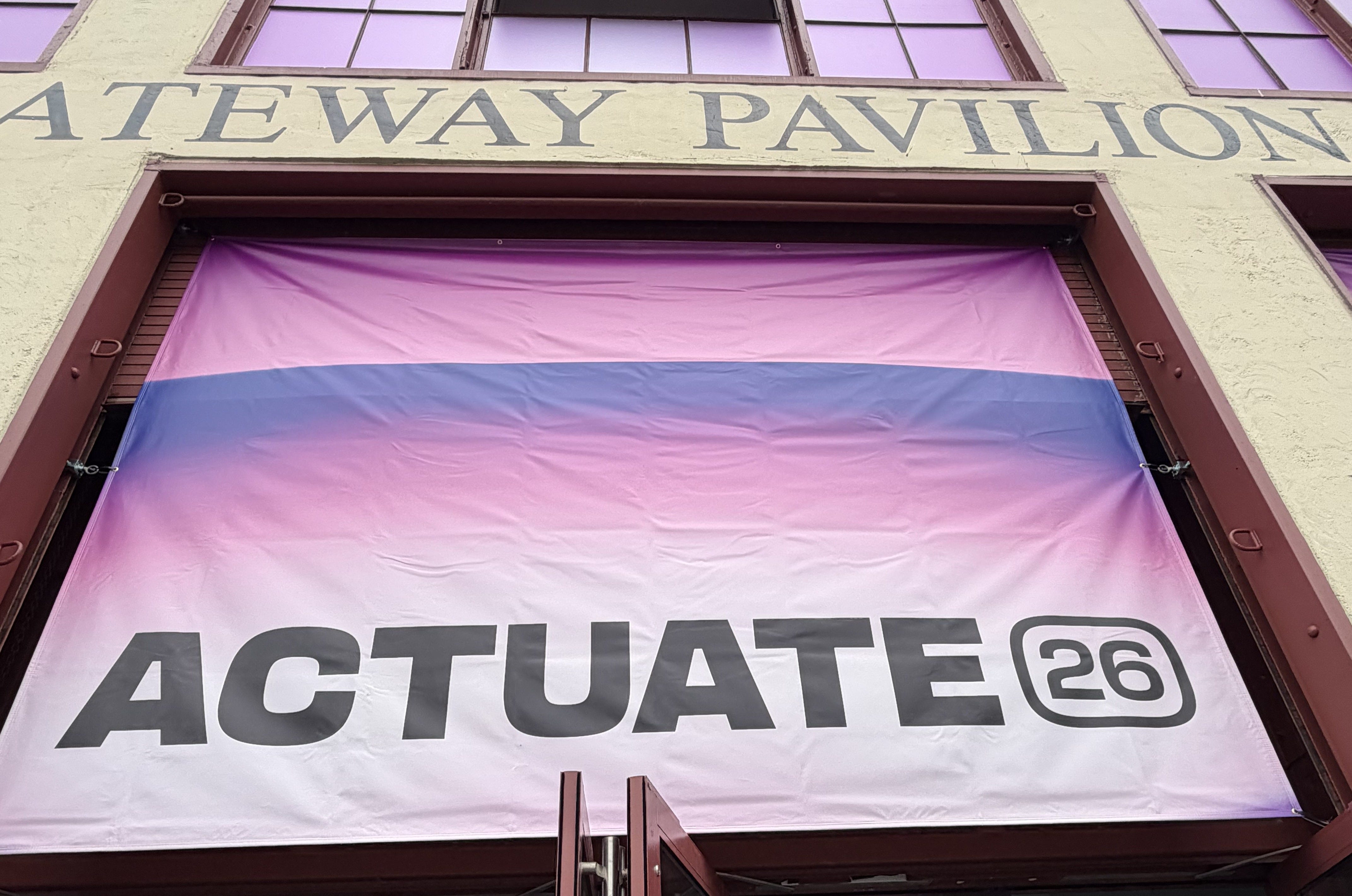
Hi all, it was a whirlwind week in San Francisco. Actuate 2026, run by the robotics data-infrastructure company Foxglove, is a developer-focused conference that has run since 2024, and the rest of the city filled up with physical AI events around it. I went Tuesday. It was buzzing. And the best part was meeting all the people I’ve been interacting with on Substack, X and LinkedIn, from founders to investors. (Thanks for saying hi / reaching out to meet!)
Flagship conferences come with product launches. Here are the highlights of the launches that came out this past week and what they mean for where the industry is headed.
Can a robotics model learn a new task quickly and generalize to new situations?
GEN-1.5
The team led by Pete Florence at Generalist AI showcased the one-shot learning capability of its new GEN-1.5 model.
Source: GEN-1.5 launch blog post
The headline was eye-catching: robot policy now does in-context learning, like LLMs do when you paste an example into a prompt. And rightfully so, a robot picks up a task after a 3-12 second demo of a task it’s never seen, with no training at all. The results:
59% (±10%) average success from a single demo, no gradient updates
66.5% on a held-out task after one gradient step on 1 minute of data.
83% (±9%) after 10 gradient steps on 5 minutes of data, roughly 50 demonstrations.
Source: Generalist AI, GEN-1.5 post, August 2026. Across 10 tasks.
Robot policies have historically needed hundreds to thousands of demonstrations per task, collected on the target embodiment, then a training run. With GEN-1.5, the amount of demonstrations drops by orders of magnitude.
Why it’s important to the physical AI industry
Deployment economics
Currently, deploying robots commercially requires weeks of engineering per new task, or per new site. This release suggests that a robot can now be adapted to a new task or new site with minimal engineering, and only a limited amount of training data. That significantly shortens the time for a robot to get up to speed in a new environment and on new tasks.
UMI data wins over teleop
Jim Fan called it a “nail in the coffin” for teleop data.
“I’ve been saying for a while that teleop will not last, and GEN-1.5 is driving the final nail in the coffin.” Jim Fan, NVIDIA
UMI refers to a human wearing the robot gripper to collect data directly. Teleop is a human controlling the robot via a skeletal device or VR headset. Generalist has previously shared they used UMI grippers to collect over 270,000 hours of data, growing 10,000 hours per week. Companies like Sunday Robotics have been using this approach as well. The UMI data teaches robots “physical intuition”. It turns out that capturing the subtle sleight of hand we humans perform constantly with objects, the micro-adjustments, the feel of a part snapping into place, is actually key for teaching a robot the intuition.
Orangewood Labs’ OWL Arms
Built from stamped and folded sheet metal, with 25,000 hours of operational life, OWL is manufactured for deployment. With the FCC ruling, they’re moving the supply chain to America. Orangewood is a YCombinator-backed startup and has been deploying robots in the US and India. The reason I find this worth highlighting is the team built this with industrial deployment in mind, designing for ease of use and long performance cycles. Unit economics of commercial robot deployment are dominated by integration labor.
What robotics products were announced at Actuate 2026
Here’s a list of major launches from the conference:
Generalist AI: GEN-1.5, a foundation model that picks up new dexterous tasks from one short demonstration and transfers simulation demos to real robots zero-shot
1X Technologies: A developer platform, teased by Tom Sanocki, shipping soon
Orangewood Labs: A new industrial arm series built from stamped and folded sheet metal, rated 25,000 hours, preorders opening
Veeda: Out of stealth the same week under Sanja Fidler, building world-model simulation for robot training, live demo on stage
Dulo: Sebastian Thrun revealed a new robotics startup at the close of his keynote, still in stealth and, in his words, “very small”
Foxglove: An agentic data platform for physical AI, semantic search over unlabeled multimodal data built on NVIDIA’s Cosmos embedding model
Where were the robots at Actuate 2026?
Most people I talked to described Actuate 2026 as plenty of data infrastructure and not many robots. I can see why: other robot conferences like ICRA have dancing robots that steal the show. The conference was focused on the infrastructure layer of robotics, which is a nascent layer for a young industry.
The data plays were everywhere. Lightwheel had a large booth showing egocentric data services. NVIDIA demoed the HALOS stack. There were at least two teleoperation stations: Foxglove’s newly launched Remote Access, and Trossen’s newly released Rivet platform, which was quoted to me for $40,000 at the booth.
I highly recommend trying out teleoperation stations at conferences. I came away with new respect for teleoperators. It is physically and mentally demanding work.