

Agility (AGLT) goes public this week, valued at about $2.8bn at Monday’s close, on $1.8mn of 2025 revenue, most of it from 5 robots sold to one investor.12 Unitree (688836.SH), which reported its Q3 last week, booked $239mn of revenue in 2025 and is worth about $40bn.34 Both report as Tesla starts building Optimus on high-volume lines in Fremont, a ramp Elon Musk expects to take at least a year to reach 20,000 robots a week.9
China races for the brain, while the US fixes the unit economics. Unitree, like other Chinese makers, is racing to catch up on the brain while fending off dozens (if not hundreds) of competitors at home. Agility, like other US makers, has to make the unit economics work and build a humanoid that sells above cost. It spends about 4.5x what Unitree spends on R&D, on about 1/134th of the revenue.
Both now have to grow into their valuations. For Agility, that means delivering on its orders and proving its robots work reliably in customer deployments. For Unitree, it means holding gross margin and growing beyond academic buyers, which also depends on better AI.
These are financial stories as much as operating ones. Agility is billed as the first US-listed pure-play humanoid company, and Unitree is the most valuable listed humanoid maker in our comparison. Unitree’s debut made China’s regulators stricter, and they now look at whether revenue comes from independent customers.33 Agility’s trading will be the first US test.
Disclaimer: this is not financial or investment advice.
In this piece
Humanoid Robot Financials Compared: Agility, Unitree, UBTech, AgiBot and Peers
Agility Robotics’ S-4: $1.8mn of Revenue, a $300m Order and a Policy Tailwind
Unitree Q3 2026: Revenue Up 70%, Margins Down and a Race to Catch Up on AI
China Races for the Brain, the US for Unit Economics
“If you don’t surge, how will the other robot makers go public?”
Footnotes
1. Humanoid Robot Financials Compared: Agility, Unitree, UBTech, AgiBot and Peers
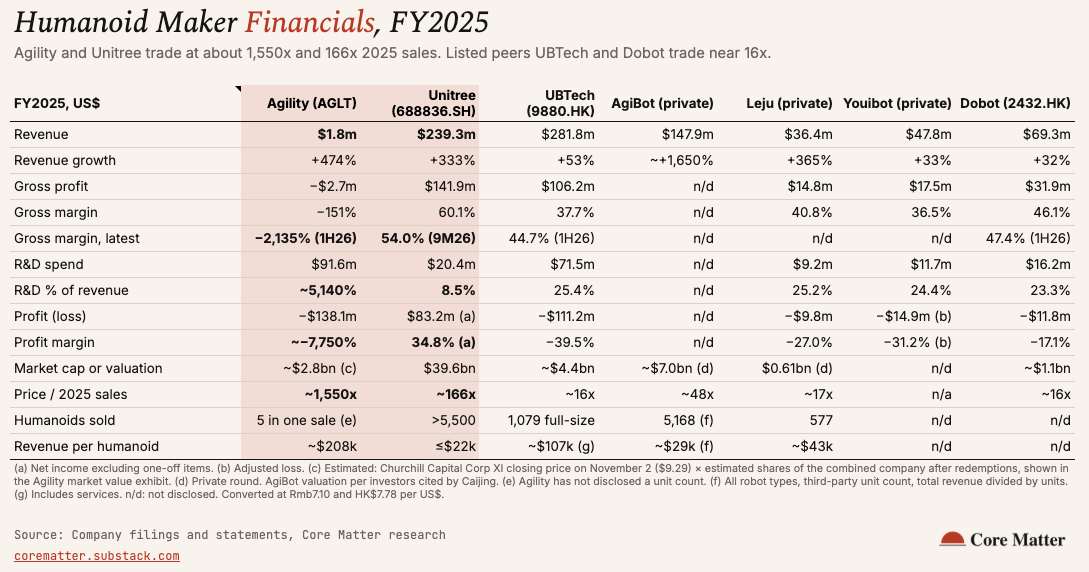
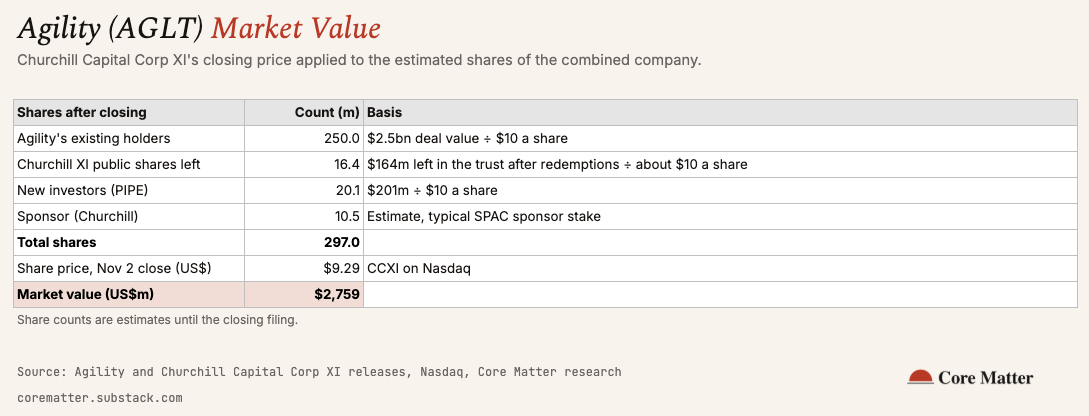
In 2025, Agility spent more on R&D ($91.6m) than Unitree, Leju and Youibot combined (about $41m).
2. Agility Robotics’ S-4: $1.8mn of Revenue, a $300m Order and a Policy Tailwind
Agility (AGLT) has 2 things going for it: reshoring and AI.
Reshoring. Agility is betting on reshoring and reindustrialization, and that there will be a handful of domestic winners that can do heavy-duty industrial work.
Washington has moved its way this year. In July, the FCC added foreign-produced advanced robotic devices to its Covered List, which bars new models from July 28, 2026 onward from receiving the authorization they need to be imported or sold in the US.7 Unitree’s 6 existing models keep their authorization.8 On Oct 29, the White House issued a Section 232 proclamation on imported robotics and industrial machinery threatening national security. It did not talk about tariffs yet, but opened 180 days of negotiations with trading partners, till April 26, 2027.17
Agility has been part of the push. Peggy Johnson, its CEO, endorsed the GUARD Act at its introduction in June and made the case for it in a July op-ed as a House subcommittee took it up. The bill would put adversary-made humanoids and quadrupeds through a national security review and onto the FCC’s Covered List.1819 About 75% of Digit’s parts are sourced in the US.2 The tailwind has a catch. Section 232 also covers parts and components. Johnson has said US developers still need to source some components internationally.20
AI. At IROS in late September, Digit ran an end-to-end, whole-body mobile manipulation demo for about 12 hours over 3 days, with several stretches running for hours without a reset.21 Chris Paxton, an engineer who works on AI at Agility, said the demo ran at “1x speed, autonomous, in a previously-unseen location (not in training data).”22 An attendee who spoke with the team reported a success rate of roughly 80% to 90%, from a policy trained on about 500 teleoperated demonstrations. Paxton described the work as research that is not yet running in production.23
The weaknesses show up in the numbers.
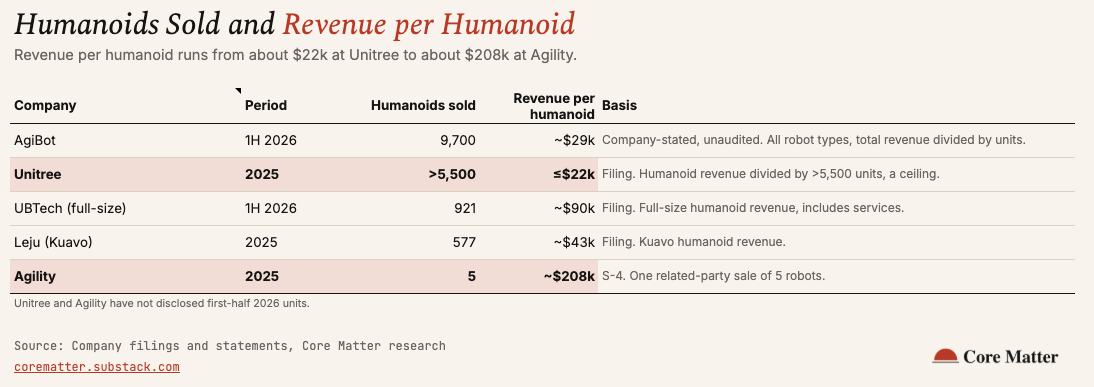
Revenue. The revenue base is thin. The 5 robots sold to one investor brought in about $1.05mn of 2025’s $1.8mn.2 First-half 2026 sales were $174k, less than the price of one of those robots.
Cost. Agility is the only publicly listed humanoid company in our comparison selling below cost, at low volume. Its bill of materials per humanoid has actually gone up: about $150,000 for Digit 5 at launch, against about $125,000 for Digit 4 today.2
Timing. Digit 5 has slipped. The first S-4 said late 2026, and the amendment says early access in the first half of 2027.2 Amazon, an investor that ran several Digit pilots, was dropped from the customer list in the amendment without explanation.24
Backlog. Agility has $300mn of multi-year orders for Digit 5. I did not find a total order backlog in the filings of the Chinese companies in our comparison. The orders come from a single contract: 1,000 Digit 5 robots on a 3-year robots-as-a-service term, tied to milestones the company has to meet. The filing says the figure is not a measure of current period revenue.2 The customer is a related party, as reported from the amended filing, and receives warrants that vest as robots are deployed, about 453 per robot.10
3. Unitree Q3 2026: Revenue Up 70%, Margins Down and a Race to Catch Up on AI
Unitree’s strengths are scale and profit. Revenue grew 70% in Q3 to Rmb665m ($94mn), and 56% in the first 9 months to Rmb1.82bn ($256mn).3 It sold more than 5,500 humanoids in 2025.4 It is also the only profitable company among those in our comparison that disclose profit, with $49mn of net income excluding one-off items in the first 9 months.3
The weaknesses are margin and AI.
Gross margin is trending down. For Chinese makers, including Unitree, domestic competition is their main worry. AgiBot surpassed Unitree’s shipments in the first half,25 with its company-reported first-half revenue was Rmb2bn ($300mn) , against Rmb1.15bn ($172mn) for Unitree.626
Unitree cut humanoid prices deliberately in 2025 “to consolidate industry position,” and its cheaper G1 model became the volume seller.4 Humanoids are still its best-margin product, which is why selling more of them raised margin in 2025. That premium is shrinking. Humanoid gross margin led the rest of Unitree’s business by about 43 points in 2023 (on 5 units), 17 points in 2024 and 6 points in 2025.4
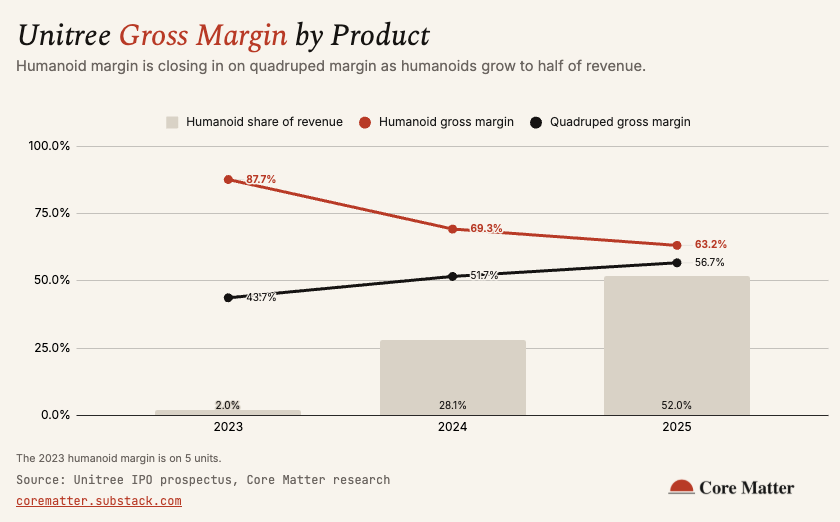
The 2026 drop at Unitree, from 59.8% in the first 9 months of 2025 to 54.0% in the first 9 months of 2026, isn’t explained in the Q3 report. Quarterly reports in China give no breakdown by product, so the cause is unconfirmed until the 2026 annual report. By product, Unitree’s humanoid margin is trending down while its share of revenue goes up. My guess is this trend will continue. Unitree’s 54% gross margin as of 9M 2026 is still much higher than its Chinese peers; UBTech’s 44.7% and LeJu’s 40.8%.
Catching up on AI is driving up R&D. Unitree founder Wang Xingxing has repeatedly said he underestimated AI: “The biggest mistake I’ve made over the past decade-plus is not believing in AI enough.”27 He titled his October keynote “Believe, believe in AI as much as possible.”28 He defines the “ChatGPT moment for embodied intelligence” as: “In 80% of unfamiliar scenarios, a robot can complete about 80% of tasks via voice or text commands.”29 He believes this could happen as early as next year, shortened from the 2 to 3 years he gave in August.2729 At Unitree’s partner ecosystem conference in October, he said: “Physical AI has already shown signs of being broken through. At the fastest, 1 to 2 years. At the slowest, 2 to 3 years.”31
The R&D spending has grown significantly, and we believe will likely continue to climb. R&D rose from 8.5% of revenue in 2025 to 19% in Q3, and Q3 net profit fell 17% as R&D jumped 250%.3 Even so, Unitree’s R&D at about 15% of revenue for the first 9 months is still lower than UBTech, Youibot and Leju (24-25% of revenue), let alone Agility (5000%) (refer to Exhibit 1).
4. China Races for the Brain, the US for Unit Economics
The challenges facing Unitree and Agility reflect wider shifts in physical AI in China and the US.
China: the race moves to the brain. Reuters reports that Chinese robot makers have mastered the moves and are now putting their money into the AI that lets robots handle many kinds of work, as hardware prices fall.11 Unitree has company:
Spirit AI raised $280m in February to scale its general-purpose embodied models.12
X Square has published research on robots learning a handling skill from a single human video, and its Series C valued it above Rmb20bn ($2.9bn).1113
Robbyant, Ant Group’s robotics unit, open-sourced its LingBot-VLA model in January and released 6 more models in July.14
UBTech offered a chief scientist up to Rmb124m ($18m) a year to lead its AI model research back in April 2026.15
Embodied AI companies in China raised Rmb93.5bn ($13bn) across 322 deals in the first half of 2026.11
US: the race is to make the unit economics work. Agility’s gross margin was −151% in 2025. Each robot has to cost less to build than it brings in. Agility has to find customers who will pay a price that leaves a positive gross margin. Its own target is a bill of materials of about $75,000 at 1,000 robots a year.2
Serve Robotics, the Nasdaq-listed maker of sidewalk delivery robots, shows the same problem outside humanoids. It booked a gross loss of $8.8m on about $3.2m of revenue in Q2 2026 as it grew its robot fleet. It cut its 2026 revenue guidance from about $26m to $9m to $10m.16
5. “If you don’t surge, how will the other robot makers go public?”
The stakes reach beyond both companies. In China, regulators have already hit the brakes. In September, Reuters reported that they were slowing a rush of humanoid listings, with one person saying humanoid IPOs had effectively been frozen for now. The main trigger was Unitree’s volatile start: its shares rose more than fivefold on debut, then fell 55% from the peak. Regulators are focused on whether revenue from local-government-backed projects, such as robot data-collection centers, reflects demand from independent customers.33
At least two dozen humanoid-related companies have filed to list in Hong Kong alone.34
With JPMorgan’s two-notch upgrade to Overweight on October 25,30 Unitree’s stock has rebounded more than 70% from its October 15 low.32 After the rebound, a highly upvoted comment on a Chinese news app put it bluntly: “If you don’t surge, how will the other robot makers go public?” (你不大涨,其它机器人怎么IPO。)35
My view is that both are in for a tumultuous few years. As first movers in their markets, they have to break through the industrial adoption cycle under public scrutiny, and there will be a lot of turbulence before the dust settles.
Tesla’s Optimus ramp over the next year will show what volume does to the cost of a US-built humanoid, the question Agility’s margin depends on.9
It was the best of multiples, it was the worst of margins. For now, investors are pricing the multiples. The next 12 months of filings will show whether the margins catch up.
Footnotes
Churchill Capital Corp XI shareholder vote, November 2, 2026. Agility press release.
Agility Robotics and Churchill Capital Corp XI, Form S-4 and Amendment No. 1 (SEC file 333-298781), and the investor presentation.
Unitree 2026 Q3 report, filed October 28, 2026, as reported by Huxiu and Guandian.
Unitree STAR Market IPO prospectus and listing materials, 2026.
Converted at Rmb7.10 and HK$7.78 per US$. Market values as of October 26 to 28, 2026. Dobot first-half 2026 margin from secondary reporting of its interim results.
AgiBot company statements, April 17 and October 29, 2026, as reported by Caixin. Unit count for 2025 from Omdia.
FCC, Fact sheet: FCC updates Covered List to include foreign-produced advanced robotic devices and power inverters, July 28, 2026.
Digital Today, on Unitree’s G1, H2, R1, Go2, B2 and A2 keeping FCC authorization.
Tesla Q3 2026 update and earnings call, October 2026, as reported by Technology.org and KuCoin News.
Agility Robotics and Churchill Capital Corp XI, Form S-4 Amendment No. 1, as reported by TechRepublic and Business Model Analyst.
Reuters, China’s robot makers have mastered the moves. Now comes the race for brains, November 1, 2026.
Spirit AI, Spirit AI lands $280M to scale embodied AI, February 2026.
Benzinga, July 2026, on X Square’s Series C.
Robbyant, LingBot-VLA open-source release, January 27, 2026, and LingBot-VLA 2.0, July 8, 2026.
Bloomberg, UBTech offers $18 million for AI scientist, April 3, 2026.
Serve Robotics, Form 10-Q for the quarter ended June 30, 2026, and The Motley Fool on the guidance cut.
The White House, Adjusting imports of robotics, industrial machinery, and their parts and components into the United States, October 28, 2026.
House Select Committee on China, Moolenaar, Obernolte, McClellan introduce legislation to ban dangerous Chinese robots, June 3, 2026.
Peggy Johnson, U.S. robotics leadership is not guaranteed, July 23, 2026.
The Robot Report, Agility outlines six recommendations for U.S. humanoid robot policies, July 15, 2026.
Jemuel Premkumar, Agility Robotics, LinkedIn post, October 2026.
Chris Paxton on X, October 2, 2026, as reported by Robotics Weekly.
Jonathan Stephens’s account of the demo, as reported by Robotics Weekly, October 5, 2026. The success rate is team-reported, not independently tested.
Ontic Post, comparing the S-4 of September 4, 2026 with Amendment No. 1 of September 30, 2026.
First-half 2026 shipment estimates from SAG (AgiBot ~8,400, Unitree ~5,900), as reported by Huxiu, and Counterpoint (AgiBot ~9,700), as reported by The Paper.
Unitree listing announcement, August 17, 2026, as reported by Eastmoney.
Wang Xingxing at the 26th China International Industry Fair, Shanghai, October 12, 2026, as reported by The Paper and Yicai. Translated from Chinese.
Keynote title at the 2026 World Physical AI Conference, Hangzhou, October 22, 2026, as reported by Caitian COVER via NetEase and Jiemian. Translated from Chinese.
Wang Xingxing at the 2026 World Robot Conference, Beijing, August 20, 2026, as reported by Cailian Press. Translated from Chinese.
JPMorgan research note of October 25, 2026, raising Unitree from Underweight to Overweight and its December 2027 target price from Rmb300 to Rmb995, as reported by Wallstreetcn via Tencent News and Investing.com.
2026 World Physical AI Conference and first Unitree Partner Ecosystem Conference, as reported by Huxiu. Translated from Chinese.
Huxiu, on Unitree’s share price from its October 15, 2026 low of Rmb404.03 to October 28.
Reuters, China slows humanoid robot IPO rush as hype outruns reality, September 21, 2026.
CNBC, China’s criteria for humanoid robot IPOs may be hard to meet, September 29, 2026.
Reader comment on Toutiao. Translated from Chinese.