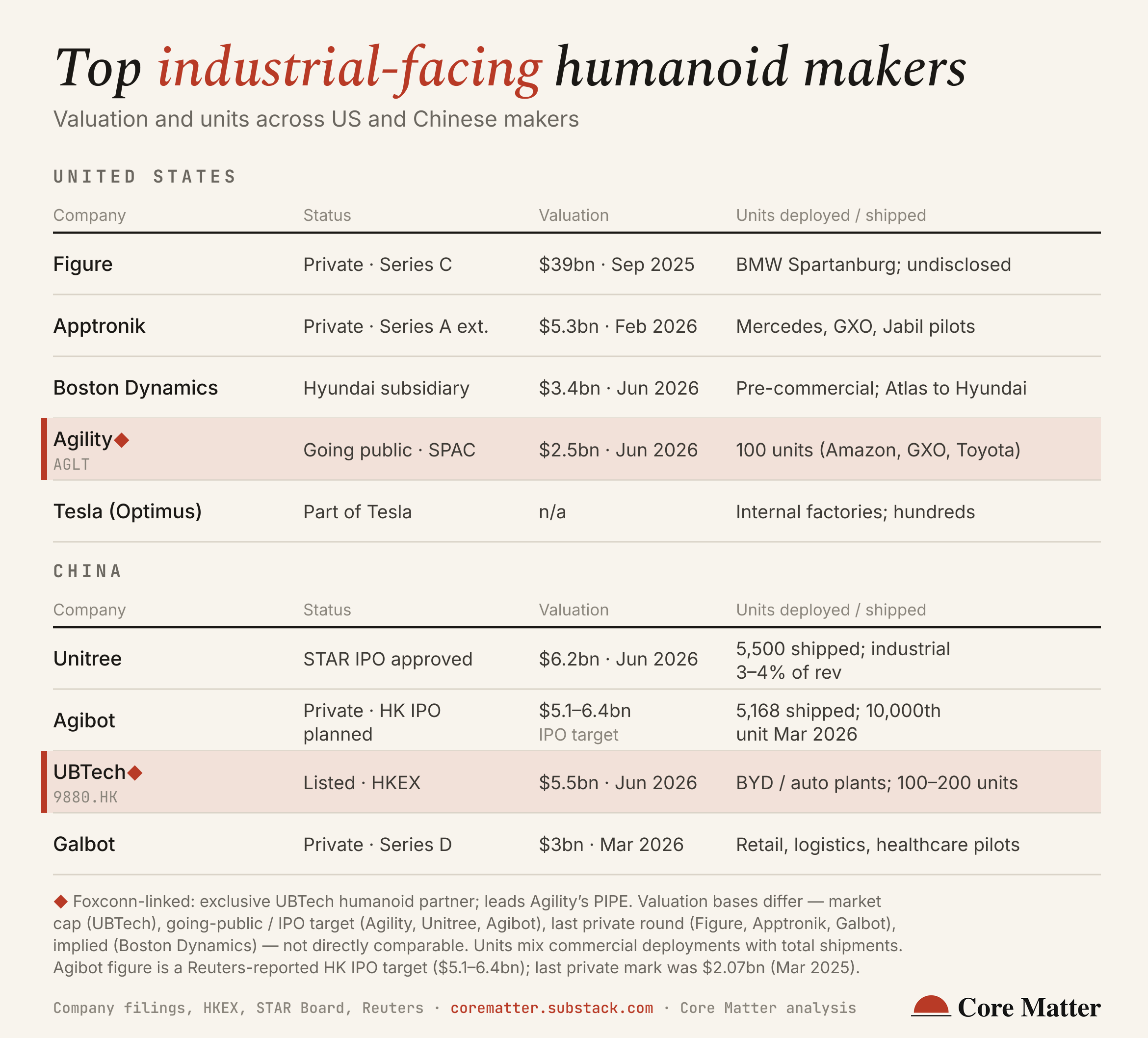
On June 24, Agility Robotics agreed to go public through a $2.5bn merger with Michael Klein’s Churchill Capital XI. The ticker would be AGLT. Of the $620mn in expected proceeds, the $420mn trust is redeemable. The only firmly committed capital is the $200mn private investment in public equity (PIPE), led by Foxconn.
Agility CEO Peggy Johnson endorsed the GUARD Act earlier in June, a bill that would bar Chinese-made humanoids from the US market. Foxconn, Agility’s anchor investor in this SPAC, is the exclusive factory partner of Chinese robotics company UBTech. UBTech’s Walker humanoids work inside Foxconn’s factories. Beyond the listing headline, let’s take a closer look at how Foxconn is positioning across the global, increasingly bifurcated humanoid landscape.
A valuation benchmark of US humanoids
The Agility SPAC was the second US humanoid valuation in the past week, days after Hyundai moved to take full ownership of Boston Dynamics by buying out SoftBank’s last 10% stake at implied valuation at $3.4bn.
Headquartered in Salem, Oregon, Agility spun out of Oregon State’s Dynamic Robotics Lab in 2015. It is founded by Jonathan Hurst, Damion Shelton, and Mikhail Jones. Its most recent funding round was a $400mn Series C in 2025, at a $2.1bn post-money valuation.
The wider story of the SPAC has been widely reported. I want to talk about the two pieces of the puzzle which are more telling to how the global humanoids race may play out.
US vs China in Humanoids
Agility CEO Peggy Johnson, a former EVP of business development at Microsoft and ex-CEO of Magic Leap, endorsed the GUARD Act publicly. When the bill was first introduced on June 3, 2026, Agility put out a supporting quote: “Agility welcomes the introduction of the GUARD Act to address the national security, safety, and economic concerns posed by Chinese-made humanoid robots.”
Johnson also said separately, at Diamandis’s Abundance Summit, that the administration is focused on humanoids “not going the way drones did”, going offshore.
Agility is one of the prime winners of the foreign policy of banning non-US-made robots, which seems to be gaining traction with the GUARD act and DoD’s 1260H list in just the past 3 months.
Foxconn’s Humanoid Chessboard
Foxconn entered into an exclusive partnership in January 2025 with UBTech, a Hong Kong-listed (ticker: 9880.HK) robotics company with both quadrupeds and humanoids, to deploy its Walker units in its factories in China and globally. UBTech’s Walker units are deployed in BYD, Geely, Audi FAW, and the S1 model has run on Foxconn lines since late 2024. UBTech is Agility’s closest Chinese competitor in industrial use case humanoid makers. Apptronik and Boston Dynamics are two other industrial focused humanoid makers domestically.
What is Foxconn doing in funding Agility, when it already has an exclusive partnership with UBTech?
Foxconn has been building positions across the humanoid stack. Beyond the UBTech partnership, it announced in October 2025 that humanoids running NVIDIA’s Isaac GR00T model would join the production line at its Houston AI-server plant, targeting early 2026 deployment. It has shown prototypes of its own humanoids, built via Foxconn Industrial Internet (FII), the Foxconn’s Shanghai-listed (SHA: 601138) smart-manufacturing arm. And through this PIPE, it takes equity in Agility, one of the key players in industrial humanoid robotics in the US.