

To rebuild a domestic manufacturing base in the US, we first need to understand what we’re trying to replicate. My visits to factories in Shenzhen and conversations with US builders have made me curious about how AI could help build that capability here.
At a precision gear factory in Songgang, Shenzhen, the owner told me about a customer’s design for an intricate part. It couldn’t be made as drawn. The factory caught the problem early and helped the customer change the design.
On the same visit, I saw experienced workers inspecting parts and checking tolerances by hand. They had spent years learning this work. Their judgment helped determine whether a part was ready to ship.
A US actuator startup founder told me about the challenge from the other side. As he scaled production, the challenge was not in sourcing machines, but in finding experienced people to run them.
I see an opportunity in helping manufacturers shorten this learning curve. How might AI capture what experienced people know, help others use it and test whether it works? Making that knowledge easier to pass on could help new factories get into production sooner.
I’ll explore this over the next few months as a series. Today, we’ll start with parts manufacturing because the products we want to build here depend on a supply of reliable parts. Following a custom-machined part from drawing to delivery gives us a concrete way to see where manufacturing gets st. By the end, you’ll have a framework for understanding where AI could help and how to judge whether it works. Components, subassemblies and finished products will follow in later pieces.
Thank you to Yeok (@yeokch), Arthur (@darthur) and Adi (@adiprasad27) for sharing their experience and feedback, and to Ted Xiao (@xiao_ted) for the presentation at the Humanoid Hub Conference that helped inform this piece.
In this piece
The manufacturing stack: where should the US start?
Where AI can improve manufacturing: from drawing to delivery
Shenzhen’s manufacturing ecosystem: could the US build its own?
Verification: what counts as proof in manufacturing AI?
3 ways AI could close the US manufacturing knowledge gap
Footnotes
1. The manufacturing stack: where should the US start?
Building domestic manufacturing capability starts with deciding what we want to make. In Apple in China, one of my favorite books I read this year, Patrick McGee describes how Apple helped build manufacturing expertise in China through engineers, equipment and work on supplier factory floors.1 That capability developed over decades of making products and iterating the processes.
I believe materials and parts are foundational to rebuilding US manufacturing because they feed the layers above. Read the stack below from the bottom up, starting with materials and standard items, then parts, components, subassemblies and finished products. A factory assembling a robot relies on suppliers for housings, brackets and other parts. More domestic suppliers could give US teams more options and shorter turnaround times when iterating on designs.
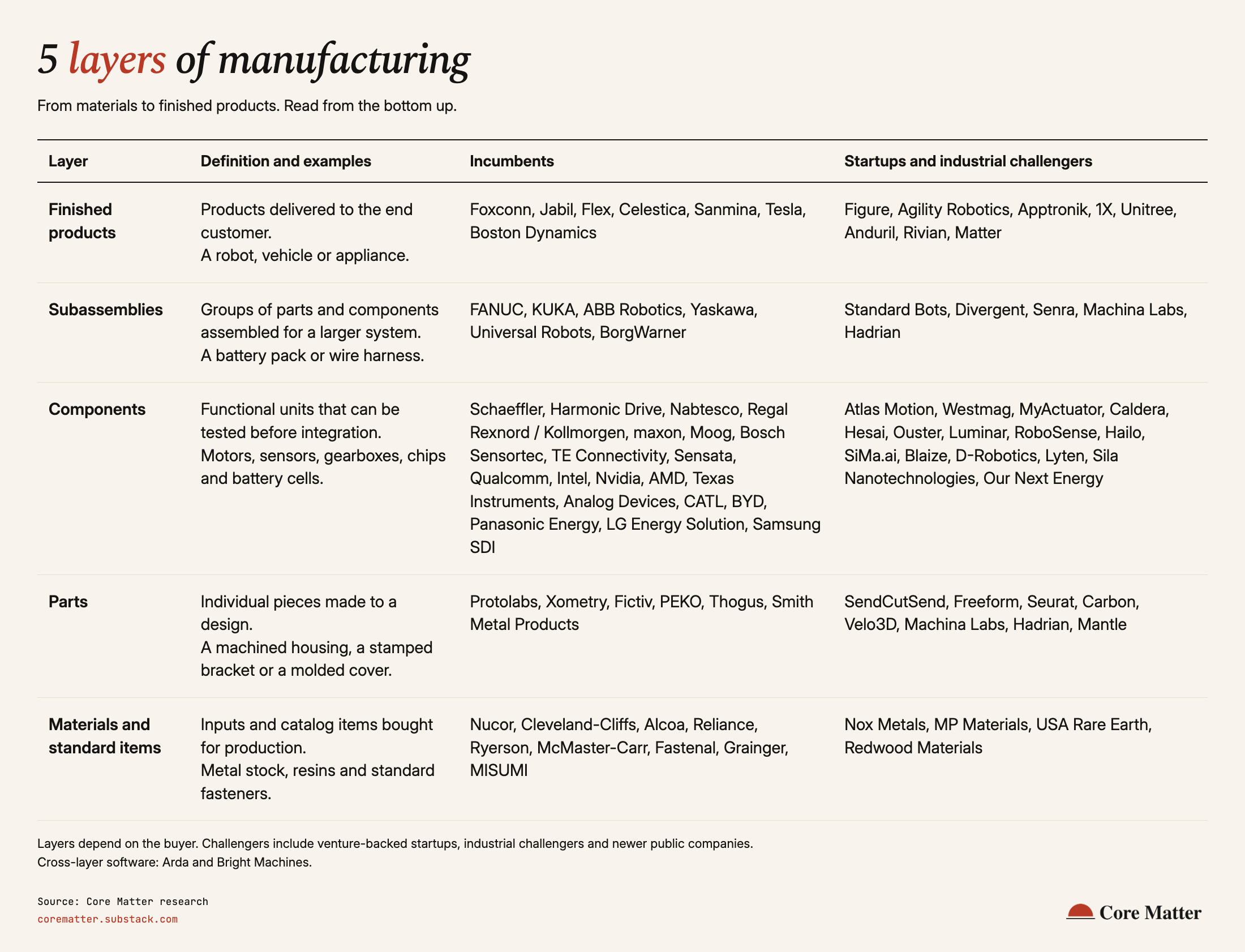
Which product falls in which layer depends on who the buyer is. A gearbox can be a finished product for a gear maker and a component for a robot manufacturer.
This piece focuses on the parts layer. Making subassemblies and finished products brings different questions about how components fit together, how to automate assembly and how to test the finished system.
2. Where AI can improve manufacturing: from drawing to delivery
Imagine a regular day in a factory: A customer sends in their drawing and asks for a quote. Before the factory can commit to a price and lead time, someone has to work out how to make the part with the equipment, people and time available.
Process planning is a classic optimization problem. The same part can be made with different tools, orders of operations, people on the team, and different combinations of those, depending on how long it takes and which machine or human is available. What separates a great factory from a good one is how optimized and flexibly adaptable the shop’s equipment, the machinists’ experience with the material and tolerances, and the customer’s deadline are.
The 5 kinds of work below follow a custom part from a request for a quote to delivery. They overlap and repeat.
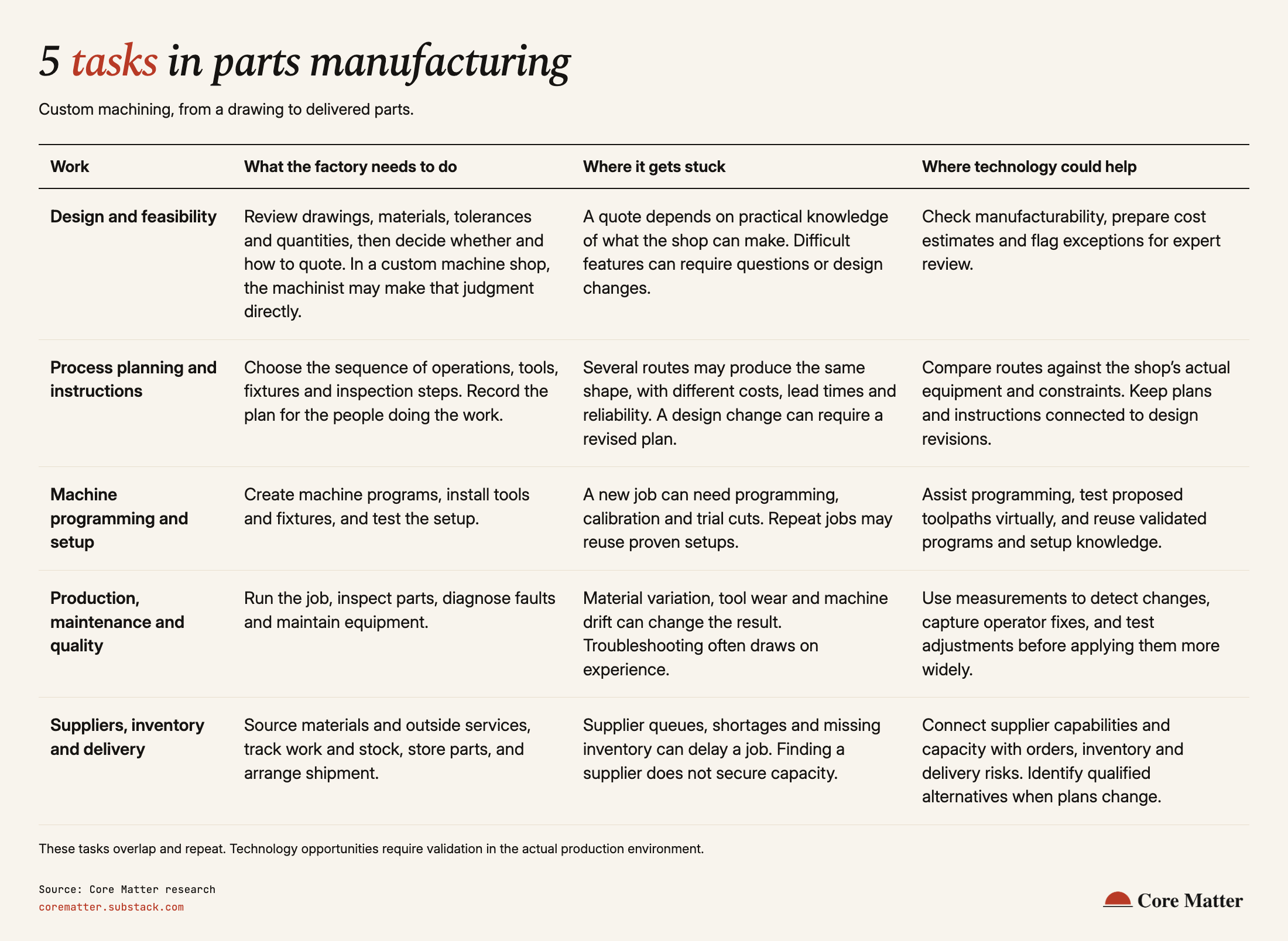
These tasks are interconnected. A different material can change the machining plan. A late delivery can change which route is practical. A quality problem can send a job back to setup or design.
3. Shenzhen’s manufacturing ecosystem: could the US build its own?
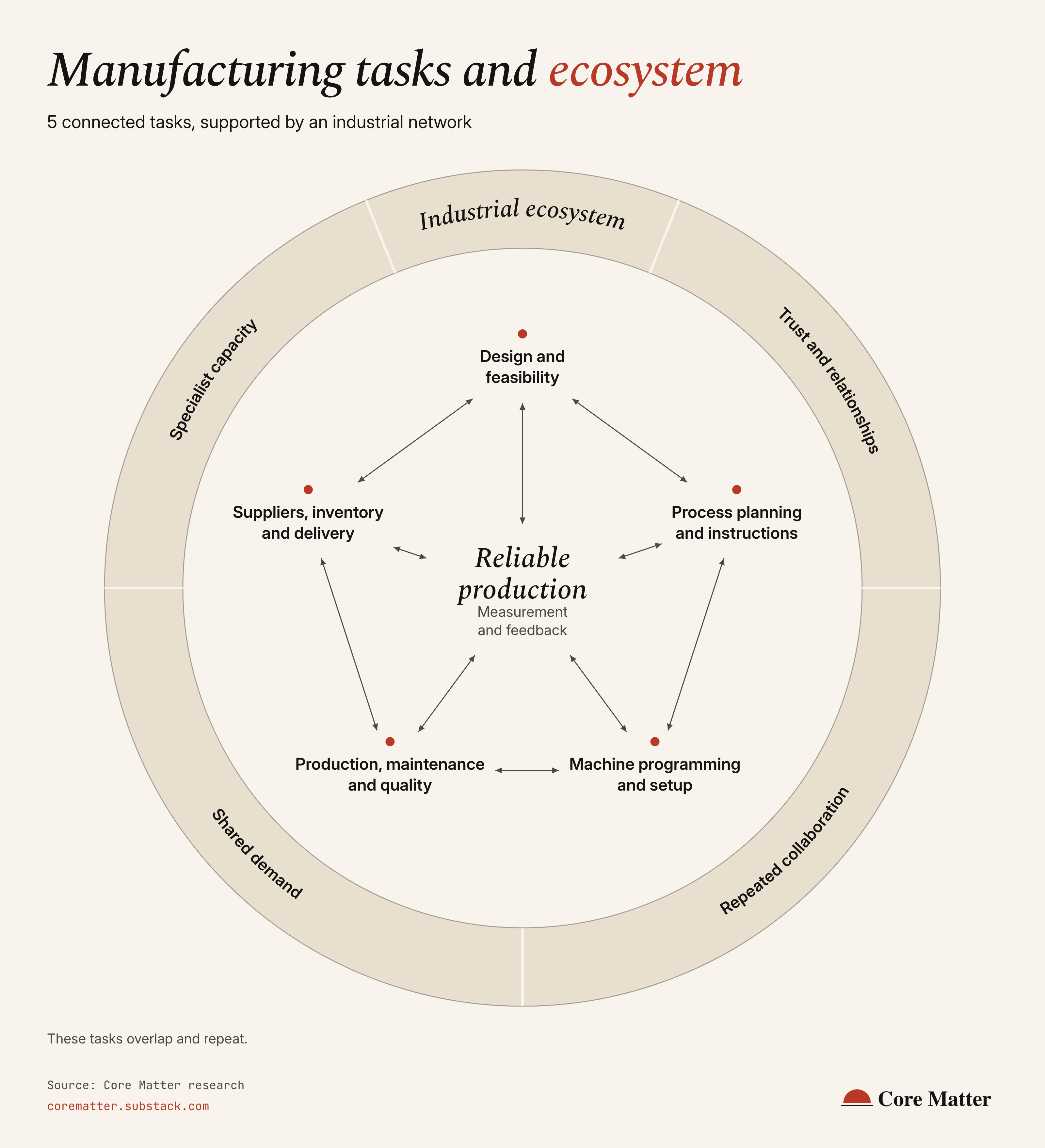
When I talk to people who have built hardware in Shenzhen, they are skeptical of the ambition of the US “replicating Shenzhen.” I can see why.
The magic of Shenzhen extends beyond any individual factory. It comes from the density, interconnected tissue and speed at which everything operates. Nearby specialists who have worked together over many jobs. The trust built between suppliers and customers. And because many factory employees move from their hometown to work close to the factory, work is a big piece of their life and they often work across the weekend.
In my interview with Eric Pan of Seeed Studio, he described working alongside Pollen Robotics to adapt Reachy Mini for production. His account points to 3 parts of that ecosystem.

Density gives factories specialists within reach. Tooling, machining, testing and repair are easier to coordinate when the relevant people are nearby. For example, a shop quoting a part that needs heat treatment could work with a nearby specialist to price that step.
Relationships save time. Trust and repeat work help suppliers understand requirements, handle changes and solve problems together.
Demand sustains the network. Orders from multiple customers help specialists keep equipment running and skilled people employed.
On top of that, Shenzhen truly never sleeps. In a few factory visits, I learned that employees live next to the factory in dormitories provided by the factories. They work 10-12 hour shifts to bank overtime pay. They choose to work 6-day weeks, or 26-day months, to bank holidays to go back to their hometown at the end of each working month.
How might the US build that capability, density and speed across more geographically dispersed hubs? Could live quoting and resource sharing help factories coordinate across distances? What would still need to happen close together?
4. Verification: what counts as proof in manufacturing AI?
“Progress follows verification.” Ted Xiao, founding engineer at Prometheus, shared in his talk at the Humanoid Hub Conference. His argument was that even after AGI, verified knowledge of the physical world would remain scarce.2
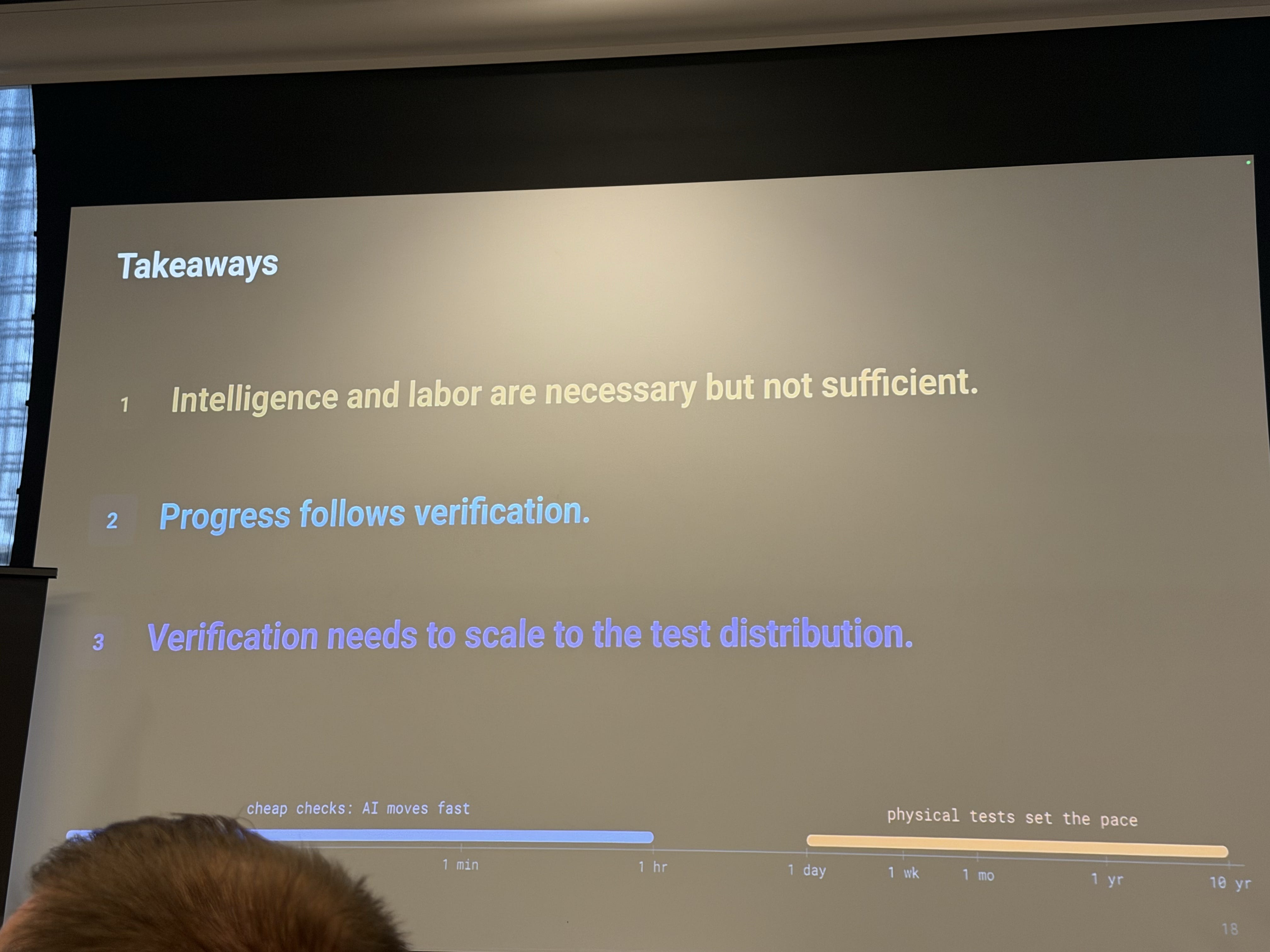
When thinking about physical AI such as manufacturing AI, verification is the measuring stick to evaluate which problem is ready to be solved and where the bottlenecks remain. An easy way to visualize what this means is by seeing the contrast between robotics data and physical data. In robotics, teams have had to collect demonstrations and experience from robot runs. Across manufacturing, decades of designs, test logs and production experience already exist. But much of that knowledge is scattered across companies, held in people’s heads or guarded as a trade secret.
When I interview machinists and engineers who work on the factory floor, the word “muscle memory” comes up a lot. It might be the angle used to hold a tool, the timing of an operation or an adjustment for a particular machine. This is the tacit knowledge that physical AI needs to collect. And it won’t be collected through data farms like robotics data.
Some software tasks have quick checks, such as running a test to see whether code produces the expected output. In manufacturing, running a check involves material, machine time and a production run. As tools wear and materials change, a trial run that’s tested to be successful can degrade over time.
For a company building manufacturing AI, think from the vantage point of verification and access to data:
How will it access the know-how and records inside factories?
How will it generate feedback it can trust?
How quickly and cheaply can it find out that a proposed method is wrong?
Verification and access to tacit and hidden data lead to progress. That gives us a way to screen opportunities: where can we get the data, measure success, afford the experiments and reuse what we learn?
5. 3 ways AI could close the US manufacturing knowledge gap
Below we explore 3 approaches to close the manufacturing knowledge gap in the US.
