

The World Robot Conference wrapped up on Sunday in Beijing. 373 companies, 3,000 products and seven main forums, with 36% more exhibitors than 2025. [1] Floor area is given as both under 50,000 and over 60,000 square meters depending on the outlet, so treat it as approximate. While I wasn’t able to attend personally, I followed the news flow closely, and Core Matter had a representative on the floor for two days. Below is what we saw, on the ground and in the coverage, and what it means for the Physical AI industry.
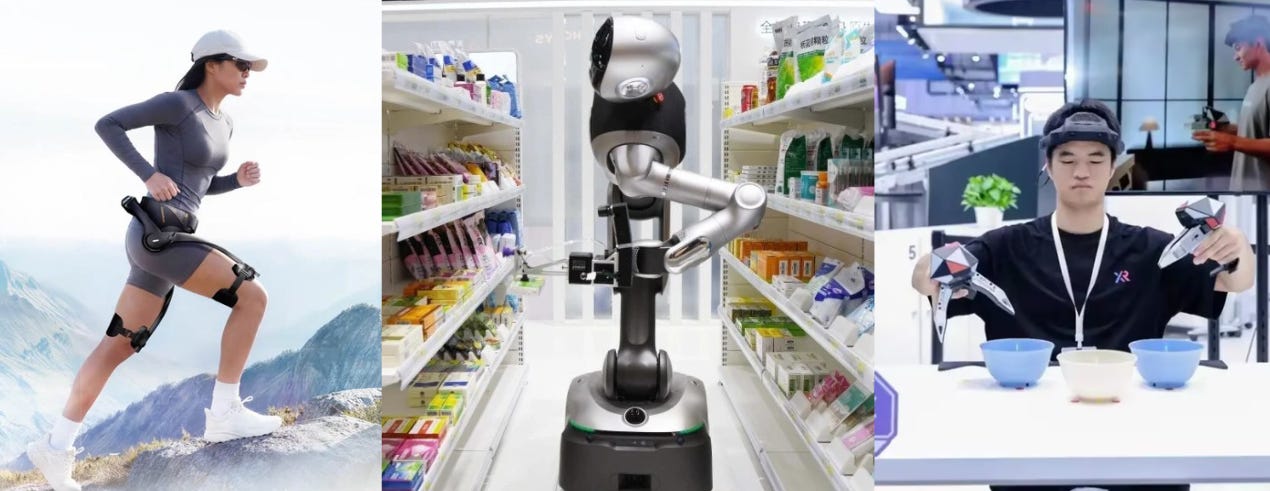
The crowd didn’t gather around the humanoids. Queues formed at exoskeletons, at massage and acupuncture applications, and at robot performances. RoboCT demonstrated a 2.2 kg consumer exoskeleton with stated capacity of 200 to 300 units a day. [2] AgiBot’s research institute ran a scan-to-rent exoskeleton counter that passed 200 rentals in its first half day. [3] The widest-reaching product on that floor was a massage robot. Hangzhou-based EasyFuture said its massage robot has close to 1,000 partner stores and institutions across beauty, traditional Chinese therapy and sports rehabilitation, and that it covers roughly 40 minutes of a 60-minute technician session. [4] The force-controlled joints under it are Rokae’s, and Rokae supplies the arm rather than operating the fleet.
How we conducted the floor survey. Our representative worked 19 booths across halls A, B and C with the same four questions at each: customer mix, unit volumes, lead times, and pricing at quantity. Ten booths answered at least one question, three declined all four, six were not reached, and seven gave a usable mix answer. Answers were recorded verbatim in Chinese. Where a supplier declined, that is reported as a refusal rather than as an absence.
In this piece:
What China shipped in the first half of 2026, and what component sales imply
State Grid’s RMB 6.8bn robot program, and the 6% of it that is humanoid
Where robots are actually working, and why three of them are pharmacies
The dexterous hand category has more entrants than end demand
Harmonic reducers and joint modules: two suppliers, two kinds of gap
Open datasets and teleoperation as a service
Wang Xingxing’s deployment threshold
What China shipped in the first half of 2026, and what component sales imply
China shipped over 40,000 humanoid robots in the first half of 2026, or 97% of the global total, according to the China Electronics Society’s 2026 Humanoid Robot Industry Development Report, released by Zhang Feng at WRC on 20 August. [5] That is about 2.2 times IDC’s count of roughly 18,000 global humanoid shipments for all of 2025, of which over 85% went into performances, education, data collection and guided tour services. [6]
What is inside the 40,000 is not published. We were not able to find more details beyond the 40,000 numbers. The report is not online, no definition of “humanoid” accompanies the number, and there is no split between bipedal and wheeled or between education and industrial use. [5] IDC, on the other hand, published in its 2025 humanoid numbers, that over 85% into performances, education, data collection and guided tours.
Unitree founder Wang Xingxing said at WRC that industrial task efficiency runs at 30% to 50% of a human worker. [7]
Supplier mix answers given on a show floor cannot be converted into robot counts, and our own survey shows why. Laifual (03952.HK), the Zhejiang harmonic reducer maker that listed in Hong Kong on 30 June 2026 and carried a market capitalization near HK$6.7bn (US$855mn) in August, told our surveyor at its booth that it shipped 70,000 harmonic reducers last year. [8] [9] Its listing materials shared 2025 unit sales at 292,000, revenue at RMB 260.9m and its China market share at 21.4%, second behind Leaderdrive at 27.5%. [8] A 21.4% share implies a China robot harmonic reducer market near 1.36 million units.
Omdia put 2025 global humanoid shipments at about 16,000 units, with China accounting for roughly 12,800. [10] At a vendor-stated 14 harmonic reducers per humanoid, those robots absorb about 179,000 reducers, or roughly 13% of that 1.36 million market.
Both Leaderdrive and Laifual told us on the floor that humanoid customers are about 30% of their book. [9] Comparing Laifual’s own 30% against its own filed shipments, the math doesn’t check out. Thirty percent of 291,000 reducers is 87,300, which at 14 per robot is about 6,200 robots. Versus Omdia’s 12,800, that would make Laifual alone the harmonic supplier to roughly half of every humanoid built in China, while holding 21.4% of the market and sitting second behind a larger competitor. Both cannot be true.
There are 3 potential reasons for the discrepancy. 1) It’s likely that 30% is a share of customer accounts, and an account can be a design-in, a sample order or a program that stalled before volume. 2) Reducers per humanoid may be well above 14, which is a vendor marketing figure rather than a teardown. 3) A large share of shipped reducers went into inventory and development programs rather than into robots that shipped.
State Grid’s RMB 6.8bn robot program, and the 6% of it that is humanoid
State Grid has started supplier selection for a RMB 6.8bn (US$950mn) embodied-AI procurement. The program covers 8,500 devices, of which 500 are humanoid live-working robots. [11] That is about 6%. The tender specifies those 500 units for live-line work. [11] The buyer writing the specification is a utility, which is a different customer from the factories most humanoid roadmaps are built for.
PowerChina disclosed a strategic purchase of 5,000 embodied-AI robots. [11] The coverage named neither the robot type nor the supplier.
Galbot’s deployment gave the clearest price signal for humanoids amongst the whole WRC floor. Galbot was named first-place winner of a RMB 235.92m (US$33mn) embodied-intelligence equipment tender in Yibin, Sichuan, for 380 wheeled robots, 80 heavy-load robots, 10 robot dogs and 30 robot retail pods. [11] Five hundred units, an average of about RMB 472,000 (US$66,000) each, and not one humanoid among them. The buyer is a state-owned energy management company, and the award was published on 23 June, before WRC.
One Chinese trade publication called out order quality directly, in a week when almost all coverage was positive:
“A non-binding letter of intent can be called an order, a framework agreement executed across several years can be called an order... at least 80% of so-called commercialization orders are fake, and that is already a conservative judgment.” [12]
While the 80% is the author’s own judgment not an audited figure, it is a useful flag on a common reporting practice.
One claim from this show demonstrates how it happens. Chinese coverage credited a company called Longmeika with a welding deployment at a Korean shipyard. Longmeika is a Chongqing joint venture established in November 2025 between a local optoelectronics firm and the Korean robotics company Neuromeka. The shipyard work is Neuromeka’s own: twelve collaborative robots for block-assembly welding with HD Hyundai Samho, signed in June 2024, and HD Hyundai Samho’s own announcements name Neuromeka. [19] The Korean parent’s contract was reattributed to its year-old Chinese joint venture, and the reattribution then circulated as a Chinese deployment.
Where robots are actually working, and why three of them are pharmacies
40,000 robots shipped in first 6 months of 2026 , and over 85% of the 2025 base went into performances, education, data collection and guided tours. [5] [6] Where did the deployments go? And which came with a named customer and a named site? Below is every one we could find at WRC, graded by what stands behind it.
The common theme behind 9 deployments. Fixed scene, single task, known objects, and a working window with no untrained public present, usually overnight. The machine is not adapting to the world. The world was already arranged for the machine.
Robot Era has its logistics sorting robots in batch deployment with China Post and SF Express across more than ten logistics centers in five provinces, and describes itself as in the batch delivery stage. [14]
Ant Lingbo runs night-shift drug sorting at a Guoda Pharmacy store in Shanghai, taking orders through a receive-to-deliver loop alongside pharmacists, with the store requiring no space modification. [13] The interesting part is the architecture: one model, LingBot-VLA 2.0, driving three different vendors’ hardware, from Leju, Stardust and Ant’s own R-2. Ant calls the stage commercialization testing, names one Shanghai store and gives no store count. This launched at WAIC in July and reappeared at WRC.
Galbot states over 100 smart pharmacies, retail pods at more than 200 locations across 45 cities, a deployment on CATL’s production line, and 80,000 accumulated hours of real-world data. [13]
Star Era built a 1:1 reproduction of an autonomous forward warehouse with JD on its stand, and took over 100 real orders through it on the opening day with no human intervention. [15] Neither JD nor Star Era issued a release, and the reporting describes the show-floor unit rather than a warehouse in operation.
EngineAI at Luxshare’s Suzhou plant. Traces back to EngineAI’s founder speaking to a Shenzhen district paper on 18 August, before the show opened. Likely due to EngineAI in IPO process and Luxshare as a newly listed entity (002475.SZ and dual listed in HK), no plant is specified and no unit count is given.[16]
UBTech’s Cruzr Y1 at Fuao Wei Taike. [17]
Leju’s Kuafu 5W running three to four months. The model is real: Kuavo 5-W appears in Leju’s IPO filing at 200 cm, 156 kg, 40 degrees of freedom and eight hours of endurance. [18] The three-to-four-month claim came from a staffer at the stand, quoted by one outlet on 21 August. Leju’s official channels featured a different and better-sourced deployment, at FAW Hongqi from April 2025, with continuous-operation stability stated above 90% across 47 acceptance items.
Pharmacy is the solved environment that three companies found independently. RobbyAnt, Galbot, and RealMan through its remote operation network all showed retail pharmacy deployments. [13] . [19] A pharmacy has fixed shelving, a bounded SKU list, no safety-critical human contact, and a night shift with an empty store. It meets all four conditions at once, which is rare in retail. Three companies arriving at the same scene independently is evidence about which environments qualify.
This gives a clue on what environments are next for deployment. Forward warehouses and inspection rounds appear twice each above, and both meet the same four conditions: fixed layout, one repeated task, a known object set, and a window when the floor is empty. Those are the scenes to watch, and they are among the same categories LightWheel used to label its open dataset, more on that in the data section below. [21]
Not one deployment on that list is a walking biped. The machines are wheeled, armed or quadruped.
The dexterous hand category has more entrants than end demand
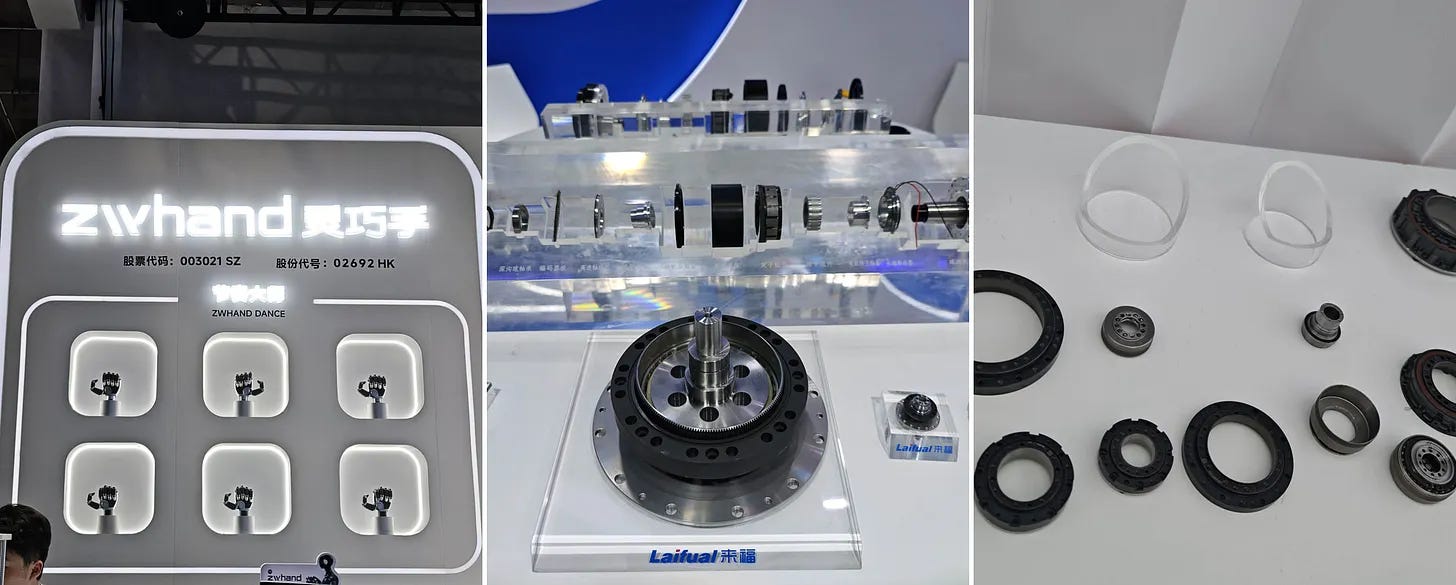
Hall B, the components hall, held at least eight dexterous hand and tactile vendors within a few aisles of each other: Linkerbot, Xino, Inspire, OYMotion, Dahuan, Tashan, PaXini and EngineAI all took stands there, several within two booth numbers of one another. [24] ZWHAND showed a range from 6 to 21 DOF and claims full in-house development, with roughly a dozen models on one stand. [9] Inspire launched a 24-DOF tendon-and-linkage hybrid hand at the show. [22]
The count of fingers is a commercial decision, and one company’s answer is visible in its hardware. EngineAI’s T800, one of the two machines our surveyor recorded drawing crowds dense enough to block an aisle, carries a self-developed three-finger hand at 7 degrees of freedom with tactile slip feedback. [24] Not five fingers, on the most-watched humanoid at the show.
An exhibitor at a neighboring component stand put the reasoning plainly: in a factory, where the scene and the task are fixed, a two-finger or simpler gripper already does much of the work, and five fingers earn their place where tasks vary. [9] That is the solved environment arriving from the supply side. The conditions that make today’s deployments possible are the same conditions that remove the reason to pay for a five-fingered hand. While dexterous hands are challenging in an engineering sense from the control complexity and anthropomorphism, it seems that even the merchants selling these hands admit that these hands have yet to find the product market fit in a factory at today’s capability. [24]
Tactile sensing moved from fingertips to feet. PaXini launched foot-mounted multi-dimensional tactile sensing and a fourth-generation sensor line built on a self-developed 6D tactile chip. [22] Foot-mounted tactile improves locomotion stability; finger tactile improves manipulation.
Harmonic reducers and joint modules: two suppliers, two kinds of gap
Laifual understated its own shipments by 4.2x. At its booth on the Friday, Laifual’s representative told us it shipped 70,000 harmonic reducers in 2025. [9] Its Hong Kong listing materials put 2025 unit sales at 292,000, with revenue of RMB 260.9m, up 142.2%, and second place in China at 21.4% share. [8] The booth answer came about eight weeks after the company listed with audited numbers.
EYou shows the same gap from the other direction. EYou told us it delivered 95,000 joint sets in 2025 with roughly an 8:2 humanoid split. [9] Chinese coverage from the same week reports an order book above 1.5 million sets and a RMB 1bn (US$140mn) Wuxi base planned at 3 million joint modules a year. [23] Its own shareholder puts it as a 15-fold increase over full-year 2025 shipments. [23] The planned capacity is more than 30 times last year’s deliveries.
Humanoid is a minority of the book at every harmonic reducer supplier with real volume. Leaderdrive, which Gasgoo identifies as the 27.5%-share leader that Laifual’s prospectus lists only as “Company A”, [8] put humanoid customers at about 30% on both askings, two days apart. Laifual said 30% humanoid against 20% industrial, 20% collaborative robots and the balance machine tools. Tianlian said humanoid is 5% of 200,000 sets. [9] The humanoid-heavy names are the small ones. For the suppliers shipping at scale today, humanoid is the marginal customer and industrial automation is the business.
Open datasets and teleoperation as a service
Many attendees criticized the show on the grounds that most demonstrations run on teleoperation, and the criticism is accurate. An engineer quoted in Chinese coverage put it plainly: “A ten-minute demonstration takes the team countless rounds of tuning beforehand. Before the performance, even we thought it would fall over.” [12] More datasets are being released as open sourced, while teleop-as-a-service is growing as a product category.
Noitom released HiPHI, a human motion and human-object interaction dataset, free to the global research community. [1] Company-stated.
Beijing Humanoid released Pelican-Unify 1.0 and the Tiangong Omni open platform, on a machine it states at 39 kg. [1]
LightWheel open-sourced EgoSuite-Open100K with Hugging Face the week before WRC: 100,000 hours of egocentric human data, over 15,000 tasks and over 15,000 distinct collection scenes, spanning 128 scene types across seven environment categories including retail, logistics, hospitality and industry. [21] The first batch is live on the Hugging Face Hub with the remainder rolling out in stages.
RealMan is selling teleoperation as the product. Its GLN remote labor network ran a robot restocking and dispensing in a 24-hour pharmacy, one on substation inspection, one making mooncakes alongside a Daoxiangcun baker, and remote operation of its own Changzhou factory from the show floor in Beijing. [20]
