

The hand was humanity’s first technological interface. The brain generates concepts, but the hand is how ideas come to life. In Physical AI, as multiple players emerge to build the body and brain, the race for building the dexterous hand is the last frontier.
Elon Musk has repeatedly called the hand the hardest part of Optimus, putting the forearm and hand at roughly 60% of the robot’s engineering difficulty. 72.8% of Unitree’s humanoids shipped in 2025 with no hand at all. This primer dives into why building a robot hand is so challenging, who is building it, how much it costs and the business around it.
Why Hands are Hard
The human hand mastered both the power grip and the precision grip in one organ. To replicate this dual mastery, it requires an intricate trade-off in the design.
To understand the robot hand, here are the key items on a hand spec sheet:
DoF - Degrees of Freedom: the number of independent ways an object or joint can move in 3D space. For example:
3 DoF is movement in three directions: X (forward/backward), Y (left/right), and Z (up/down).
6 DoF: an object can move freely in 3D space. This involves the three positional movements mentioned above, plus three rotational movements: pitch (tilting forward/backward), yaw (turning side to side), and roll (tilting side to side).
Number of joints: a joint is a place where the hand can bend; an actuator is a motor that drives the bending. The two counts differ in most hands, because one motor can drive a joint directly while other joints follow along through linkages or tendons. Vendors call the directly driven joints active and the follower joints passive. For example, Linkerbot’s L10 lists 20 joints, 10 active and 10 passive: 10 motors each drive one joint, and each driven joint drags a second joint with it through a linkage. The DoF-vs-actuation section below covers why buyers should count only the active ones.
Backdrivability: Fully backdrivable means when the joint is being manually moved, the motor easily spins backward. This allows machines to “feel” and react naturally to their environment, to safely interact with humans. The downside is that the motor must actively consume power to hold a static position. Non-backdrivable means the mechanism is mechanically “locked” in reverse. It’s ideal for holding heavy loads securely without using electricity, but because the system doesn’t comply when it encounters an obstacle, it can be dangerous for human-robot interaction.
Cycles: how many open-close repetitions the hand survives. Spec sheets almost always quote unloaded cycles, and 1-2M unloaded is the current top of the industry. In reality, hands are almost never unloaded. A teardown of 1X’s literature puts NEO’s tendons at ~2M cycles nominal but ~100k at 3x load - a 20x derating [teardown + company literature]. A metric to consider is the unit price divided by loaded cycles, that balances durability with the headline price.
Force: the spec sheets quote three different quantities
Fingertip force, in newtons (N): what a single fingertip can push with — Sharpa 20N, NEO 45N, LinkerBot L10 15N per fingertip.
Grasp force, also in newtons: the total squeeze of the closed hand, always the larger number. The range is around 45-100N. [confirm based on various datasheets]
Wrist torque, in newton-meters (Nm): a rotational moment, not a force — NEO’s 17.75Nm cannot be compared to any grip force without specifying a lever arm. A vendor quotes whichever of the three flatters its design; the reader’s first job with any force number is to identify which one it is.
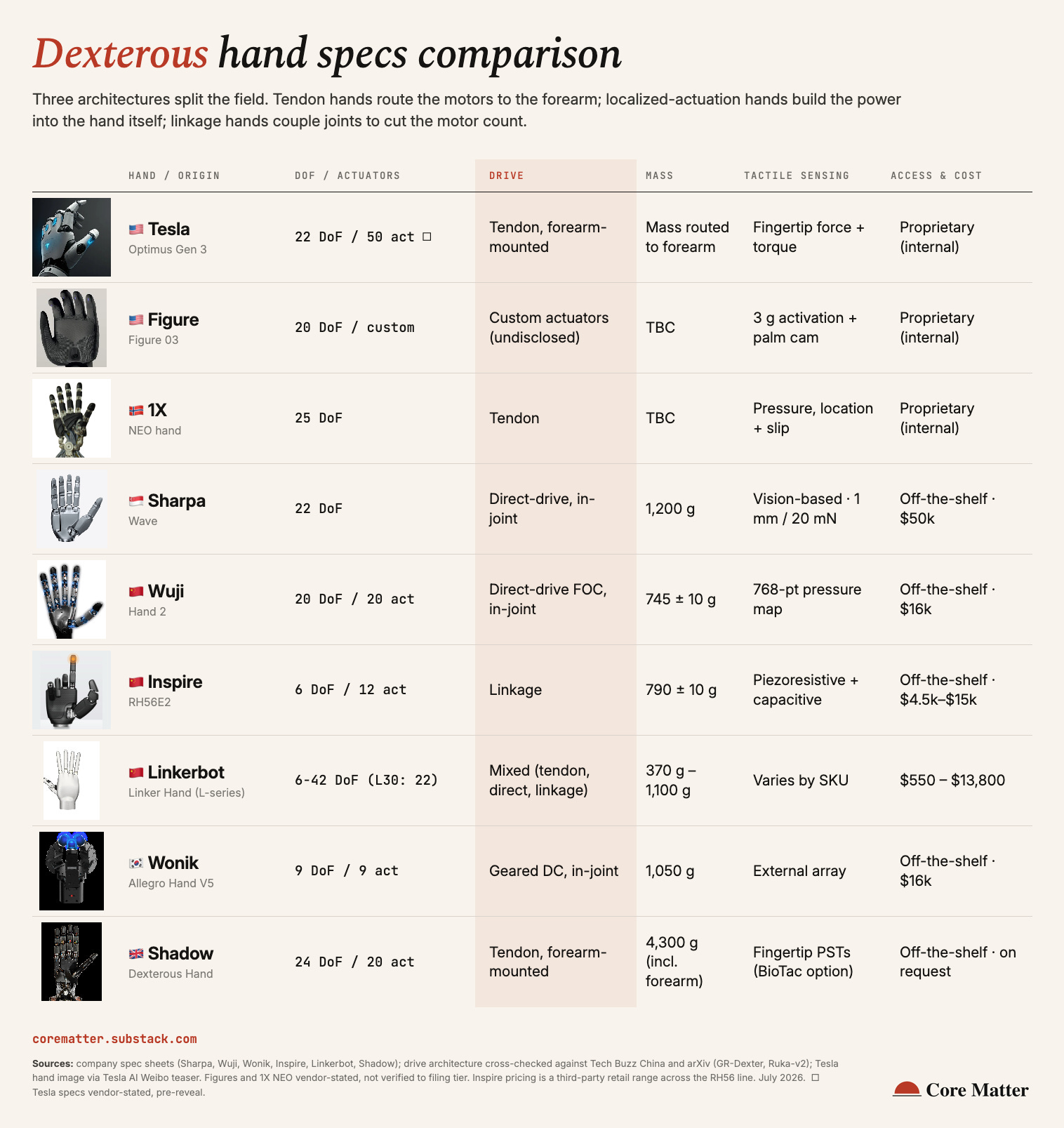
Weight: Both the hand itself and the forearm matter. Sharpa hand is 1.3kg, Wuji hand is <600g, LinkerBot L10 hand 800g. 1X’s Neo hand is unlisted (likely due to the high weight including the forearm tendons). A 500g hand rides a 3kg-payload arm with 2.5kg left for the task; a 4–5kg hand (eg. Shadow with forearm: 4.8kg) demands a 10kg-payload arm before the task gets a gram. Weight compounds up through the arm into total system cost.
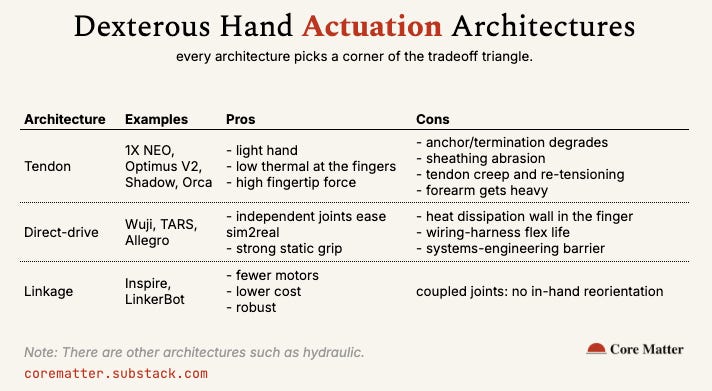
A lot of these performance specs come from the drive architecture. Today there are 3 main types of architecture when it comes to building hands. They are all about choosing where, or whether to put actuators on the hands.
Tendon-driven: The gears are on the forearms, instead of the hands. The cables (tendons) run through routing channels or pulleys, connecting the gears to the fingers and palms, using a pulling mechanism to make the fingers move.
Direct-drive: Each joint is an actuator, independently moved.
Rigid linkage: Actuators in some joints, and some in the palm. The other movements in the other joints are made through linkages
The key trade-offs are:
Tendon-driven hands allow for slim fingers and a lighter hand, with the weight shifted to the forearm. Shadow arm, for example, weighs 4.8kg with the forearm included. However the weak point is the anchor of the tendons. A 150N-rated tendon holds ~100N after limited cycles because the knot/sleeve termination degrades. It typically only works for thousands of cycles, not millions (sourced: Prensilia interview). As cables lose tension over time, movements also become less precise.
Direct-drive hands give full control of individual joints, one motor per joint. The sim-to-real gap is a clear advantage: there are no springs or tendon friction to model. The downside is that it usually comes at a cost premium as actuators are the most expensive line item in a hand. Another weakness of direct-drive design is thermal: holding a grip means motors continuously drawing high current, and small motors shed heat poorly.
Linkage hands are robust and cheaper than fully actuated hands as it requires fewer actuators. Weaknesses include (1) coupled motion, meaning the inability to manipulate individual joints, makes it impossible to do in-hand reorientation or piano-type gestures; (2) Grasp shape is determined passively by object contact, which sacrifices precision; (3) Compliant elements such as springs and linkages under load, are hard to simulate, lowering sim-to-real performance.
Failure modes (Mechanical)
1. Tendons lose tension or snapping: Repeated tension, bending, friction against routing pathways causes cables to stretch, fray or snap over time.
2. Fingers break: Fingers bump into fixtures, get struck or dropped on. They fail first because they take the impacts, hence quick-swap fingertips as a design requirement.
3. Gear wear, then failure: As the gear teeth slide and roll contact under load, and as lubrication breaks down or gets contaminated, it causes abrasive wear or cracks. This leads to a gap between mating teeth. The finger wiggles slightly even when the motor is locked, lowering precision and position control.
4. Motor overheating: Especially with the direct-drive design, in order to hold a grip in place, motors continuously draw high current, rapidly generating heat.
5. Gearhead structural failure at torque limits: Direct-drive or linkage hands use miniature gearheads, often with teeth at fractions of a millimeter wide. When a robotic hand accidentally hits a rigid surface (eg, smashes into a wall), the torque spikes past the gearhead’s maximum tensile strength which leads to the root of the gear tooth snapping off.
6. Wiring harness fatigue: the wires carrying power and signal to the finger motors and sensors flex with every joint movement, and copper conductors fatigue the way a paperclip does when bent repeatedly. Cracked conductors and loosening connectors produce intermittent electrical faults long before anything mechanical breaks. The flex life of the harness is estimated at ~1M cycles, which makes the wiring, on the company’s own numbers, the binding constraint on hand life [founder-claimed].
In addition, test conditions matter as much as the count. Each grasp type loads only some of the hand’s joints, so a million cycles of one power grasp proves out the three joints that grasp uses and leaves the rest of the hand untested [founder-claimed]. A cycle count on a hand spec sheet certifies the single motion that was tested, nothing more.
Reading the DoF number: Passive vs. active actuation, and abduction
Active vs. passive. If DoF is more than the number of motors, it is an underactuated hand, which means some of the DoF is controlled passively by a motor not at the actual joint but through linkage or tendons.
Abduction is also an important mechanism, which is the finger’s ability to spread apart laterally. It allows the hand to perform complex tasks like in-hand rotation, reducing task-completion time.
Flexion is the curl of a finger toward the palm, and it turns out very few independently controlled curl joints are needed. There are also studies in the research literature that basically say that having a hand that is able to have abduction movements and two to three degrees of freedom in the flexion of the fingers is equivalent to having a 20 degrees of freedom hand without abduction. When asked to spec a hand for a 10,000-unit humanoid, a researcher argued five motors can achieve ~90% of daily-living grasps.
The map: the hands market is a stack
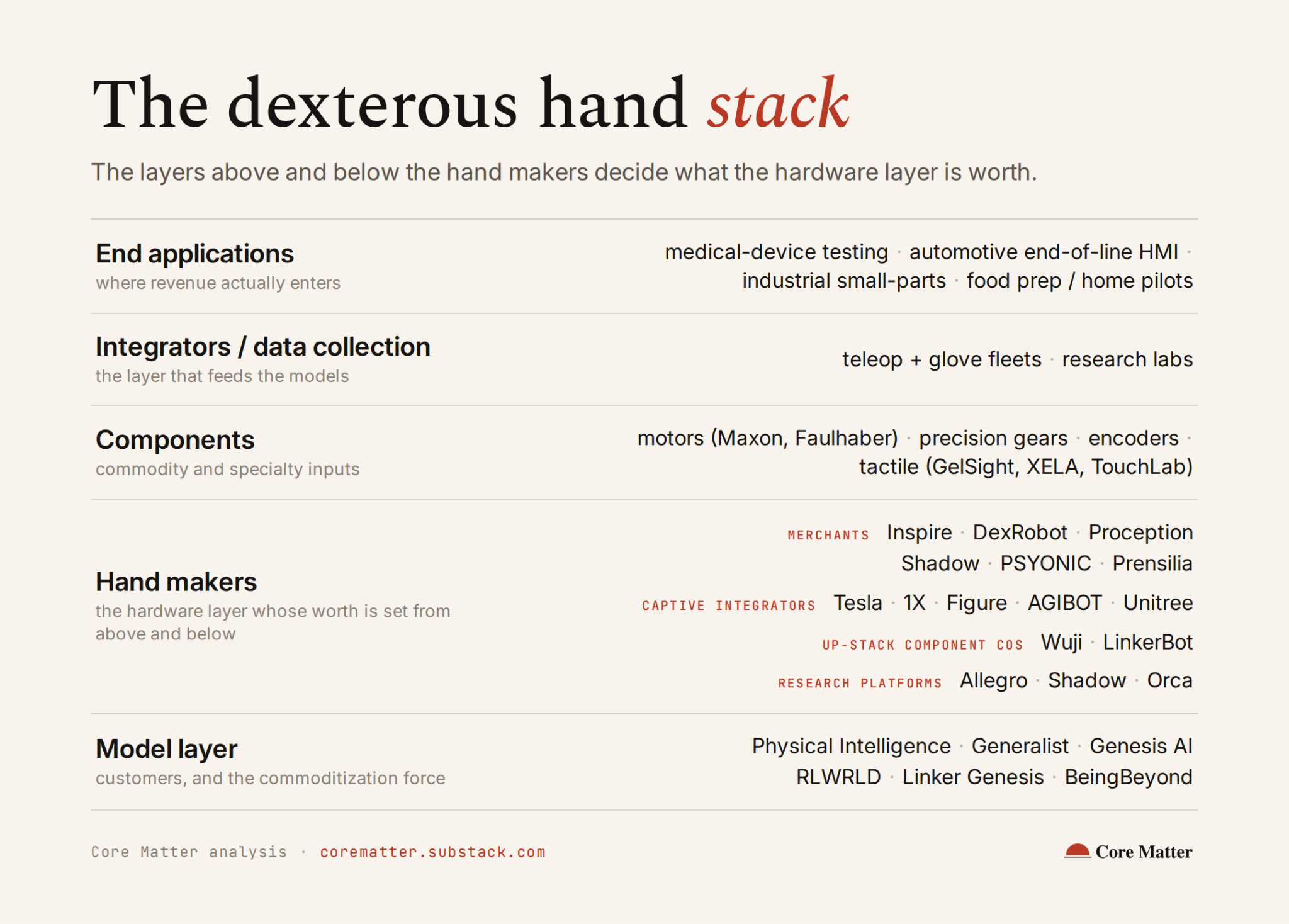
The hands market today is growing rapidly. It spans the model layer, hand makers, components, integrators, and end applications.
Robotic Foundation Models: They build models for robots to operate in, increasingly adding in the dexterous layer on top of locomotion or pick and place. They shape the hand maker market in three important ways: (1) they buy or build hands for data-collection fleets (near-term merchant demand); (2) their architecture bets (vision-plus-proprioception vs. contact-rich training data) decide whether tactile is on the critical path; (3) their success decides whether the hand commoditizes into an interchangeable peripheral, with value accruing to the model layer.
Players: Physical Intelligence: hardware-agnostic VLAs from mixed embodied data. Generalist: GEN-1, trained on 500k hours of human interaction, adapts to a new body and task with ~1 hour of robot data [company-claimed]. Genesis AI: the vertical bet with its own hand, own glove, 1:1:1 kinematic mapping. RLWRLD: dexterity-first VLA with force/tactile channels, data from dispatched workers amplified by generative video [company-claimed].
Hand Makers: There has been an influx of hand makers, split into 4 lineages.
Pure-play merchants: Inspire, DexRobot, Proception, Shadow, Wonik, Psyonic, Prensilia);
Humanoid OEMs building captive: Tesla, 1X, Figure, AGIBOT, Unitree);
Actuator/component companies moving up-stack: the Maxon/Faulhaber-adjacent path, Wuji, LinkerBot, and Zhaowei;
Research platforms: Allegro, Shadow DEX-EE with DeepMind, Orca with ETH Zurich (tendon driven).
Components: key components inside a robot hand are
Actuators: For the direct-drive or linkage based design, it requires miniature actuators, which requires high precision gears. It is a very specialized production line, which is why many actuators companies are starting to make hands.
Encoders: Actuators require ultra-precision encoders, a lot of which are sourced from the West.
Tendons: the cable itself is Dyneema (or the equivalent Spectra), an ultra-high-molecular-weight polyethylene fiber stronger than steel by weight, sold by the spool as a fishing-line and rope commodity by Avient and Honeywell. The fiber is not a bottleneck: it is cheap, abundant, and not hand-specific. The engineering value sits one layer up, in termination and routing.
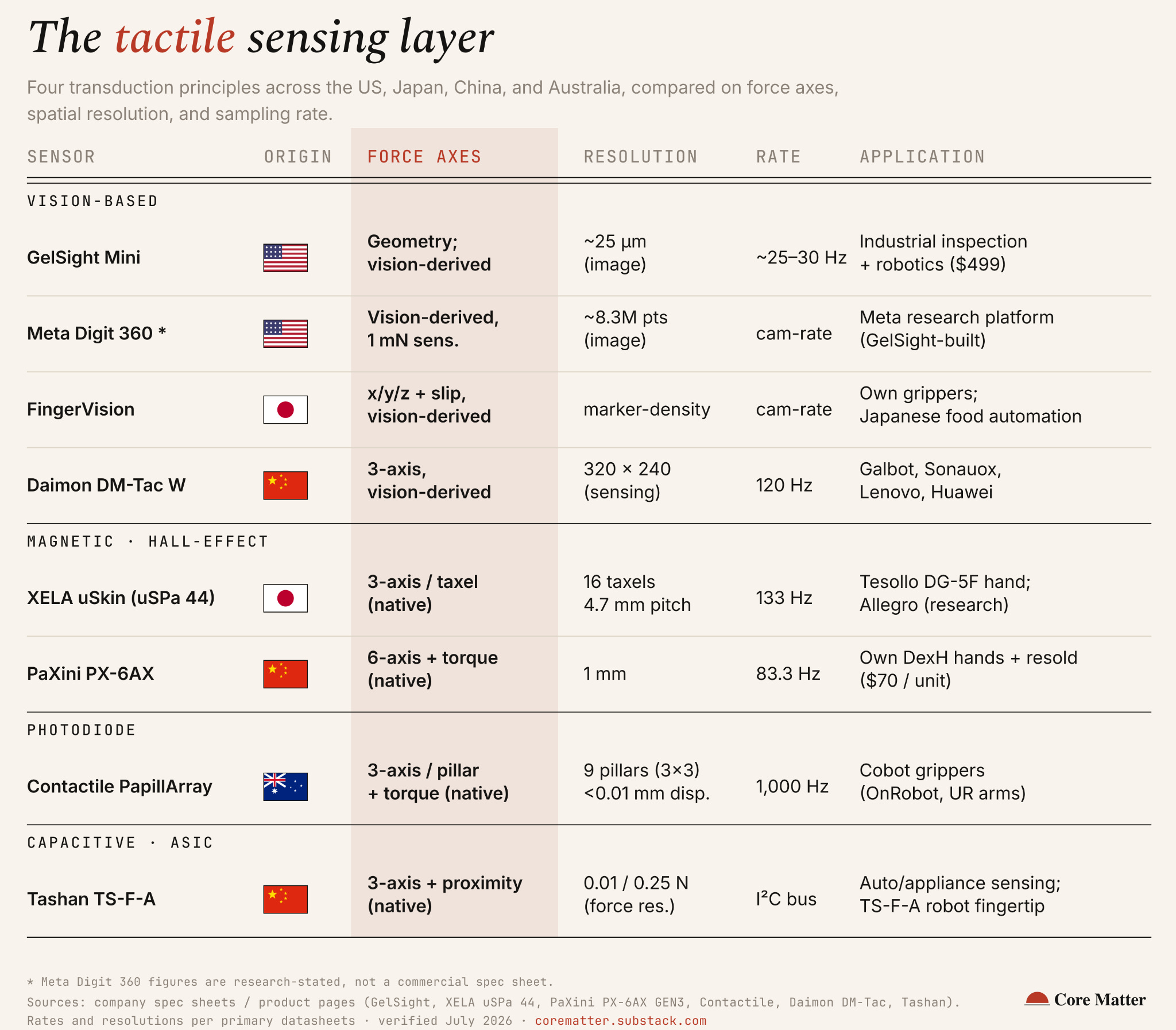
Tactile sensors: There are different designs behind tactile sensors which we’ll cover in the next section, and there is no industry standard in tactile sensing.
Tactile: the twin problem
Hands allow humans to interact with the world, and through manipulating objects, we gain understanding of the world around us. The hand is an active sensory organ: touch isn’t a passive input channel but an experiment the body runs continuously. In order to capture contact information, tactile sensors need to be placed on the robot hands. Tactile, as it turns out, is a separate unsolved stack with its own frontier.
Tactile has no standard. The supply base is startups and academic spinouts with no production-scale manufacturing yet, globally. The tactile is a younger industry than the hand itself.
Overview of Tactile Sensors Providers
Below is a list of players: vision-based (GelSight), magnetic/Hall, capacitive skin arrays (XELA). Like hands, durability is a metric that’s not listed on the spec sheet. The deployment bar is around 5 million touches, where lower-cost sensors age out at 1 million.
Another approach is putting a tactile glove onto the hand, where all sensors are on the tactile glove and the hand makers focus on the mechanical aspects of it. The glove acts as the bridge between tactile hardware and manipulation data.
Is tactile prerequisite or luxury?
The deeper question is whether manipulation data must include contact, or whether vision plus proprioception can substitute. The industry is making different bets.
Wuji ships encoder-only (”in the end state the glove is the only solution”). Many hand makers choose to outsource sensing entirely. A Shenzhen micro-drive manufacturer we interviewed specs and sources its tactile, rather than building it. 1X puts it in the glove material, not the skeleton. In contrast, Tesla put palm sensors on its Optimus V2 hands.
The physics behind shipping without tactile sensors is transparency. In a finger with low gear, the motor and fingertip stay mechanically linked in both directions. So pushing on the fingertip shows up as a change in the motor’s current. This lets the controller estimate fingertip force from motor current alone, with no force sensor in the finger.
The strongest evidence for “not on the critical path” is what the model layer omits: Levine’s recent talk on dexterity contains no tactile sensing at all [academic, absence datapoint]. HIL-SERL reaches 100% success on chip insertion from images alone in ~15 minutes of training, 2–3x faster than imitation baselines [academic]. And RLDG finds RL-generated data outperforms human demonstrations at equal success rates [academic]. Vision plus proprioception keeps clearing bars it was supposed to miss.
The Retargeting Gap
Glove-collected human motion has to be retargeted into robot command space, and there is no consensus method: force feedback is not touch, and “if the data is junk, the robot’s going to be junk”.
Researchers are also testing the “train-rich / deploy-lean” hypothesis: dense tactile during the teaching phase, simpler or no sensors at deployment. If this holds, it may limit tactile demand to only training fleet and not in mass deployment.
The cost curve: the BOM and which component costs are collapsing
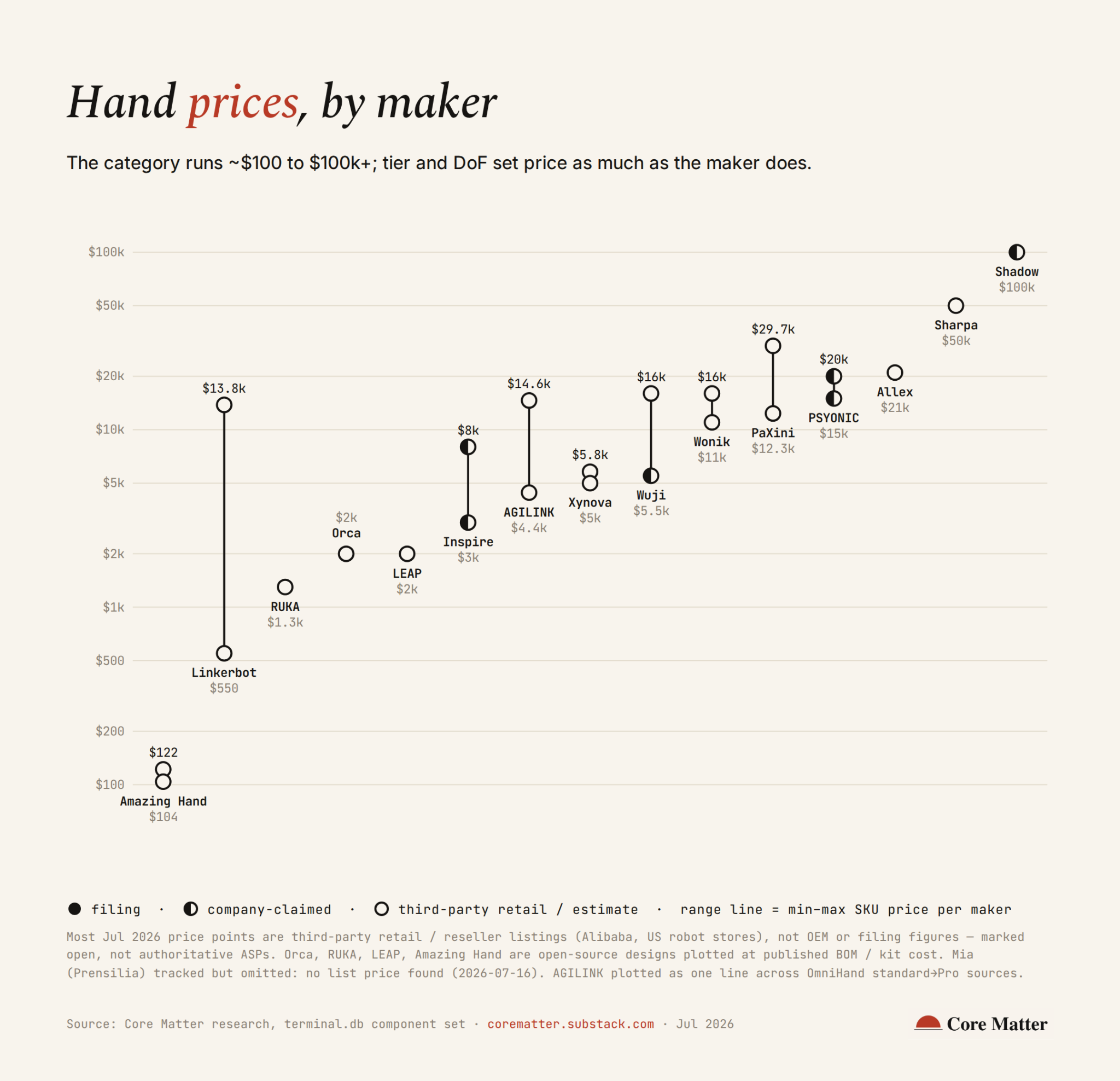
Assembled-hand prices are falling fast: $100k-class research hands, to $20k, to Inspire’s $3–8k at roughly 10,000 units delivered, toward a claimed sub-$1k floor.
The key cost drivers of a hand are: precision gearboxes (the actual cost driver), matrix tactile sensors (disproportionately expensive per unit vs load cells), and the operating-model gap between design firms and volume manufacturers.
BOM of a hand
The BOM shape depends on which supply chain builds the hand, and the difference is the point:
In a European build on catalog motors, mechanical transmission and structural frames run ≈70% of BOM, and the motors alone are roughly one-third of total cost [company-claimed, Prensilia].
In a Chinese build, the motor is the cheap part: brushed motors at RMB 50–100 (US$7-14), brushless at RMB 500–1,000+ (US$70-140), an order of magnitude apart. The precision gearbox is the expensive stage of the actuator [call, anonymized].
PCBs and electronics are already cheap and fall further with scale.
Tactile sensors stay disproportionately expensive per unit relative to load cells.
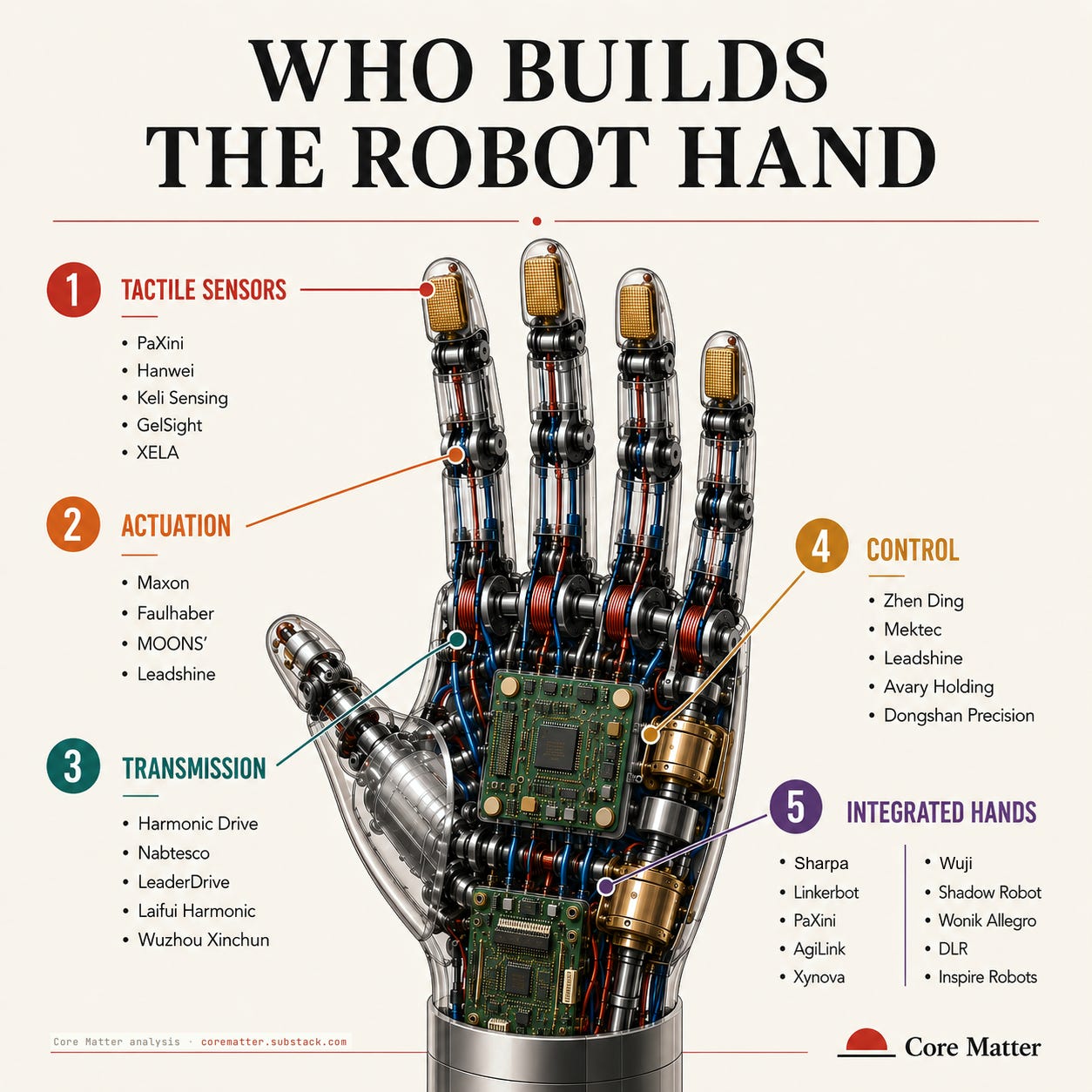
The motor line item collapses as sourcing moves to Chinese vendors. The precision gearbox resists collapse in both geographies, which is what makes it the cost driver.
The challenge is not just the BOM but also manufacturing scale.
For research grade makers, the hands are in-house engineered, outsourced fabrication and in-house assembled. The volume tops out at hundreds of hands per year. Going to thousands per year, requires redesigning for volume processes, partnering with assembly firms.
For players that come from motor and micro-actuators backgrounds, their already-available mass production capability enables them to scale quickly. One listed maker is expanding hand capacity ~70% in H2 2026 at its existing plant.
And that is why Inspire is delivering 10,000 units at $3–8k and LinkerBot claims 80% hand market share with its sub-$5k hands.
Beyond purchase price, the total cost of ownership (TCO) is a key metric to compare to evaluate ROI. That includes maintenance, reliability and uptime. Tendon hands need periodic re-tensioning, teardown analysis expects 1–2 year replacement cycles on wear components, and sensor gloves are consumables that tear [teardown, 46:39]. Direct drive designs have overheating issues; sustained grips draw continuous current, limiting uptime.
What exactly is a hand business: Where value sits
Is a hand company a data company with hardware, or a component supplier with component margins?
The revealed volumes are small. Unitree discloses Rmb 17.2mn (US$2.5mn) of Inspire hand purchases over the first nine months of 2025, for 1,210 hands, 96% of everything Unitree bought in hands from outside suppliers [filing]. That is a pilot-scale line item for a company shipping humanoids in the thousands. Unitree is also building its own Dex5 in-house [filing]. Sharpa claims mass production and has published no numbers [company-claimed].
For many merchant hand makers, the first market is university and corporate research labs. Unitree’s early revenue came from selling robots to academic labs, which proved that academia buys robot hardware in real volume. Wuji, LinkerBot, and a few other Chinese hand makers picked the research first approach. The incumbents in that field are Inspire and Shadow.
The third paying channel is industrial automation, and for the Western merchants it is already billing. Prensilia CE-marked the Mia hand as an industrial gripper in early 2025 and puts its buyer mix at 50% research, 35% prosthetics, and 15% industrial, the segment it is now pushing hardest [company-claimed]. The lead use case is human-machine-interface testing. Automotive plants station a person inside each car at the end of the line to test the interior, and a lightweight hand on a standard robot arm can run the same touchscreen, button, and lever checks; ultrasound machines and other medical-device interfaces follow the identical logic [company-claimed]. PSYONIC reports the same pattern from the US side: over 50 robotics customers, including NASA, Meta, Google, and Amazon, mount the Ability Hand on humanoid robots and on industrial robot arms, for tasks that run from car assembly to laundry folding [founder-claimed].
The framing that fits this revenue is the hand as the flexible complement to the industrial gripper, riding arms that are already deployed. Robotiq and Schunk are the incumbents whose customers these dexterous hands sell to: the gripper wins single-part work on speed, force, and repeatability, and the hand wins the cell that handles many part types or an interface designed for human fingers [company-claimed]. Humanoid programs supply the category’s headlines. The invoices, for now, come from installed arms.
Platform or component
Not every hand can be a standalone product. Forearm-integrated designs (Tesla, 1X, Wonik’s Allex) cannot be unbundled and sold separately: the actuation lives in the forearm, so there’s no product boundary at the wrist.
For the hands that can be sold, the question is what keeps a customer.
Data: Training data collected on one hand is recorded in that hand’s kinematics. That does not survive a switch to another model.
Code: Customer’s software stack is written against the vendor’s SDK: the control APIs, the simulation models, the calibration routines, the data pipeline. Swapping the hardware takes an afternoon; rewriting that integration, re-tuning controllers, rebuilding the sim environment, and re-validating everything downstream takes months.
Together, choosing a hand is closer to choosing a platform than buying a component.
That is the logic of the cheap-hand strategy: make the cheapest hand that clears the performance bar, win the research market on price, and let dataset and integration code accumulate on your kinematics. The equilibrium price then becomes the marginal cost of its motors, plus a standard SDK intended to become the default research platform.
Where value sits in the hand stack
Currently humanoid makers are split in the approach: a) building in house for more control, or b) buy for speed, and often, buy expertise in reverse engineering and time for internal development.
When bigger humanoid players make their hands in-house, they still buy parts. The squeezed party is the finished-hand merchant, who loses the order when the customer goes captive. What remains for merchants is the software-led programs, and there the defensible asset is the switching cost described above.
Does the model layer or the hardware capture value for robot hands?
Leading foundation-model players such as Physical Intelligence and Generalist are hardware-agnostic, built to treat any robot embodiment, hand included, as an interchangeable peripheral. If that works, hand makers compete on price like component vendors. The scarce asset is then the model and its data.
The flip side is, if manipulation performance stays tied to hand-specific kinematics and hand-specific data, then the hardware layer keeps its value, as the product is the hand, glove and model all tied together.
Every hardware-agnostic success moves value up the stack, every vertical-integration success holds it down.
If hands do commoditize, the unglamorous industrial layer then becomes the gating factor: system integration, reliability and the test protocol. A test protocol is a reproducible procedure for proving performance claims: which grasp, at what load, at what temperature, for how many cycles, with what counted as failure. The vendor whose test protocol buyers trust ends up writing the rules of the comparison. Semiconductors already work this way: datasheet conventions began as individual vendors’ formats and hardened into the shared language every part is judged in. The hand market is one credible protocol away from the same structure.
And whether the dataset is the moat is to be determined. There are at least three ways collected data could fail to improve policies:
Models may generate better data themselves. RLDG finds RL-generated data outperforms human demonstrations at equal success rates [academic]. Every result like it shrinks the value of a stockpiled demonstration corpus.
The recording may lose what matters in translation. Glove and teleop recordings must be retargeted into the robot’s command space, and Section 3 showed that translation degrades exactly the contact behavior training needs. Teleop quality compounds the problem: “if the data is junk, the robot’s going to be junk” [teardown commentary].
Deployment may out-produce collection. Working fleets generate manipulation data as a free byproduct of paid work: PSYONIC’s prosthetic hands, in daily use on 300 patients, are a data source no glove-collection operation matches on realism or cost [founder-claimed]. If deployed fleets scale, purpose-collected data becomes a wasting asset.
