

On July 31, Tau Robotics, a San Francisco robotics startup with three engineers and $2.6 million in pre-seed funding, announced a $30 per hour robot cleaning service. A Unitree G1 arrives at your home, operated by a remote operator, and every frame of the videos goes back to the company. The company claims the waitlist is several hundred people long.
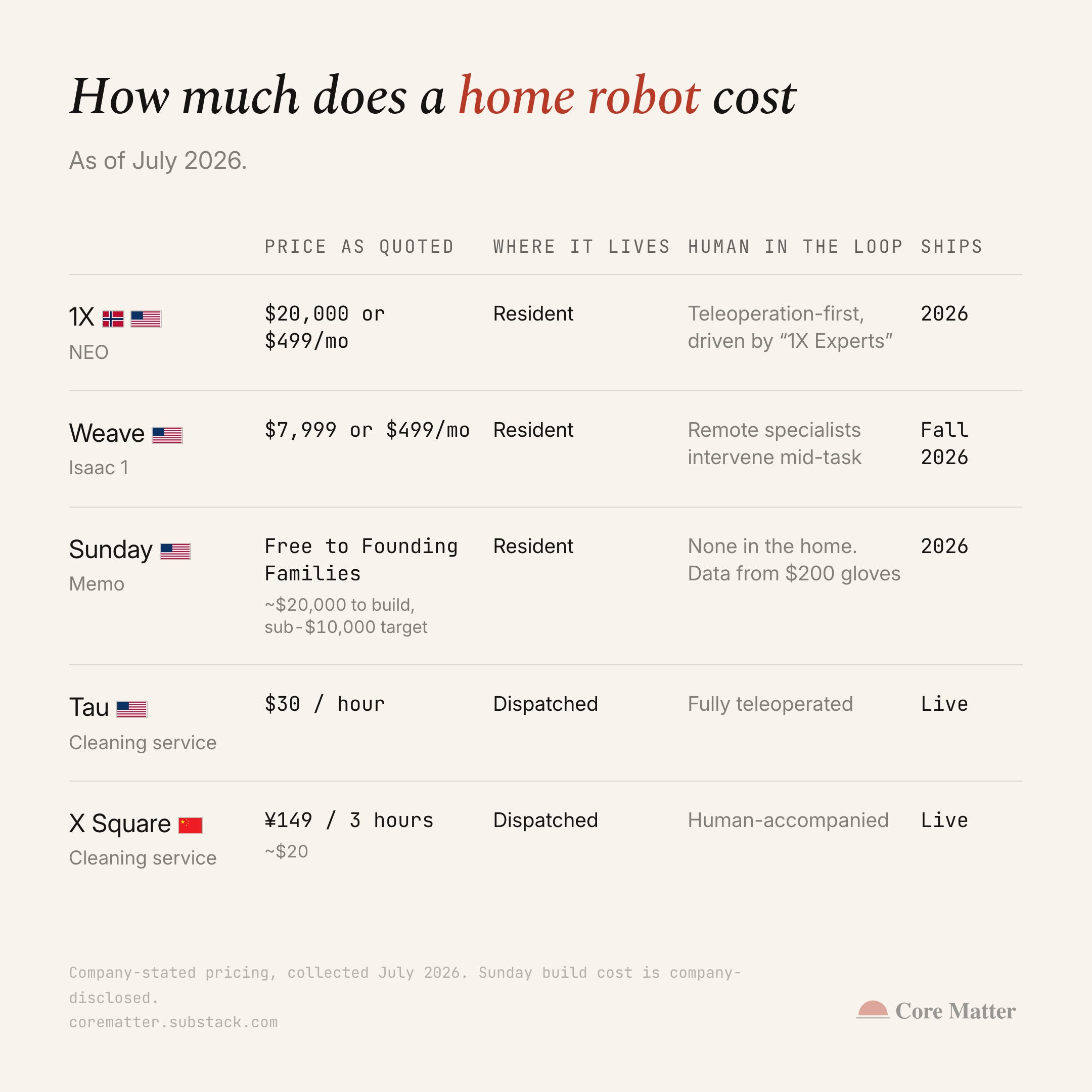
Most robotics builders and researchers we speak to put mass-produced home robotics years out. On the other hand, 1X says NEO ships in 2026, so does Sunday’s Memo. Weave says Isaac 1 ships in fall 2026. So, the next few months should put these machines into real homes, onto social media, and into mainstream news.
In this piece, we analyze the economic reality of these technologies, by working through these six questions:
What does the pricing actually signal?
How does each price compare to a human-equivalent hour?
How large is the subsidy, per unit and per trip?
What does an hour of real-home data cost, by channel?
What has to be true for these robots to deploy?
Who buys them, and how fast does the cost come down?
Pricing is the cost of admission to a home
In San Francisco, where I live, a three-bedroom cleaning is $200 to $250 per visit. Twice a month, that’s around $400 to $500 per month for a household line item.
That number may ring a bell. It’s what 1X’s NEO and Weave’s Isaac 1 both charge: $499 per month.
These two robots could not be more different underneath. Isaac 1 is a low-DoF gripper platform on a wheeled base with Physical Intelligence’s foundation model. NEO has 75 degrees of freedom, a tendon-driven bipedal body, a pair of top-of-the-line 25-DoF hands, built in house from body to brain. The bill of materials differs by a large multiple.
The price is not derived from cost, but from the household-services wallet share the company is trying to capture.
Where the robot lives
Nearly every home robot is teleoperated or tele-assisted. Where the robot lives determines the pricing strategy of the robot.
Resident: 1X’s NEO, Sunday’s Memo, Weave’s Isaac 1. Each robot belongs to one household. The customer purchases the robot. The company’s subsidy per household is capped by the price. Data cost per hour falls every month it stays.
Service: Tau, X Square. The robot arrives, works, leaves. Tau is teleoperated, X Square is human-accompanied. Every hour sold carries the same cost for the company, because the dominant input is a wage.
A resident deployment gets cheaper the longer it runs. A dispatched deployment does not get cheaper at all.
Rental. There is also the option to pay by month. Neither a NEO or an Isaac 1 subscriber ends up owning the robot. At $20,000 vs. $7999 for the same monthly rental rate of $499, 1X is either absorbing a much larger subsidy or expecting to need fewer human interventions.
Price vs. Cost per human-equivalent hour
In order to compare a $499/month with $30/hour with Rmb149/3 hours, we need to make some assumptions:
Utilization. Hours per month the robots actually work. At $499/month, 20 hours of use is $25 per hour. For reference, a home vacuum robot runs 45 minutes nightly logs about 22.5 hours per month, and it does one task with no hands.
Throughput. How fast the robot works versus a human. If a G1 takes an hour to do what a person does in 20 minutes, Tau’s $30/hour is a $90 human-equivalent hour, which is above the SF cleaner at $50 per person-hour ($200 across two cleaners for two hours).
Both dispatched products price below local labor. X Square at Rmb40.7 per hour, vs. Rmb80/hour for Shenzhen cleaner, Tau at $30 against $50 to $62.
The path to economic viability for dispatched service is by increasing the operator-to-robot ratio. Where staffing has been documented, the ratio is 1:1. AgiBot runs one operator per robot across 200 machines, a second operator is needed when a scene needs resetting. A Shandong data collection site staffs 33 collectors against 31 robots, a ratio of 1.06. Tesla pairs one robot with one motion-capture rig and one operator. All three are data-collection facilities rather than commercial services.
With an SF-based operator at $40/hour, at 1:2 the labor line falls to $20, which covers the $30/hour charge. Tau stated plans to move operators to cheaper countries.
How much is the subsidy
Sunday discloses that Memo costs $20,000 hand-built and targets 50% cost reduction at volume, implying sub-$10,000 price. The Founding Family program allows access to the units for free, so the subsidy starts at the full $20,000.
Memo is a wheeled, low-DoF gripper platform, similar to Weave’s Isaac 1. So its $7,999 is priced under cost at launch volumes.
NEO sits at the other end, with 75 degrees of freedom and two 25-DoF hands. Dexterous hands are the subsystem whose costs fall slowest with volume: a Sharpa hand sells at $50,000 each, $100,000 per pair (see our Dexterous Hand primer). A $20,000 price on that build is below cost on any reasonable reading. The question is how much.
Per trip, the dispatched version is about labor costs.
Tau charges $30 per hour. One operator per robot at $40 fully loaded, with idle time between jobs at roughly 1.5 operator-hours per billed hours, is $60. Add G1 depreciation of $11 per billed hour, on a $16,000 body over three years at 500 billed hours per year. Total is $71, less the $30 service fee, so about $40 subsidy by the company per billed hour.
X Square charges Rmb149 (about $22) per three-hour job. The accompanying worker minds the robot and handles the areas it cannot, so the wage sits somewhere between a robot technician and a cleaner. At ¥40 an hour loaded across 3.5 hours including transit, that is ¥140, which the ¥149 fee roughly covers. Platform depreciation is the rest: on a machine in the ¥150,000 range over three years at 500 billed hours a year, roughly ¥100 an hour, or ¥300 for the job. Net cost lands near ¥90 to ¥97 per billed hour, about $13.
So X Square is roughly at labor breakeven. If Tau moves its operators offshore, it’ll go to labor breakeven. But hardware amortization stays constant regardless of where the operator is. Accounting for that and maintenance, the hourly rate is still not breakeven in aggregate.
Sunday is the exception. It says that the robot collects no training data at all, and that Memo trains on recordings from its $200 gloves (more on that below). So, the Founding Family units and all sales buy no trajectories. They’re more a product-validation spend for distribution, proof of concept and failure discovery. That leaves Sunday with the most conventional economics in the group. Without the data trade to underwrite the discount, it has to reach a real gross margin on hardware eventually.
Cost per hour of real-home data, by channel
How much does the data cost for these home robots, and how does that compare with the data factories?
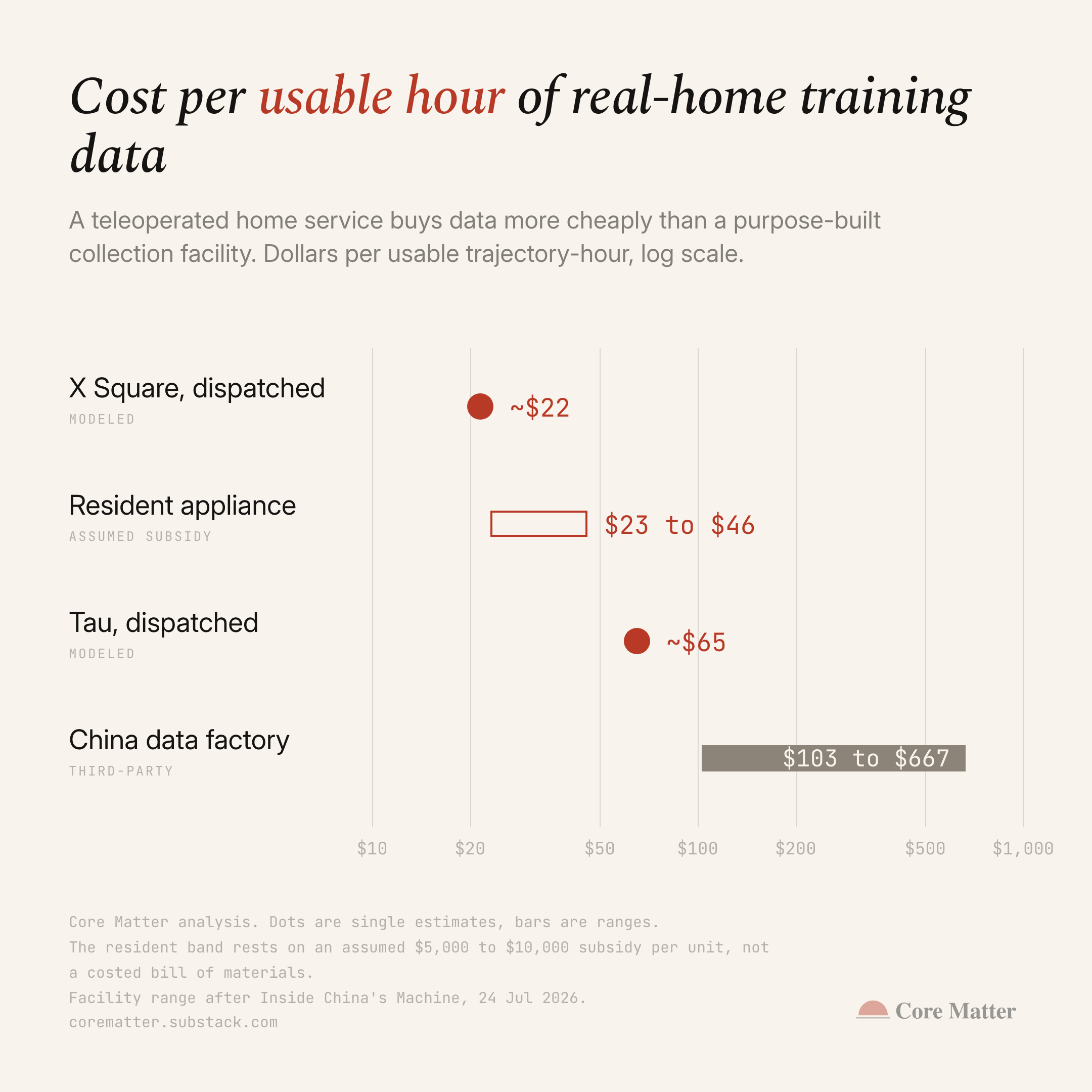
Resident. Assuming that the robot company is subsidizing each unit with $5000-$10000, a robot working an hour per day produces 365 hours per year. That puts raw data at $14-27 per hour. Not every minute yields a usable trajectory. At 60% yield, that becomes $23 to $46 per usable hour.
Dispatched. About $40 of net cost per billed hour for Tau, or $65 per usable hour with the same 60% yield. X Square is at $13 raw and $22 usable.
Facility benchmark. The comparison set is China’s purpose-built data factories, which exist to generate robot trajectories. Analysis published by Inside China’s Machine in July puts one usable trajectory-hour at ¥740 to ¥890 when a station runs at its best observed rate, and ¥3,990 to ¥4,800 at the utilization those facilities actually achieve across a year. The gap between the two figures is idle time: scenes being rebuilt, robots being repaired, stations sitting empty. At ¥7.2 to the dollar, that is $103 to $124 at best case and $554 to $667 in practice.
Counter-intuitively, the home channels are cheapest. X Square lands near $22 per usable hour, resident appliances at $23 to $46, Tau at $65, and a Chinese collection facility at $103 to $667.
A teleoperated home service generates data more cheaply per hour than a purpose-built collection facility, despite the facilities heavily subsidized. Every real home is a new scene, and each customer is paying something toward the operator wage. The facility pays its own operators, buys its own robots, and absorbs the utilization gap.
Sunday and 1X both are taking the robot out of the data loop. Sunday pays contractors, called Memory Developers, to wear a $200 sensor glove while they do their own chores at home. Sunday says it has 10 million of these recordings from more than 500 homes, and that Memo trains on those alone, with no teleoperation inside the customer home. Similarly, 1X released a glove kit with NEO’s tactile sensors and vision system.
What needs to be true for the home robots to work
Past the early adopters, these four conditions decide whether this crosses into the mainstream.
Safety. ISO 13482 for personal care robots, UL 3300, IEC 63310. A 35kg body moving near a toddler, elderly or pet either holds a certification or ships under a beta agreement and a liability waiver.
Privacy. Sunday claims that Memo “does not need to learn through human teleoperation in your home”. Weave discloses that the robot records visual content including people in frame, that its workforce may remotely access it, and puts the burden on the customer to configure the environment so it “only records visual content that you are comfortable sharing with Weave.” Tau retains indefinitely unless the customer asks for deletion. In this cohort, Sunday is the only company that does not ask the buyer to accept a camera with remote human access.
Maintenance and uptime. When it breaks, who performs the maintenance, at what cost. Mean time between failures, or a service-level commitment will move the unit economics significantly, beyond the price tag.
Functionality. How many tasks they can do reliably within the household.
