

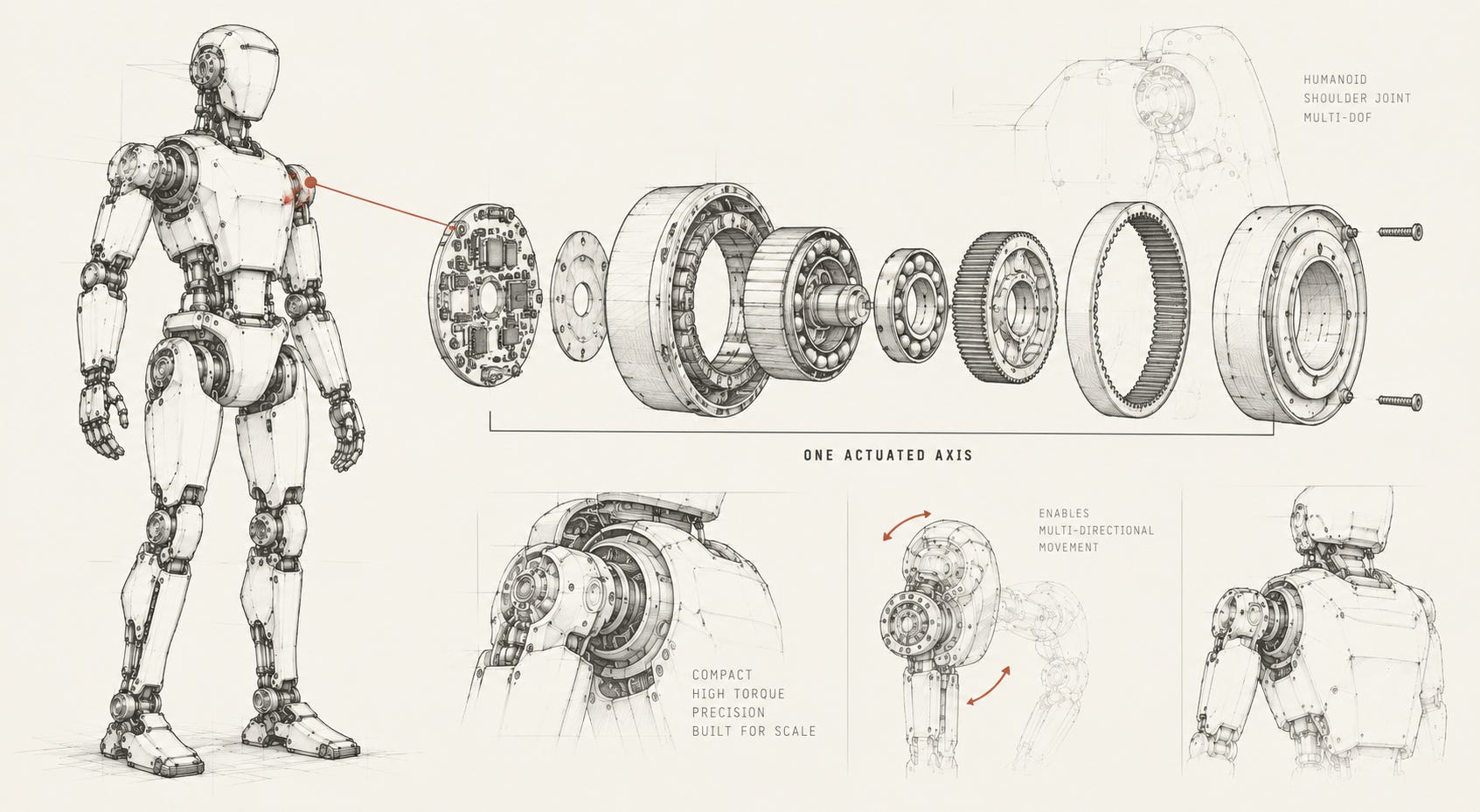
Welcome back to the 4-part series “the Business of Actuators”. This is part 2. If you’re new here, this series aims to cover the business of actuators. We go deep enough technically in order to understand the underlying factors driving the economics of actuators, and hence physical AI. Part 1 covered what is inside a humanoid joint: mechanical parts, the main designs, joint anatomy and the low-ratio vs. high-ratio design trade. Start there if you missed it.

This piece looks at how much an actuator costs. We work from an audited filing, current vendor listings and an independent teardown. One buyer’s audited price for a single driven axis is $202, and an independent teardown estimates a comparable joint near $167. [1]
And thank you for the feedback on the first post. If you are building actuators, robotics components or industrial automation systems, I would love to hear from you.
Sections
How Much of a Humanoid’s BOM Is Actuation?
The Right Unit of Comparison: Cost Per Actuated Axis
What Does One Actuated Axis Cost?
Why Retail Pricing Overstates What a Manufacturer Pays
What the $202 Benchmark Actually Tells Us
Data Provenance and Methodology
1. How Much of a Humanoid’s BOM Is Actuation?
One benefit of the current wave of Chinese robotics IPO filings is that we are finally getting more granular supply-chain data.
LeJu Robot, the company behind the Kuavo humanoid, filed for an IPO on the Shenzhen Stock Exchange’s ChiNext board under its fourth listing standard for high-growth technology companies.
Its prospectus reports direct-material cost of $19,587 per Kuavo unit, representing 78.9% of total build cost. [1] Most percentages below use that $19,587 direct-material denominator; a few use total unit cost or another filer’s own hardware-cost base, each labeled where it appears.
Start with the joint modules. Kuavo carries between 26 and 38 modules. LeJu’s audited procurement table gives a blended module price of RMB1,115, or approximately $156. That puts joint modules alone at 20.7% to 30.3% of direct-material cost. [1]
Now add the driver electronics. LeJu buys the driver boards on a separate line. Driver-board spend is 29.5% of joint-module spend in the same audited table, which puts $46 of drive electronics on a $156 module. The combined module and driver basket therefore reaches 26.8% to 39.2% of direct-material cost. [1]
Then add the dexterous hands. LeJu’s procurement data prices the pair at $3,370. Including the hands brings the full electromechanical drivetrain to 44.0% to 56.4% of direct-material cost. [1]
For a full electromechanical drivetrain including hands, the share is 44.0% to 56.4% of direct-material cost and 34.7% to 44.5% of total unit cost. [1]
Quick glossary:
Direct materials are the parts and inputs that go into the robot.
Total unit cost is direct materials plus assembly labor, manufacturing overhead and other costs allocated to the finished unit. For reference, 78.9% of Kuavo’s total unit cost of $24,825 is direct materials.
Electromechanical drivetrain is the full motion path: joint modules, electronics and hands
Joint module is just the mechanical assembly, motor and reducer.
This is why published actuator shares are all over the place. These calculations are using different inputs: the numerator, the denominator, and the robot. [1]
Numerator: the actuator can mean at least three things: (a) the mechanical joint module, (b) the joint module plus driver electronics, (c) the full electromechanical drivetrain including the dexterous hands.
Denominator: which dollar figure you divide by. Direct materials, total unit cost, hardware cost and ex-factory price are four different bases. The same $156 module is 0.8% of Kuavo’s $19,587 direct-material cost and 0.63% of its $24,825 total unit cost, before the numerator basket even changes.
Robot: which machine produced the numbers. A full-size biped, a wheeled AMR and a quadruped carry different actuated-axis counts and different architectures, so the share moves with the machine even when the basket and the denominator are held fixed. Youibot’s 50.2% below states its numerator and denominator clearly, and it is still the wrong robot for a humanoid benchmark.
Our own earlier estimates of 40% to 50%, and separately 50% to 65%, labeled these boundaries too loosely. I am retiring them in favor of the basket approach above.
Drivetrain BOM share has trended up over time. Youibot, which makes wheeled and inspection robots and filed for an HKEX listing under Chapter 18C, reports drivetrain rising from 33.7% to 43.8% and then 50.2% of its hardware cost over three years. [2]
Youibot (a Chinese industrial robot company)’s fleet is still mostly AMRs and inspection robots. It launched two humanoids in 2025, a wheeled model in March and a bipedal model in August. Humanoid revenue stays inside total company revenue in the filing and reads as immaterial. As a reference, Youibot shows that the drivetrain can become a larger share of the hardware basket as robot capability increases.
For a full-size biped the share is higher. An independent teardown of the Unitree G1, which shipped more than 5,500 units in 2025, puts its joints alone at about 66% of that robot’s bill of materials. [8] That covers joints only, on a different robot than the Kuavo ladder above.
2. A Consistent Unit of Comparison: Cost Per Actuated Axis
Before comparing prices, we need a consistent unit. Robotics terminology makes this more confusing than it should be.
A joint module is the physical mechanical assembly around a joint: typically the motor, reducer, encoder, bearings and housing. The driver is the power and control electronics.
An actuated axis is one independently driven direction of motion: one commandable output with its associated motor and transmission chain.
A physical joint can contain more than one axis. A wrist that both bends and rotates may contain two independently controlled axes in a single joint assembly.
Actuator is the physical hardware component.
Degrees of freedom, or DoF, describe the robot’s kinematic freedom rather than how many motors it contains. It refers to the total number of independent, movable joints that a robot can shift position or rotate.
Actuator count, actuated-axis count and DoF are often close to one another. But they are not universally 1:1.
Below are three examples:
Tendon-driven dexterous hand. To actively control 1 single rotational axis in both directions, 2 actuators are needed to pull in opposite directions, like a pulley. This is similar to bicep and tricep muscles for humans. (actuators = 2, actuated axis = 1, DOF = 1)
Swinging pendulum. A swinging pendulum has unactuated (passive) degrees of freedom (DOF), but zero actuated axes. (actuated axes = actuator count = 0, DOF = 1).
Soft robotics hands. Made of silicone, the material can bend in every millimeter of its structure. So, its DOF is theoretically infinite, while driven by a single cable motor (actuated axes = actuator count = 1, DOF = ∞).
For consistency, we use cost per actuated axis as the comparison unit in this piece. It gets us closer to the cost of adding one independently controlled direction of motion to a robot.
3. What Does One Actuated Axis Cost?
LeJu’s filings shed light on actuators volume pricing in China today.
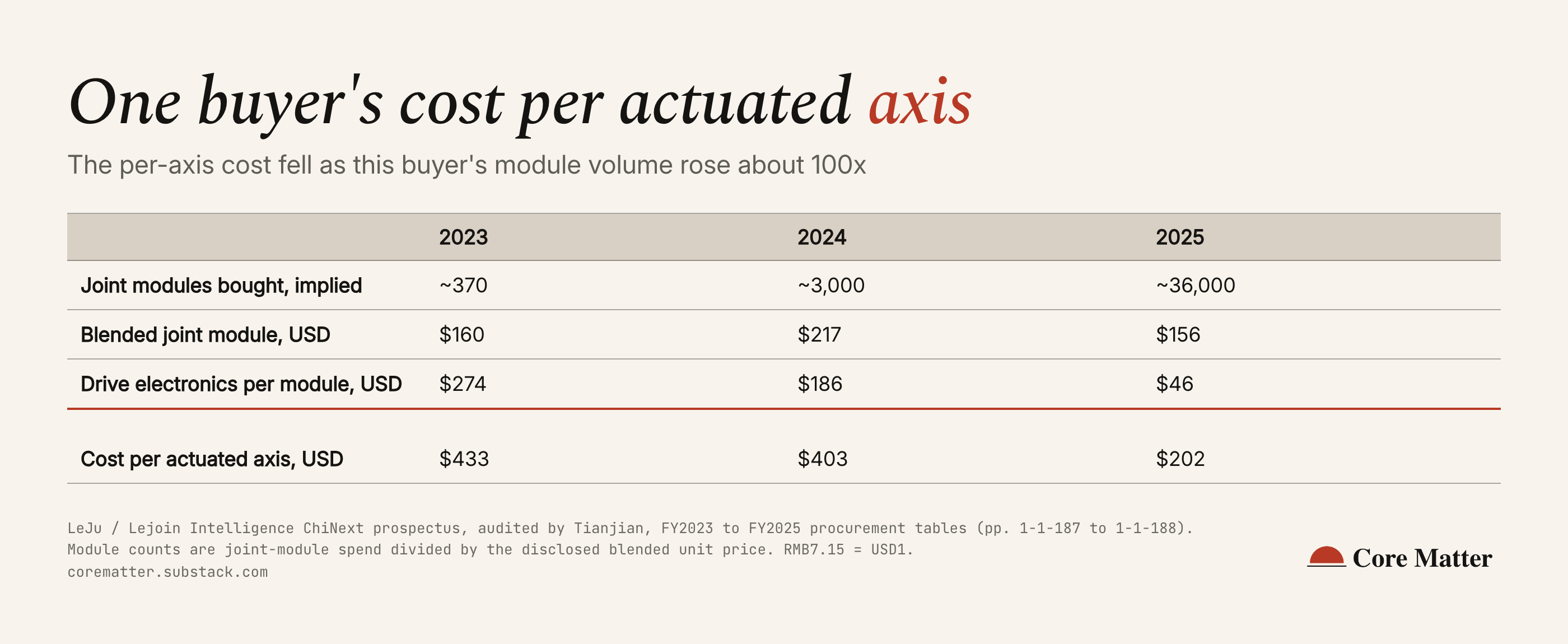
Its audited prospectus reports Rmb40.3mn ($5.63mn), spent on joint modules in 2025 at a blended unit price of Rmb1,115, or about $156 per module. [1]
Dividing total module expenditure by that disclosed unit price implies roughly 36,000 modules purchased. LeJu buys driver boards on a separate line. Driver-board spend is 29.5% of joint-module spend, which puts $46 of drive electronics on each module. [1]
That brings the combined mechanical module plus driver electronics to:
$156 + $46 = $202 per actuated axis.
This is a useful high-volume benchmark. Zooming in to the data and recent statements, we found three insights about the pricing:
1) Price halved as LeJu’s purchasing scaled 100X. Over the two years LeJu’s annual module purchases went from roughly 370 to roughly 36,000, and its per-axis cost fell from $433 to $202, with nearly all of the decline on the driver-electronics line. [1]
2) $202 is a related-party price. LeJu owns 5.73% of the supplier making these modules, its finance chief sits on that supplier’s board, and roughly 83% of its comparable-product procurement comes from that related party, Wuxi Quanzhibo. [1] The filing says pricing uses a cost-plus arrangement and sits slightly below comparable products. [1]
3) Industry-grade joint modules on average cost $210 in 2025, to fall 10% in 2026 and mass-market pricing at $140. Quanzhibo, LeJu’s supplier, shared some details on pricing in July. Its CMO shared the 2025 industrial-grade joint-module average near Rmb1,500 ($210), expects module costs to fall roughly 10% in 2026, and the whole-robot mass-market pricing at Rmb1,000 ($140). [9] LeJu’s Rmb,115 blended price sits below that 2025 industrial average, which is consistent with the filing’s “slightly below comparable products”.
The filing gives no torque, mass, gear ratio or gear family for the $156 module, so it represents an average across joint sizes. One independent build-cost estimate exists for a joint of the same type. China Post Securities’ March 2026 teardown of the Unitree G1 built its joints up from components: Rmb1,000 ($140) for a small joint and Rmb1,500 ($210) for a large one, about $167 blended, driver board included. [8]
A merchant module price of $202 and an in-house build-cost estimate of $167 are referring to the same joint module (motor + reducer + driver + encoder).
4. Why Retail Pricing Overstates What a Manufacturer Pays
Now compare that $170-200 volume figure with what a robotics startup pays one unit today.
Current online-retailer listings, quoted in US dollars, from September 2026 include:
DAMIAO DM-J8009-2EC: 9:1 low-ratio planetary architecture, 20 N·m rated / 40 N·m peak torque, 896 g, dual encoders, onboard driver — $385. [6]
MyActuator RMD-X8-25: $450 without the USB-to-UART accessory and $480 with it. The selected version is listed “Without Driver,” so it is not directly comparable with DAMIAO without separately pricing the motor driver. [7][11]
ZeroErr eRob 80T: 50:1 to 120:1 strain-wave architecture, 21 to 31 N·m rated and 44 to 143 N·m peak, 1.94 kg — starting at $1,440. The listing does not clearly specify driver status.
Pendulum Robotics’ public comparison table lists 130+ named rotary actuators with price, torque, dimensions, ratio, gearbox type and encoder configuration. The table includes a $325 DaMiao DM-JH11, a 52 mm, 51:1 harmonic actuator, and a $257 DaMiao DM-J6248P-2EC, a 76 mm, 48:1 harmonic actuator. These are public single-unit retail listings for finished actuators. The $202 benchmark above is an OEM volume-procurement cost. [7]
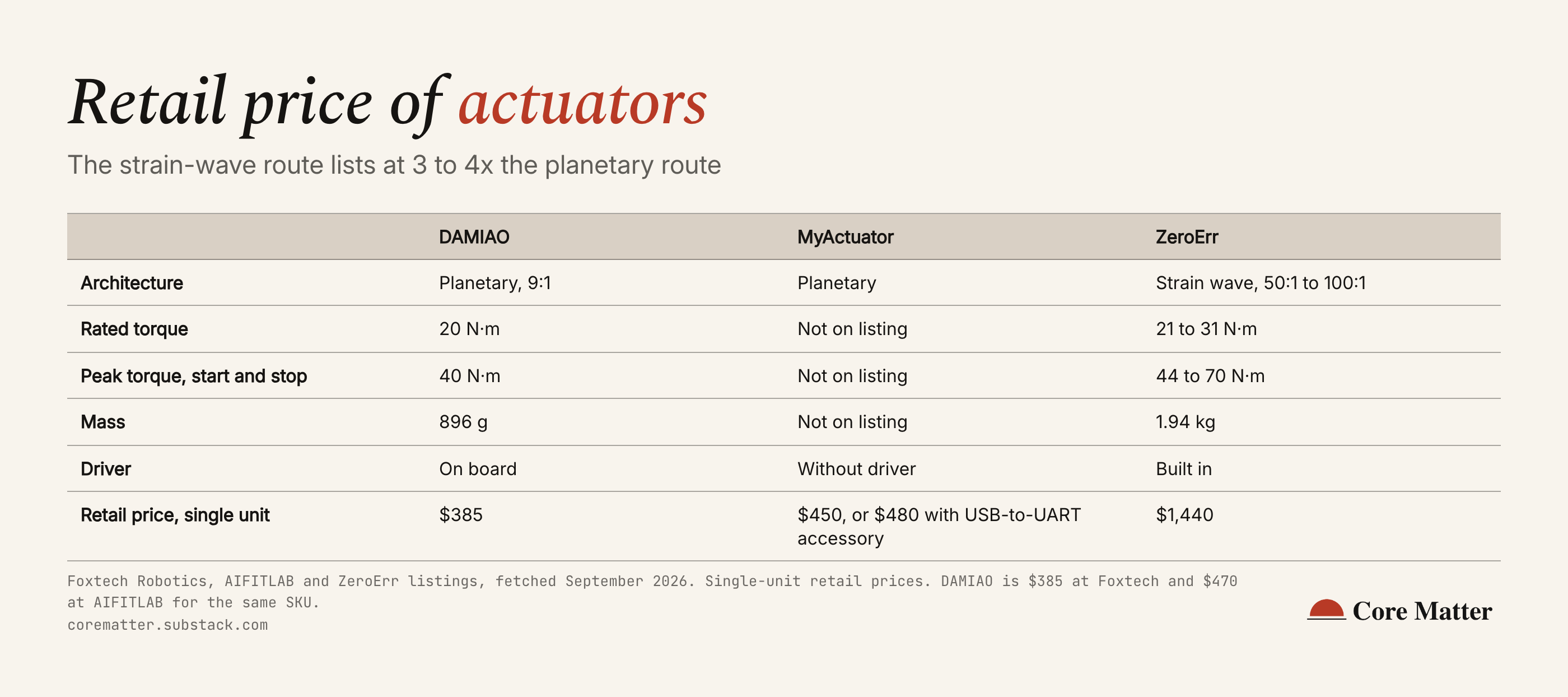
These are not apples-to-apples products. Each quoted price bundles architecture, size, electronics integration and purchase volume
The ZeroErr strain-wave module sells at 3.6X the price of the DAMIAO planetary module, and delivers less peak torque per kilogram at every ratio, 0.8 times DAMIAO’s. We covered the performance trade-offs behind those architectures in Part 1.
LeJu’s $202 combined module-and-driver cost is about 52% of DAMIAO’s $385 retail price for a broadly comparable low-ratio module. [1][6]
Single-unit retail pricing is a poor proxy for what a manufacturer pays at volume. LeJu bought roughly 36,000 modules in 2025 across about 1,000 robots. Unitree, which shipped more than 5,500 humanoids that year, designs and integrates its joint modules in house. [8] Part of the gap between $202 and a $385 retail listing is purchasing scale, and part is the related-party pricing already described.
5. What the $202 Benchmark Actually Tells Us
We draw two conclusions from the numbers.
