

Welcome back to the Business of Actuators series. In Part 1 I covered what is inside a joint: the eight parts, the three gearbox architectures, and how gear ratio moves cost between the gearbox and the motor. In Part 2 I covered what one costs.
Are actuators the bottleneck of humanoids or robotics? Which part exactly limits supply? Who are the main suppliers for each component that goes into the actuator? In today’s Part 3, we cover the global supplier map of actuators, for each component and where the facilities sit. We also look at where actuator supply could become constrained.
I spent the last month reading through dozens of corporate filings from the Chinese robotics supply clusters, and they sharpened the question for me. Scaling actuator supply means securing qualified parts for a particular robot design, at the required volume.
The supplier map shows where to investigate: precision manufacturing, motor performance, and materials and bought-in components. Those exposures move differently. Reading Laifual’s filings made me separate two questions: what a reducer costs, and how much qualified output a supplier can deliver. Today, we map the global supplier reality layer by layer.
Subscribe to get the next ones in your inbox. If you work in this space, please reach out. I would love to compare notes.
This piece covers six sections.
Bill of Materials: The Processes and Players Behind the Joint
The Global Actuator Footprint: East vs. West
The Friction Points: Feedstock vs. Process Control
Falling prices can coexist with tight capacity
Magnets: The Downstream Chemical Chokepoint
What could limit actuator supply at scale?
1. Bill of Materials: The Processes and Players Behind the Joint
We walked through each component from an engineering perspective, covering the metrics and what they do in Post 1, section 1. To dig into the supply chain dependencies, I find it helpful to look at these components from a manufacturing lens: the material, manufacturing process, and supplier set.
Quick refresher: the actuator is the muscle of the robot. It moves the joint. A shoulder actuator needs to be strong, since it is lifting a heavy arm and whatever the hand is carrying. A finger actuator’s speed requirement depends on the task.
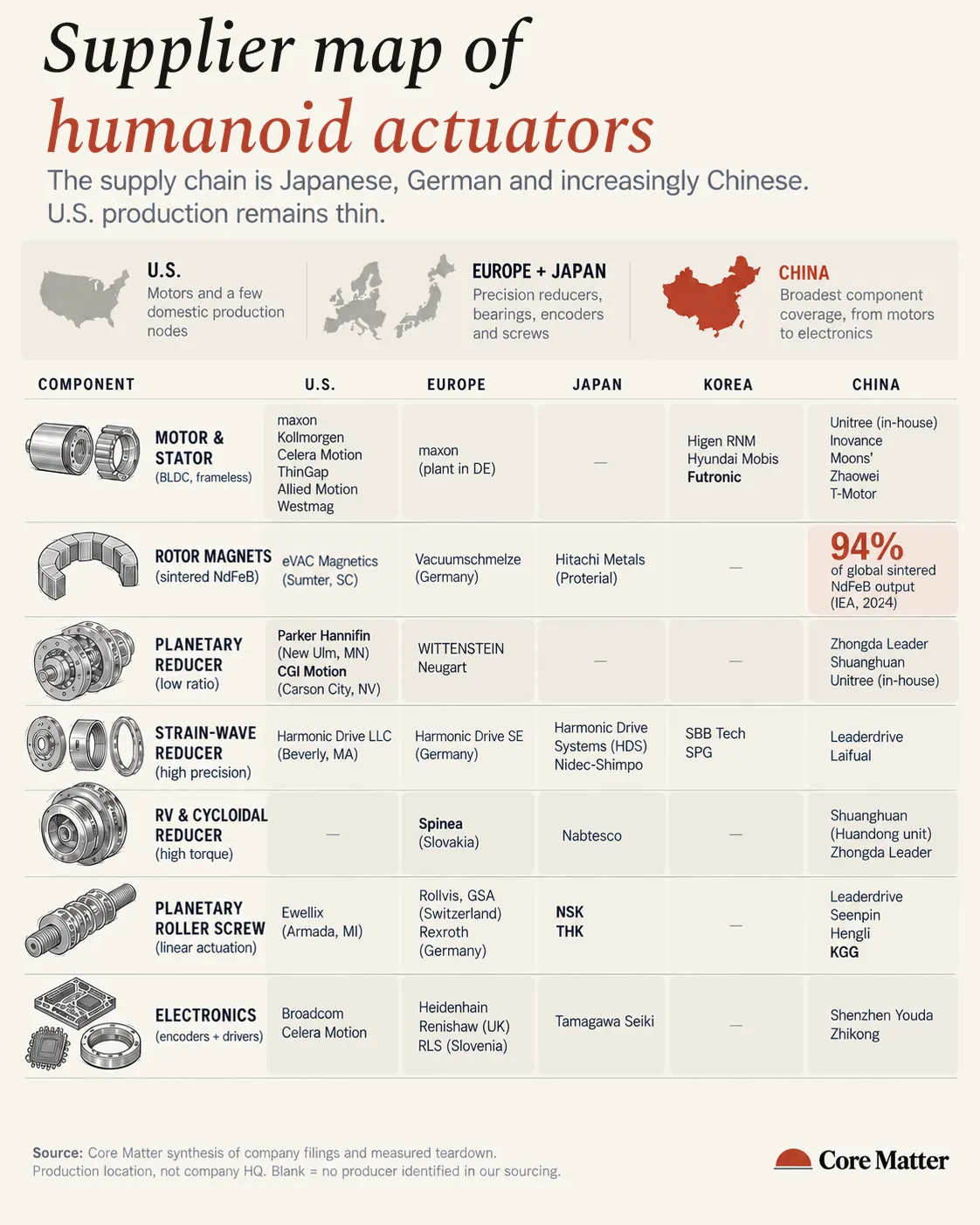
Stator and motor. One option is a frameless brushless motor. In a slotted design, the stator is a stack of steel laminations with copper windings. The rotor carries permanent magnets. Frameless versions ship as rings that the robot maker fits into its own housing. Unitree’s filing states its motors are self-developed, and that it outsources some production steps, winding among them. Merchant suppliers include maxon, Kollmorgen (a Regal Rexnord brand), Novanta, MOONS’ and ThinGap.
Rotor magnets. One option is sintered neodymium-iron-boron (NdFeB), made by powder metallurgy: mill the alloy, press it in a magnetic field, sinter it, machine it, coat it, magnetize it. These are the magnets whose field interacts with the energized stator windings to produce torque: they are what makes the actuator spin. Processing is concentrated in China, which accounted for 94% of global sintered NdFeB magnet production in 2024, according to an IEA report published in April 2026. [1] Suppliers include JL MAG, Ningbo Yunsheng, Earth-Panda, Vacuumschmelze, Proterial, Shin-Etsu Chemical and TDK.
Reducer, low-ratio planetary. This is a quasi-direct-drive route, covered in Post 2. Precision planetary gearboxes can use ground gear teeth. Planetary-reducer suppliers include Zhongda Leader and Newstart.
Reducer, strain-wave. This is a precision route for robot joints. A strain-wave reducer uses a thin steel flexspline that deforms during operation. Suppliers include Harmonic Drive Systems, Nidec-Shimpo, Leaderdrive, Laifual and Schaeffler. Harmonic Drive LLC also has a Massachusetts production facility. This layer is expanded in sections 3 and 4.
Reducer, RV and cycloidal. This is the heavy-load precision route. The named suppliers are Nabtesco of Japan, Shuanghuan via its Huandong unit, and Zhongda Leader.
Planetary roller screw. This is one linear actuation route: a rotary motor turns a roller screw to create straight-line motion for high-force joints. It has a threaded screw, a set of grooved planetary rollers, and a nut. It is difficult to make at the high end because several rollers must share the load at once. Small errors in thread shape, pitch or alignment create uneven contact. See more in Section 3. Suppliers include Rollvis and GSA of Switzerland (one group since 2016), Ewellix (a Schaeffler company, with roller-screw production at Armada, Michigan), and Bosch Rexroth. Chinese entrants include Leaderdrive, Seenpin, and Hengli, which reported sampling and initial mass production in 2025.
Encoder. Encoder options include magnetic rings and optical discs read by sensors. Suppliers include Renishaw, Heidenhain and Broadcom.
Output bearing. Cross-roller bearings are one option for supporting joint loads. Suppliers include IKO, THK and Schaeffler. Laifual reports making crossed-roller bearings for its own products; Leaderdrive’s SKF joint venture is focused on R&D and industrialization of high-precision robot-joint bearings.
Driver board. The board carries power-switching and control electronics on a PCB. Servo-drive suppliers include Leadshine, Elmo and Kollmorgen; CubeMars lists a standalone driver board.
Housing and brake. The housing and brake depend on the joint design. Spring-applied brakes are one option, such as Mayr’s ROBA servostop.
2. The Global Actuator Footprint: East vs. West
The supplier examples span Japan, Europe, China, South Korea and the US. US production includes Harmonic Drive LLC’s Beverly, Massachusetts facility for precision reducers, Ewellix’s Armada, Michigan roller-screw plant, ThinGap’s Camarillo, California motor production, and eVAC’s Sumter, South Carolina magnet plant. VAC said in July 2026 that eVAC began commercial magnet production in 2025. Sanhua said in its 2025 annual report that it is expanding overseas production of its actuators, and updated in Aug 2026 that it’s processing through batch delivery and production-line ramp.
These are representative suppliers of actuator components. Exhibit 1 below records disclosed manufacturing locations where they could be matched to the product; other entries are marked manufacturing location unverified.
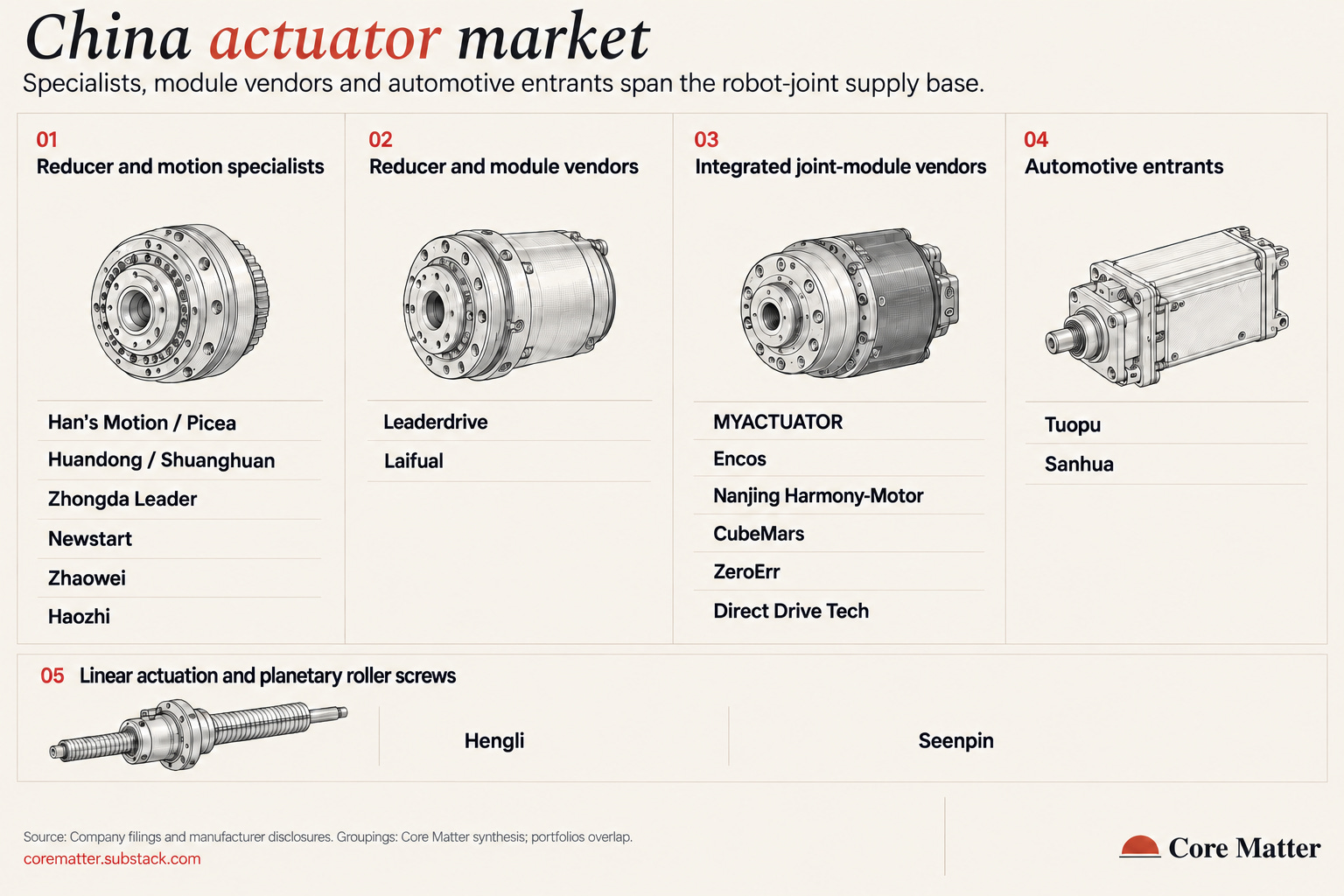
China’s actuator market is split between precision transmission specialists, integrated module suppliers, and automotive Tier 1 manufacturers pivoting into robotics.
3. The Friction Points: Feedstock vs. Process
Now this is the exciting part. Now that we know at a high level how each component is made and who makes it, it’s time to zoom into the requirements and potential exposures for each component. Broadly speaking, there are two places to investigate. (1) Feedstock and bought-in parts: the raw material, plus the merchant components that arrive finished, like sintered magnets and encoder chips. (2) Process and machining: what turns the raw material into the part, and the machines that do it.
Strain wave reducer. The process requirement is manufacturing control and accumulated know-how around the flexspline. The manufacturing challenge is making a thin flexspline that repeatedly deforms while maintaining gear accuracy and the required fatigue resistance. Material selection, heat treatment and machining must be controlled together.
Planetary reducer. The process requirement is manufacturing precision gears. Grinding the gear teeth is one process used in precision planetary gearboxes. Newstart, a Zibo, China-based maker that filed for a ChiNext IPO, reported ASPs for its mainstream 50-240 mm planetary reducers of RMB 780 in 2023 and RMB 791 in 2025. Its whole-company gross margin fell from 55.49% to 48.05% over the same period. [4]
Quasi-direct drive. The performance requirement sits in the motor itself. With less gear reduction, the motor must supply more torque for the same joint requirement. Take Direct Drive Tech as an example. This company sells direct-drive actuator modules for consumer, industrial and commercial applications. Its draft PHIP shows that, from 2023 to 2025, enameled copper wire rose from 6% to 27% of group material costs while the magnet share fell from 23% to 18%. These are group material-cost shares across its product mix. [5]
Planetary roller screw. The potential process exposure is the machining step. Leaderdrive’s H1 2026 report describes Chinese industry dependence on imported high-precision thread grinders, with high equipment prices and long delivery times. [6] Seenpin’s June 2026 application similarly describes reliance on imported high-end precision grinders. [7]
Rotor magnets. The potential exposure sits upstream in rare-earth separation and downstream in NdFeB sintering capacity, with China at 94% of global sintered NdFeB production in 2024, according to an IEA report published in April 2026. [1]
Encoders and driver boards. The potential exposure is bought-in availability: merchant chips and read-heads for the encoders, and the power semiconductor chain for the driver boards.
4. Falling prices can coexist with tight capacity
Laifual’s disclosures put price and capacity on the same page. They also show why a lower average selling price does not answer whether a supplier can meet the qualified weekly output for a particular design.
From 2023 to 2025, Laifual’s blended harmonic-reducer ASP fell 28%, from RMB 795 to RMB 571. Its small-size category fell 37%, from RMB 634 to RMB 397. These are category averages, not same-SKU price changes. Laifual attributed the 2023–2024 decrease to a higher share of small-size products and strategic price adjustments, and the 2024–2025 decrease primarily to the higher small-size share. Over the full 2023–2025 period, its harmonic-reducer sales rose from 115,315 to 291,515 units. [8]
H1 2026 tells a separate capacity story. Laifual reported designed harmonic-reducer capacity of 270,000 units and actual production of 256,900 units, a 95.1% utilization rate. The company also said that, against a backdrop of earlier relatively constrained production capacity, it had prioritized industry-leading customers. By July 2026, designed capacity had reached 64,800 units per month, so the H1 utilization figure should not be read as a September measure of spare capacity. [9]
A September 2 seller offer adds a point-in-time procurement reference, not proof of a fulfilled ramp. Laifual offered size 17, 20 and 25 component sets, each at a 100:1 ratio and a quantity of 100, for US$145, US$160 and US$173 per set EXW, respectively, with a stated lead time of three to four weeks. [10]
The buyer question is concrete: for the specified part and qualification standard, how many units can the supplier deliver each week while maintaining quality?
5. Magnets: The Downstream Chokepoint
Magnets represent a highly concentrated layer of the actuator supply chain. Recall that permanent-magnet motors carry magnets on or within the rotor. Electric current flows through the copper windings in the stator, creating an electromagnetic field. The rotor magnets follow that field to spin the motor. Torque per unit of mass is a critical metric for a humanoid robot that must carry its own weight.
These are made from a sintered alloy of neodymium, iron, and boron (NdFeB), commonly called “neo magnets”.
It turns out that “rare earths” are actually not that rare. Economically viable concentrations are uncommon, and their chemical similarities make them hard to separate. [11]
To map the potential exposure for robotics, I group the value chain into 3 phases using International Energy Agency (IEA) data. All three are concentrated in China:
1. Mining (Upstream). Hard-rock ore is extracted, crushed and concentrated. China supplied 60% of the four magnet rare earths (neodymium, praseodymium, dysprosium and terbium) in 2024. Other producers include Myanmar, Australia and the US. [1]
The potential exposure here is access to economically viable deposits. Extraction routes differ: hard-rock ores require crushing, while ion-adsorption clay deposits, including those in Myanmar and southern China, can be leached.
2. Separation and refining (Midstream). This is a highly capital-intensive and chemically complex stage, and China accounted for 91% of refined output of the four magnet rare earths in 2024. A common process is Liquid-Liquid Solvent Extraction, routing dissolved rare earths through repeated extraction, scrubbing and stripping stages. [1]
The potential exposure here is environmental policy and process know-how. Waste treatment depends on the ore and processing route. Where the ore contains thorium or uranium, processing can concentrate radioactive material in residues.
(3) Sintered permanent-magnet production (Downstream). Metals are alloyed, milled into powder several microns in size, pressed in a magnetic field and sintered. [12] China accounted for 94% of global sintered permanent-magnet production in 2024. [1]
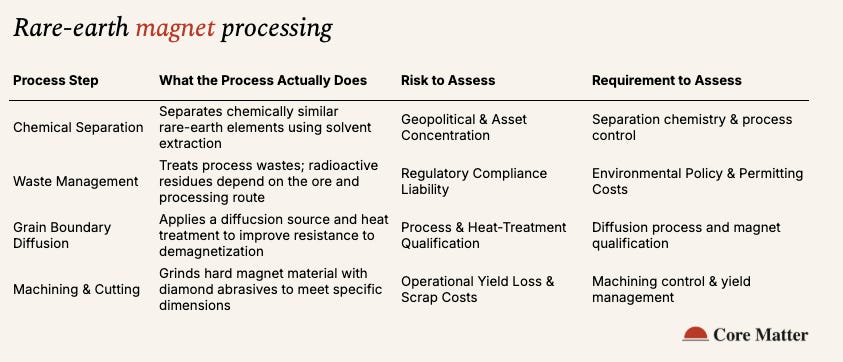
Two processing challenges in this stage are machining yield and grain boundary diffusion.
Machining and Yield Loss: Shin-Etsu describes grinding sintered magnets with diamond abrasives to reach the required dimensions. Removing material during machining creates a yield-management problem. [13]
Grain Boundary Diffusion (GBD): A heavy-rare-earth diffusion source is brought into contact with the magnet, followed by diffusion annealing. This can improve coercivity, the magnet’s resistance to demagnetization. [14]
Getting magnet supply set up is so much more than finding and opening a mine. The potential constraints include navigating midstream separation chemistry, waste management costs, and downstream precision processing.
§6: What could limit actuator supply at scale?
Congratulations on making it to the end of this post! This piece has got longer than I originally anticipated. But this also shows how deep and complex supply chains are. As a final reward of finishing the post, let’s apply what we’ve learned on the supply chain to tackle the million dollar question: if annual humanoid production rises from an illustrative 20,000 robots to one million, what breaks first?
