

Core Matter covers the physical AI stack, and that stack is not complete without the compute layer. Today, let’s dive into the world of edge compute through a physical AI lens. This is my first piece related to chips. As always, I welcome and greatly appreciate any feedback and comments.
This morning NVIDIA announced Jetson Orin Nano 2, the entry tier of its robotics compute line. Put simply, Jetson Orin Nano 2 is a distribution strategy: NVIDIA’s move to lock in the physical AI value chain from the beginning of a product’s lifecycle. We will discuss in detail later in this piece.
Before that, we will first go over an overview of NVIDIA’s three-computer architecture in physical AI, and how the company is positioning for the next wave of growth in robotics and distributed computing. While NVIDIA frames its physical AI stack as three computers, two further layers come into play when building a working robot. Below training sit the data operations layer, and actuation and motion control. NVIDIA partners on both instead of building them, and we explore why. The entry tier is also becoming a crowded place, so we close on competing offerings from Qualcomm, AMD and others.
Sections
What is NVIDIA’s three-computer architecture?
What is a Jetson, and what do the numbers on the spec sheet mean?
What did NVIDIA announce on August 25, 2026, and what gap does it fill?
How does Jetson Orin Nano 2 compare with Thor and the rest of the line?
Which layers of the physical AI stack does NVIDIA not sell into?
Why doesn’t NVIDIA make robot actuators?
Who competes with NVIDIA at the edge?
What this means for an investor
Claim ledger
What is NVIDIA’s three-computer architecture?
Deepu Talla, NVIDIA’s Vice President of Robotics and Edge AI, framed it this way on the launch briefing:
“Physical AI ultimately is the largest opportunity in front of us. And we’ve been working on this problem for over a decade. And we are starting to see now real uptake because of improvements in model accuracy and intelligence.” [1]
AI is moving into the physical world: factories, warehouses, farms and city infrastructure, and each of those settings needs models that run on the machine, not in a data center. NVIDIA reports more than 3 million developers building on its robotics stack and more than 10,000 companies on Jetson, either shipping a product or developing one. [2]
NVIDIA divides physical AI development into three steps, and assigns a computer to each. Train, simulate, deploy. A builder trains a policy for the robot to perform a task, tests that policy in simulation, then deploys it onto the machine.
Why does a robot need more than one computer? A robot itself is not one computer. Policy inference, perception, sensor fusion, limb-local control and safety monitoring are different workloads with different latency budgets.
A beginner’s guide to NVIDIA’s physical AI stack
Here is what NVIDIA sells at each step.
Train: DGX. Integrated GPU systems that live in a data center or are rented from a cloud provider. Training a robot policy on large volumes of video and telemetry carries the heaviest compute demand of the three steps.
Simulate: OVX and RTX Pro. Graphics-heavy systems built for physics simulation and rendering at scale. This allows a policy to be tested across thousands of virtual attempts before touching hardware. This is super important as robot hardware is costly to replace and breaks easily.
Deploy: Jetson Thor and Jetson Orin Nano 2. The modules that go onto the robot itself. These have to be small, fast and power-efficient, because a watt spent on compute is a watt not spent on runtime.
Around the hardware, NVIDIA gives away a large body of software. Two model families run across all three computers:
Cosmos. Open-weight generative world foundation models. This also includes tokenizers that compress video into the units a model predicts over, and a pipeline that turns raw video into training-ready synthetic data. It sits alongside Omniverse on the simulation computer.
GR00T. A robotics foundation-model family and data pipeline. It is trained on DGX, validated through NVIDIA’s simulation suite, and executed on Jetson.
For simulation:
Omniverse. A development platform for 3D simulation and digital twins, built on OpenUSD as its scene format. Omniverse Kit is the SDK.
Isaac Sim. A robotics simulation application built on Omniverse Kit, adding robot models, sensor models and ROS 2 support.
Isaac Lab. A robot-learning framework on top of Isaac Sim, for reinforcement and imitation learning at scale. It replaced Isaac Gym and ORBIT.
For deployment:
Isaac ROS. In NVIDIA’s words, “a collection of NVIDIA CUDA-accelerated computing packages and AI models” for building robotics applications. [3] GPU-accelerated ROS 2 packages, in plain terms.
cuVSLAM. A CUDA-accelerated stereo visual-inertial SLAM library, renamed from ELBRUS, that estimates a robot’s position from stereo cameras and an optional IMU. [4]
What is a Jetson, and what do the numbers on the spec sheet mean?
Jetson is NVIDIA’s product line for the deploy step, the modules that go onto the robot’s body. It is the embedded line of NVIDIA’s physical AI chip offering, built for machines that move: robots, drones, cameras and industrial equipment.
This is confusing, but Jetson Nano and Jetson Orin Nano are different products. Jetson Nano launched in 2019 on the Maxwell architecture and was the entry board. Jetson Orin Nano launched in 2023 on Ampere. The line goes Jetson Nano, TX2 for drones and small robots, Xavier for autonomous machines, then Orin and Thor. [5] And Orin is a family, with Orin Nano at the entry, Orin NX in the middle and AGX Orin above it.
A cheatsheet for compute terminology
TOPS or TFLOPS, with the precision attached. Trillions of operations per second. Precision is the number of bits used to store each number the model works with: FP32 uses 32 bits, INT8 uses 8, INT4 uses 4. Fewer bits means a smaller memory footprint and faster arithmetic, the trade-off is accuracy. The same chip produces roughly double the TOPS at INT4 that it produces at INT8.
Dense or sparse. A sparse figure assumes the model has been pruned so the hardware can skip zeros. Vendors tend to quote whichever number is larger. It’s important to check which density they’re referring to.
Memory capacity and bandwidth, in gigabytes and gigabytes per second (GB/s). For language and vision-language models, memory bandwidth, not raw compute, sets the limit on speed. This is why a part can have impressive TOPS and still produce tokens slowly.
Power envelope, in watts for the whole module. For a robot, this is battery life, and it converts directly into runtime between charges.
Form factor and module compatibility, in mm. Whether a new module drops into the existing carrier board determines whether an upgrade is a firmware update or a hardware redesign.
Supported-until date, calendar year. How long the vendor commits to shipping the part determines the length of amortization years on a design, which sets the cost structure of the chip.
What did NVIDIA announce on August 25, 2026, and what gap does it fill?
NVIDIA announced Jetson Orin Nano 2, the entry tier of its offering, on August 25, 2026. The specifications are below, all marked preliminary and subject to change on NVIDIA’s own materials: [6]
Compute: 78 TOPS INT8, Ampere GPU
CPU: 8-core Arm Cortex-A78
Memory: 8 GB LPDDR5x, 120 GB/s
Power: 15 W to 40 W, entire module
Compatibility: full-stack NVIDIA software, form-factor compatible
Availability: 1H 2027
Price: not disclosed. No price appears in the press release or the briefing deck.
Ampere vs. Blackwell. Ampere is NVIDIA’s 2020 GPU architecture. Blackwell is the current architecture, released in 2024. Here are the full Jetson generations: Nano on Maxwell, Xavier on Volta, Orin on Ampere, Thor on Blackwell. [5]
Orin Nano 2 is the first new entry-tier design in 3 years. Talla confirmed Orin Nano 2 is new silicon, still on Ampere, with the GPU optimized further for inference. [7] This means NVIDIA paid for a new chip design on a 5 year old architecture, instead of bringing Blackwell down to the entry point.
Jetson Orin Nano Super, launched December 2024, used the same Ampere silicon as the original Jetson Orin Nano from 2023. A software update increased performance from 40 to 67 TOPS, and lowered the price from $499 to $249. [8] Orin Nano 2 is an actual new chip at that tier.
Before Orin Nano 2, NVIDIA’s compute offering was strong at the high performance end and stale at the entry end. Built on Blackwell, Thor put a data-center-class part on the robot at 2,070 FP4 TFLOPS, 128 GB and 40-130 W. [9] The entry tier stayed on Ampere, at 40 TOPS on the original Orin Nano and then 67 on the Super. Both were too slow for a VLM.
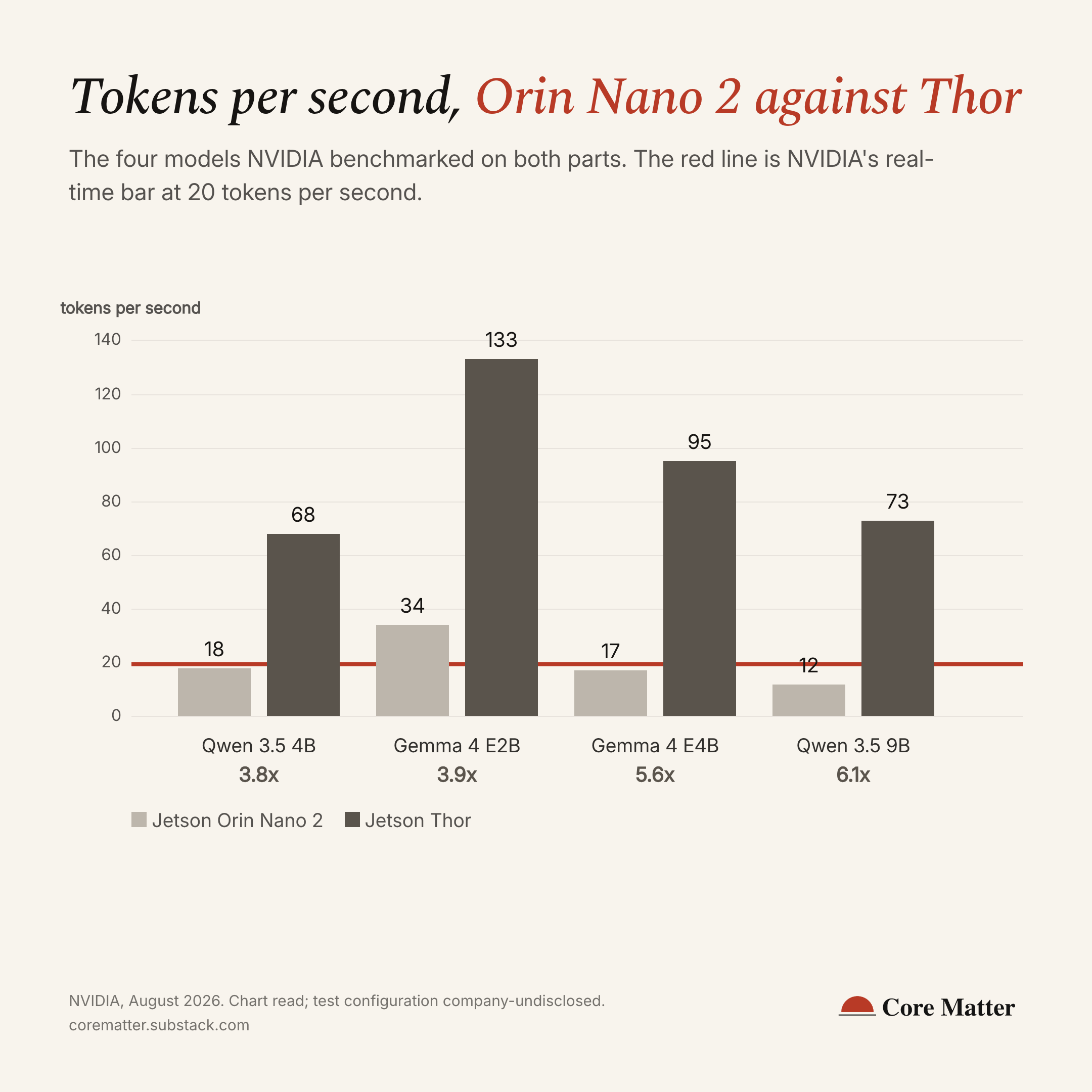
NVIDIA shared real time model performance for Orin Nano 2 against Thor. Against a 20 tokens-per-second line the company labels real-time interactivity, 5 of the 10 models tested clear it. Every model at 8B parameters or above falls short, at 10, 12 and 14 tokens per second. The 4B tier straddles the line, at 17, 18, 21 and 21. The 2B tier clears comfortably, at 34, 39 and 42. Cosmos Reason 2 8B, NVIDIA’s own robotics reasoning model, produces 14 and misses NVIDIA’s own threshold. [10]
How does Jetson Orin Nano 2 compare with Thor and the rest of the line?
Orin Nano 2 is the entry offering of NVIDIA’s edge compute Jetson family. It replaces Jetson Orin Nano Super and shares its form factor. That means a builder can move to it without redesigning the carrier board.
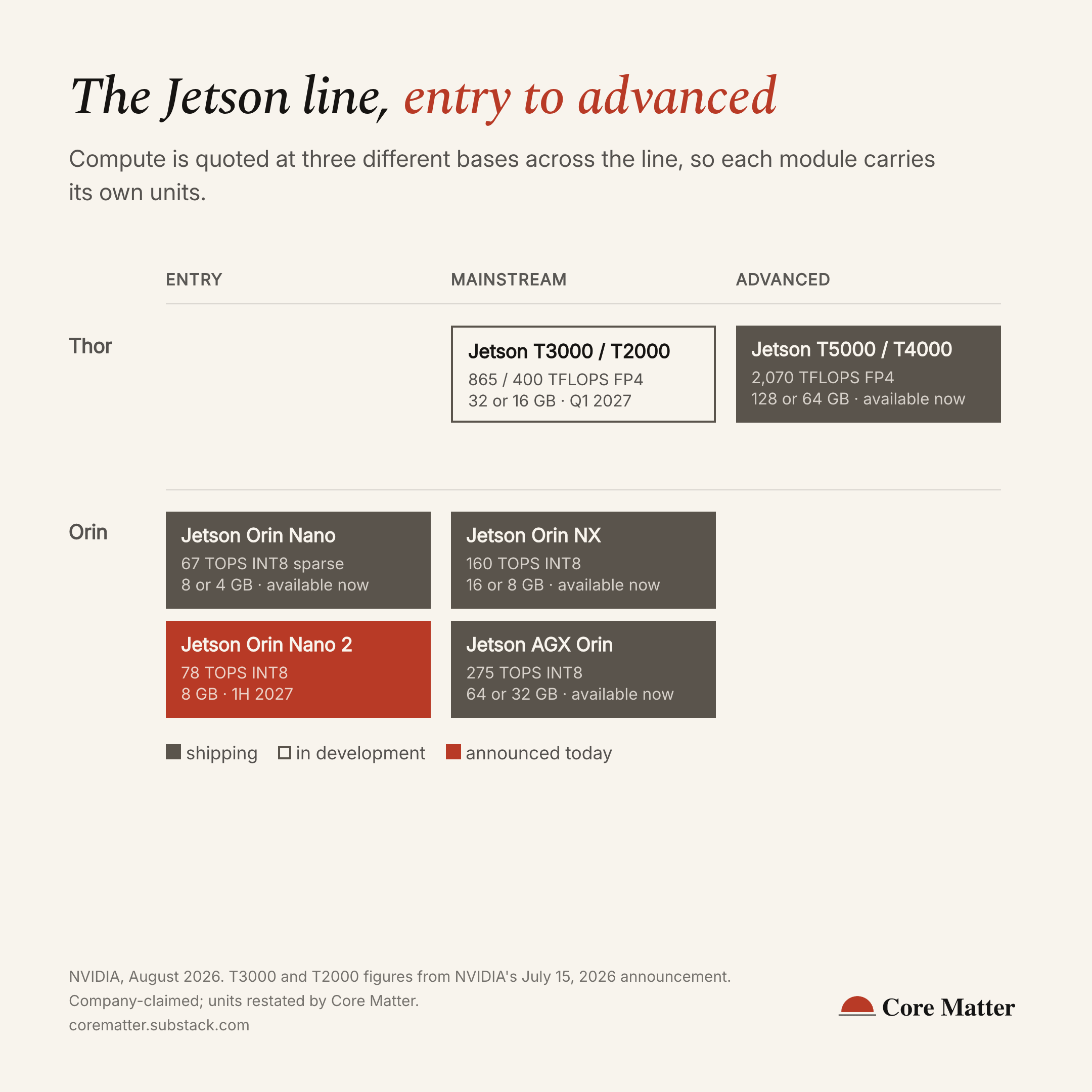
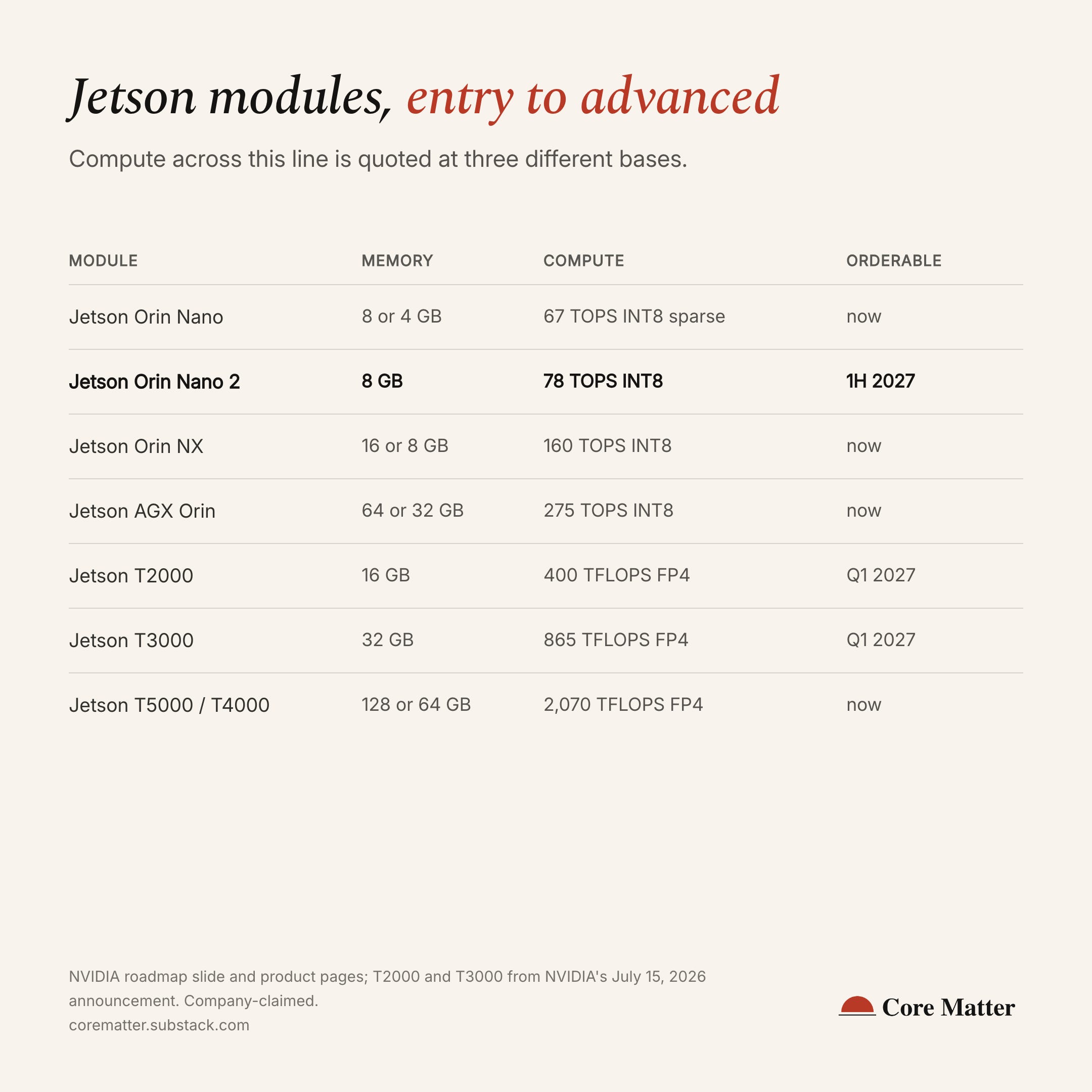
On NVIDIA’s own benchmarks, Thor delivers 3.8x to 6.1x the throughput of Orin Nano 2. Thor executes 31B and 35B models above the real-time line. Orin Nano 2 tops out around 4B. [11]
Qwen 3.5 4B: 18 to 68 tokens per second, 3.8x
Gemma 4 E2B: 34 to 133, 3.9x
Gemma 4 E4B: 17 to 95, 5.6x
Qwen 3.5 9B: 12 to 73, 6.1x
Thor is the brain. Orin Nano 2 is the part for a gripper, a sensor head, an AMR base, an inspection box beside a line. NVIDIA demonstrated two Reachy Mini robots operating from a single Orin Nano 2, each executing a small language model, speech recognition and vision at once. [12]
Which layers of the physical AI stack does NVIDIA not sell into?
While NVIDIA frames its physical AI stack as three computers, there are more than three layers involved in building a working robot. Below training, there’s the data operations layer, the collection, curation, labeling and fleet observability that feeds everything above it. And underneath the machine sits actuation and motion control, the motors, reducers, drivers and the control loops that move the machine.
NVIDIA partners on both layers. Deepu Talla said on the launch briefing:
“So NVIDIA, we build these three computers, we sell these three computers, we build the acceleration libraries and reference models and software on top of these three computers for data generation, for training, for testing, and lastly, for runtime deployment. And then we work with literally every robot company on the planet, whether they’re building a physical robot, whether they’re building a robot brain, whether they are in the field of actuation or sensing, whether they’re providing just data collection services, it doesn’t matter what layer they’re in the ecosystem, we partner with every layer of the ecosystem. NVIDIA does not build robots, but we enable every company building this technology.” [13]
Talla names both missing rows himself, actuation and data collection services, 40 seconds after saying which layers NVIDIA builds and sells. He shared that actuation is becoming an extremely important part of the solution and that NVIDIA partners with several actuation companies. However, he didn’t name any companies. [14]
This gives us a rule that holds across NVIDIA’s physical AI strategy, and we will call it the silicon pull test: NVIDIA occupies every layer that creates demand for its own silicon, and partners on every layer that does not.
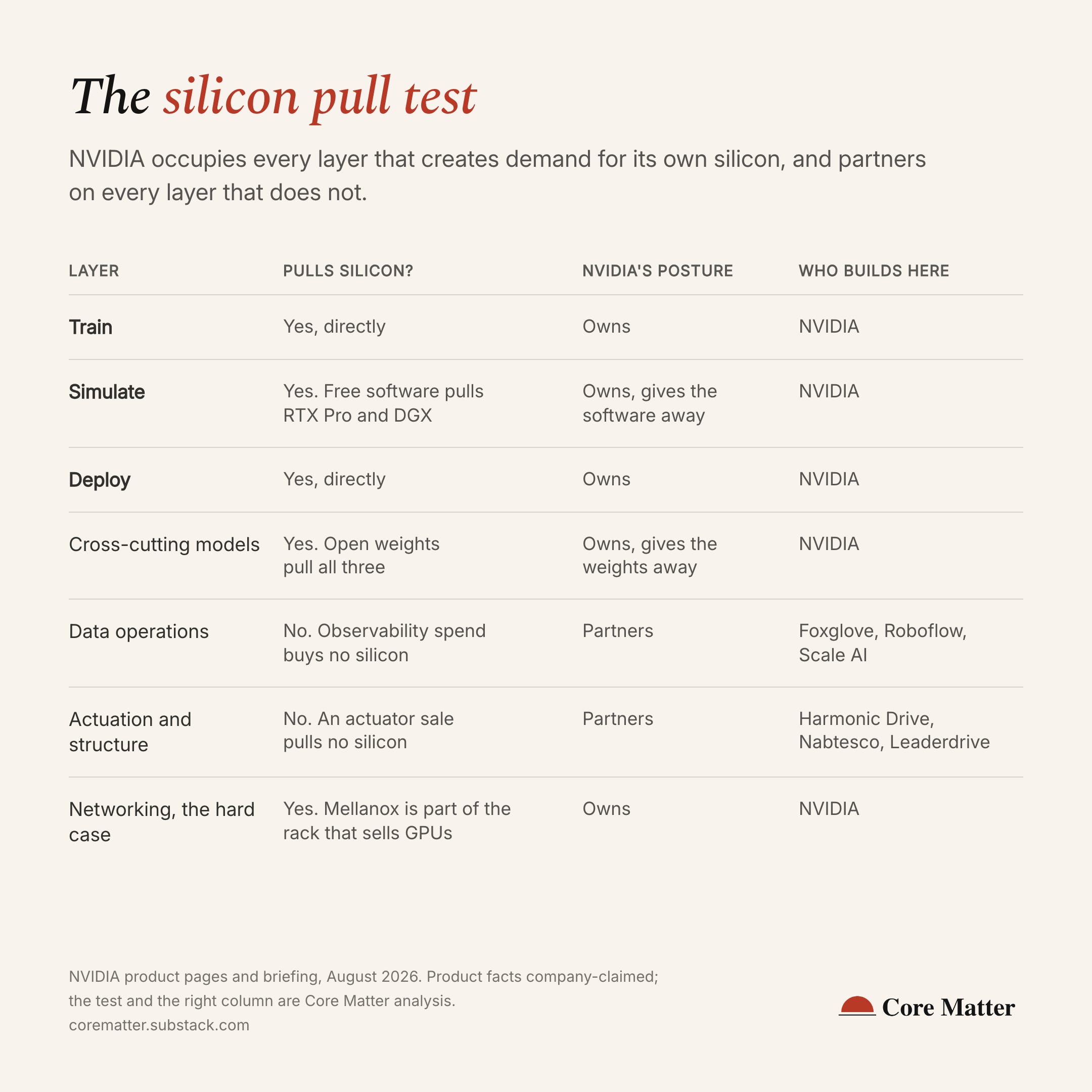
In data operations, fleet observability and semantic search over robot logs do consume GPUs. Those GPUs sit in a data center. NVIDIA already sells them through DGX and cloud providers. NVIDIA keeps giving away models and simulation, as long as it seeds and expands demand for its silicon. If data curation moves onto the robot, it creates a new compute socket on the machine, then the layer becomes NVIDIA’s territory.
Why doesn’t NVIDIA make robot actuators?
An actuator converts electrical power into controlled motion at a joint. A robot-grade one packages a motor, a reducer, an encoder and a driver into a single unit, and a humanoid carries 25 to 50 of them depending on hand complexity. [15]
Three reasons why NVIDIA doesn’t make robot actuators today.
Actuators fail the silicon pull test. Actuators do not create demand for new GPUs.
Actuators and chips have structurally different margins. Manufacturing reducers requires high capex and high fixed costs. Harmonic Drive Systems makes the strain-wave reducers that go into precision robot joints. In its FY2026 annual report, gross margin came in at 30.4%, up from 26.7% the year before. [16] Nabtesco reported its Component Solutions segment, precision reduction gears, at 10.6% operating margin on ¥45.5bn of sales in H1 FY2026. [17] NVIDIA’s gross margins are in the 70%s because of its fabless business model. [18] These are structurally very different businesses.
Cost per unit for actuators does not come down with scale. NVIDIA’s cost per unit of compute decreases with every process and architecture generation. That improvement comes from economies of scale over a fixed cost. It lets NVIDIA cut price per unit of compute, widen the market and hold gross margin in the 70%s at the same time. A harmonic reducer is the opposite. Its costs are materials, grinding tolerance and fatigue life. These are all variable costs. Increasing volume does not change the cost basis. Silicon can achieve annual price reductions. Precision mechanics cannot. That’s why we see a player of HDS’s scale achieving 26.7% gross margin, and break-even operating profit.
That being said, actuation increasingly requires real-time motion control, and that control needs silicon. Which may be NVIDIA’s playground.
Who competes with NVIDIA at the edge?
The entry tier of edge computing has become a crowded space. Qualcomm is shipping now. AMD released a Thor-tier product in July with a decade-long supply commitment. Hailo and Horizon are selling into the tiers on either side of Orin Nano 2. The common theme is that competitors are putting real-time motion control silicon on the same board as the AI accelerator, while NVIDIA keeps that function on a separate part.
