

Hi everyone, I'm excited to launch this deep dive on compute for robots. After a month+ of research and writing, I learned a ton about chips and various demand drivers for compute from robotics. We also have a CEO interview episode launching this Friday on this topic that will add a lot of color to what that means to a $1bn robotics company.
Also, a side editor's note, from now on, the bracketed source numbers next to each figure will be moved to the footnotes, as they look quite messy to read inline. If you have questions on where any numbers are from, welcome to reach out directly.
Robots and physical AI create 3 sources of demand for compute: developing the models, the computers inside each robot, and the servers that run deployed fleets. Each source has different growth drivers.
At Bank of America's forecast of 1.2mn humanoids shipped in 2030, one of the higher public forecasts, the main AI modules inside those robots alone would cost $479mn to $6bn a year, at 1 module per robot, depending on which NVIDIA module they carry. A base Unitree G1 uses a much cheaper computer, estimated at about $198.
More capable models need more compute to train, while they may reduce the compute needed for each task. The industry is also deciding where the "thinking" happens: on the robot, on a nearby server or in the cloud. That will shape the demand curve for onboard modules and the datacenter capacity.
Robotics is in its infancy as a driver of compute demand, compared with LLMs. The large commitments sit in development: Figure's $3.5bn deal with Nscale is orders of magnitude larger than the published training runs in this piece. Inside the robot, compute is getting more expensive. NVIDIA raised Jetson prices by up to 101% in July 2026, and AgiBot's G2 and 1X's NEO carry its top-end Thor module. The alternatives come from in-house chips, such as Tesla's AI5 and XPeng's Turing, and from low-cost processors, such as the Rockchip chip in the base Unitree G1.
Compute does not just sit on the demand side of the equation. In my view, the supply of compute is existential for robotics companies. In the coming years, I expect securing compute to become a strategy question for robotics companies, as it already is for AI labs. Figure's $3.5bn commitment with Nscale is one early example. This piece covers the demand side. Part 2 of this deep dive will cover the supply side: whether and how robotics companies can secure the compute they need.
In this piece
What robotics could spend on compute
What robots use compute for
How robotics drives compute demand
The cost of onboard compute
The cost of compute for simulation and training
What can run off the robot?
What this means for NVIDIA and other suppliers
Note: In this piece, robotics means physical AI broadly: humanoids, industrial arms, mobile robots and the models that run them. Humanoids are a small piece of that market. I use them for the onboard numbers because they have the clearest public shipment forecasts. Some of the compute covered here is shared with adjacent uses. For example, Tesla's Cortex clusters also train its self-driving software, and world models such as Odyssey's serve more than robots.
1. What robotics could spend on compute
Robotics' compute spend = onboard purchases + development compute spend + shared inference
The calculations below use annual shipments for onboard purchases and an active fleet for recurring inference. A fleet can include robots bought in earlier years.
Onboard purchases
Annual module spending = robots shipped × share using the module × modules per robot × module price.
Bank of America Global Research forecasts annual humanoid shipments of 90,000 in 2026 and 1.2mn in 2030. Its March 2026 report supplies the shipment inputs below. BofA's forecast is about twice the industry figure in Unitree's prospectus. Unitree's IPO prospectus cites industry research of 605,700 humanoids sold worldwide in 2030, about half BofA's figure, so the spending below would halve too.
The calculation assumes 1 module per robot, 100% adoption of the selected module and today's published prices held constant. It excludes replacements and spares. Each price column represents a different hardware choice, with different capabilities. The prices are NVIDIA's suggested prices at quantities of 1,000 or more.
Those prices are recent. NVIDIA raised Jetson prices by up to 101% on July 22, 2026, without an announcement.
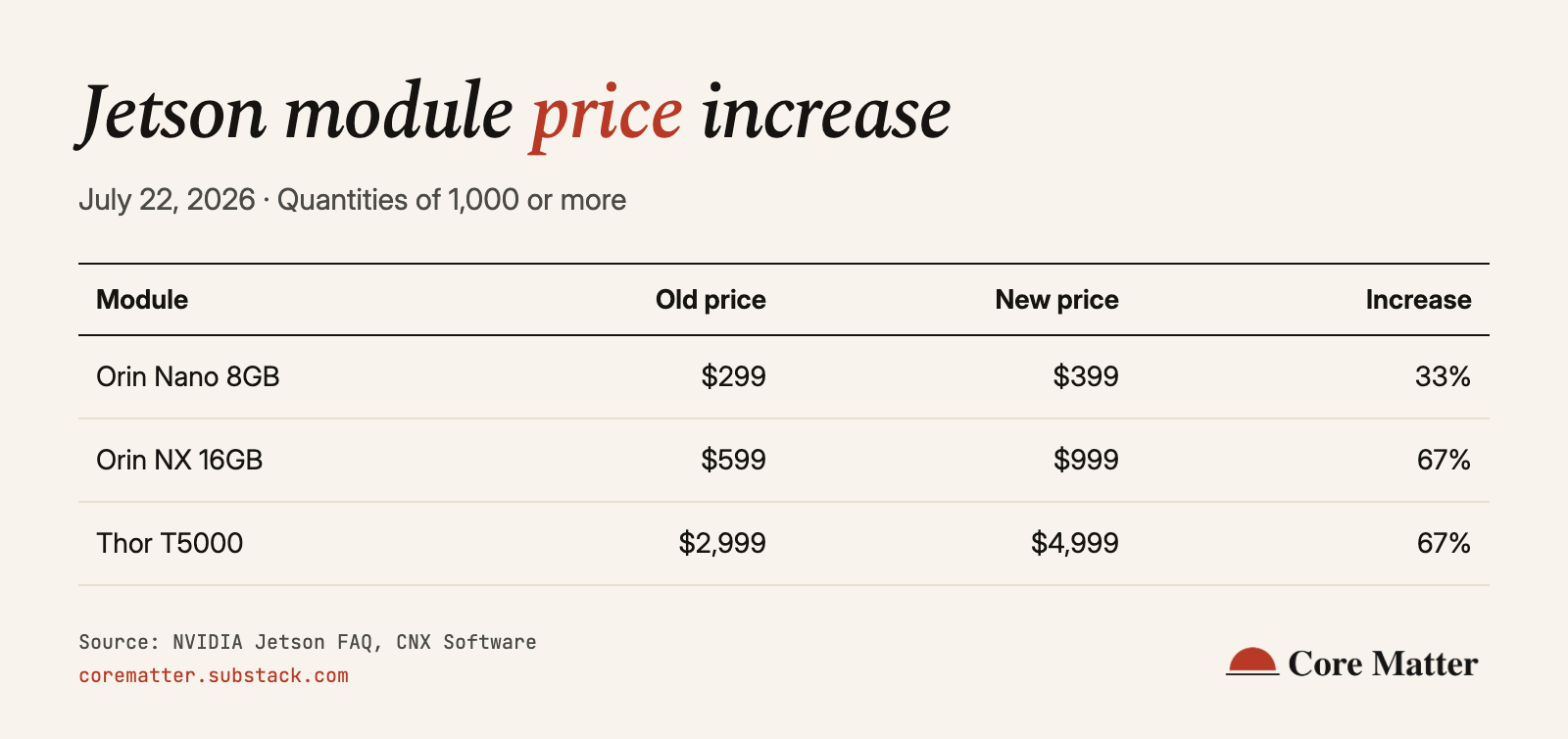
At the old prices, the 2030 range would have been $359mn to $3.6bn.
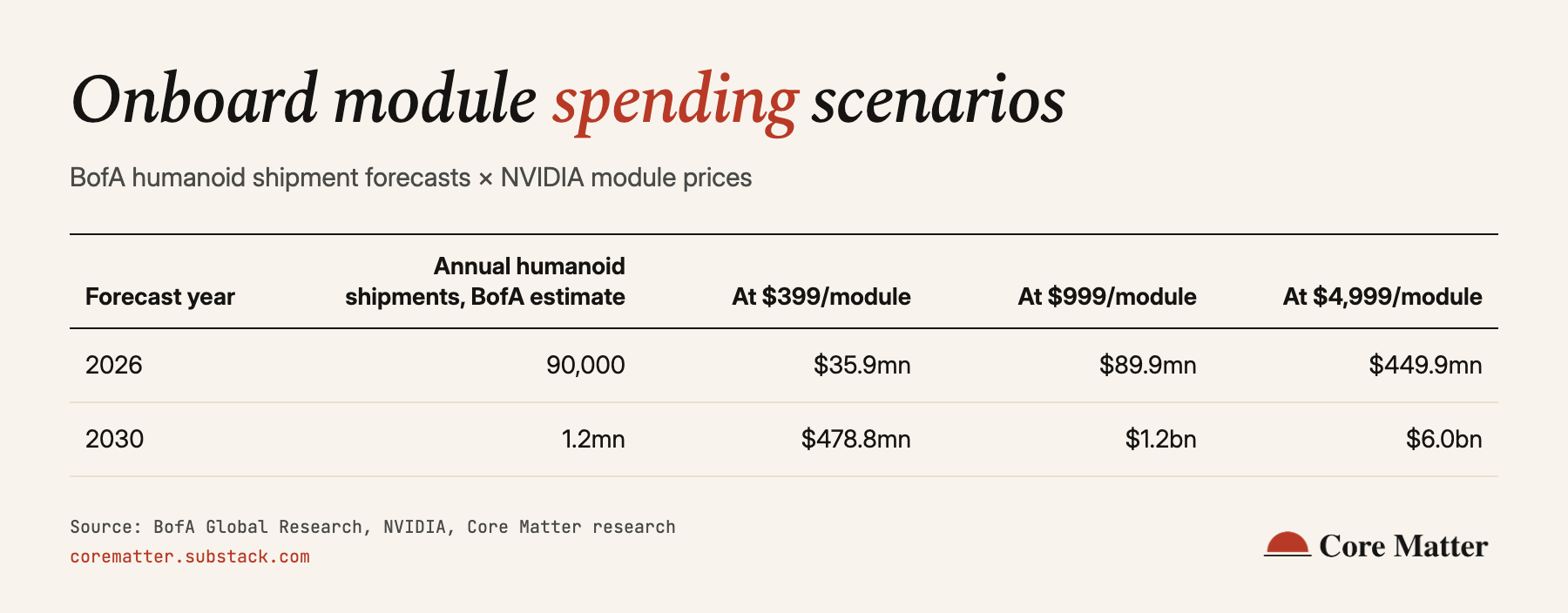
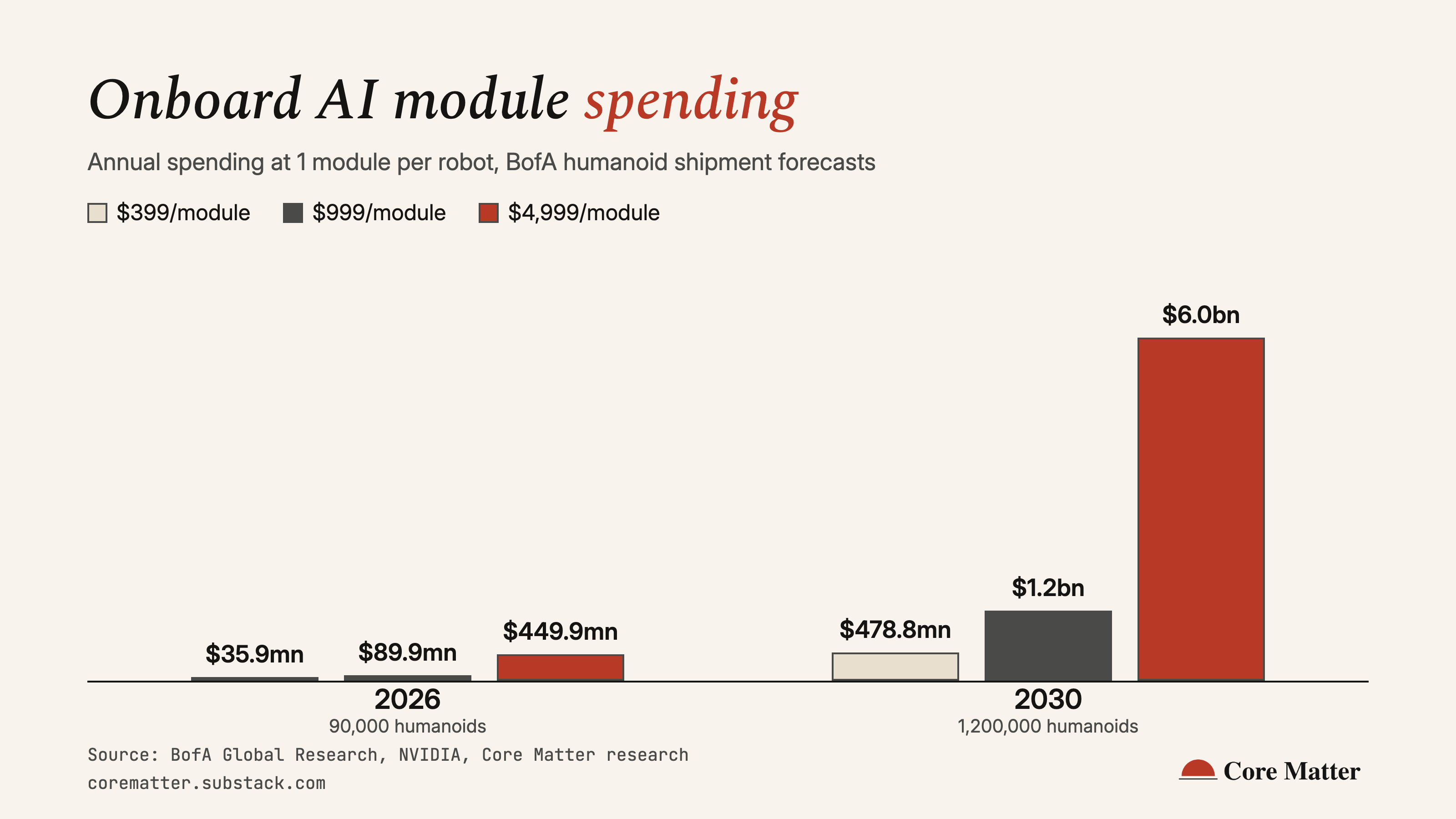
At a $999 module price, 1mn annual module purchases would produce about $1bn of spending. At $4,999, 200,000 modules alone will lead to $1bn spending. Some humanoids ship with less expensive compute. China Post Securities' line items for the base Unitree G1's main control board sum to RMB1,415 ($198), below the $399 column.
For context, IFR reports more than 600,000 industrial robot installations in 2025. Those include many applications with different computing requirements from a general-purpose humanoid.
For scale, NVIDIA reported $2.3bn of automotive and robotics revenue in fiscal year 2026, which ended in January 2026. That was about 1% of its $215.9bn total revenue.
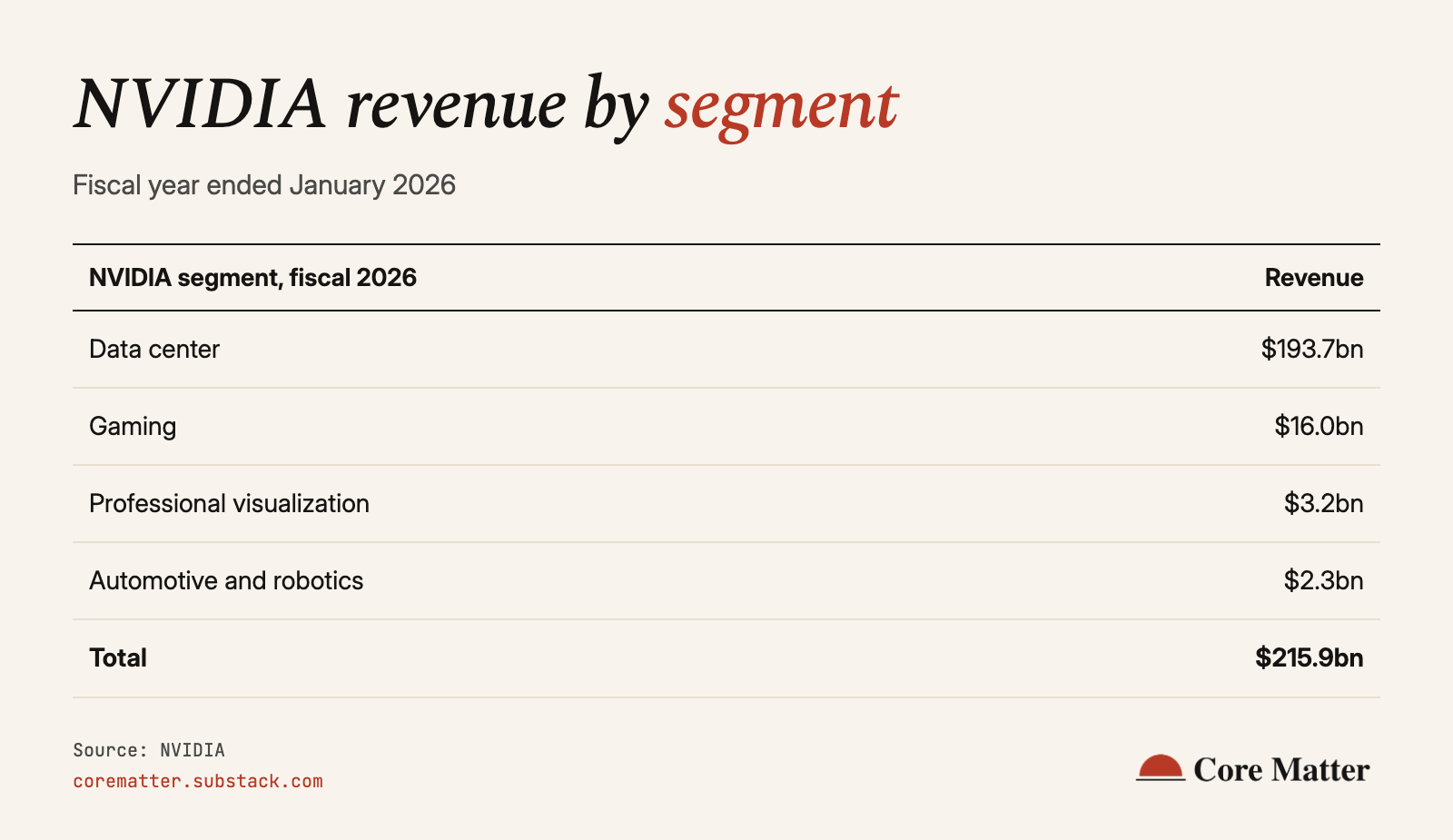
From fiscal 2027, NVIDIA reports automotive and robotics inside a broader Edge Computing segment, which also covers gaming, PCs and workstations. Edge Computing brought in $7.2bn in the quarter ending July 2026, against $89.0bn for data center. NVIDIA's results releases do not disclose Jetson unit sales.
Development compute
Annual development spending = GPUs dedicated to robotics development × hours used × rental rate.
Renting 1 H100 year-round at Lambda's $3.99 per GPU-hour on its 8-GPU H100 plan, before its November 16 increase, costs about $35,000. Every 10,000 H100s used year-round for robotics development therefore adds about $350mn a year.
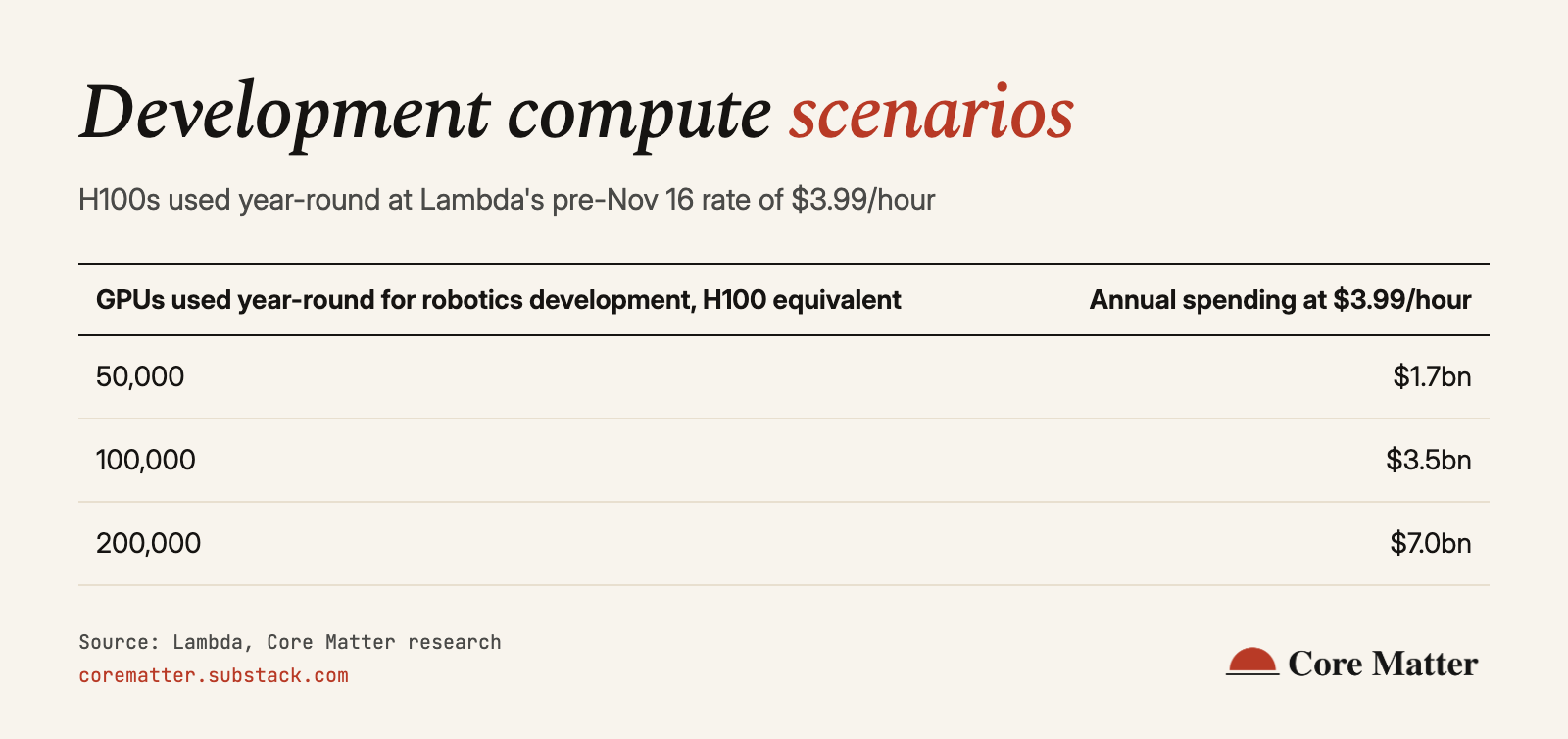
For reference, Figure alone plans up to 100,000 NVIDIA Vera Rubin GPUs under its $3.5bn Nscale commitment, and Vera Rubin GPUs will likely rent for more per hour than H100s.
Development spending depends on the models, tasks and experiments needed to support the fleet. For a defined simulation-data batch, Cosmos' benchmark and Lambda's published H100 PCIe rental rate before its November 16 increase give:
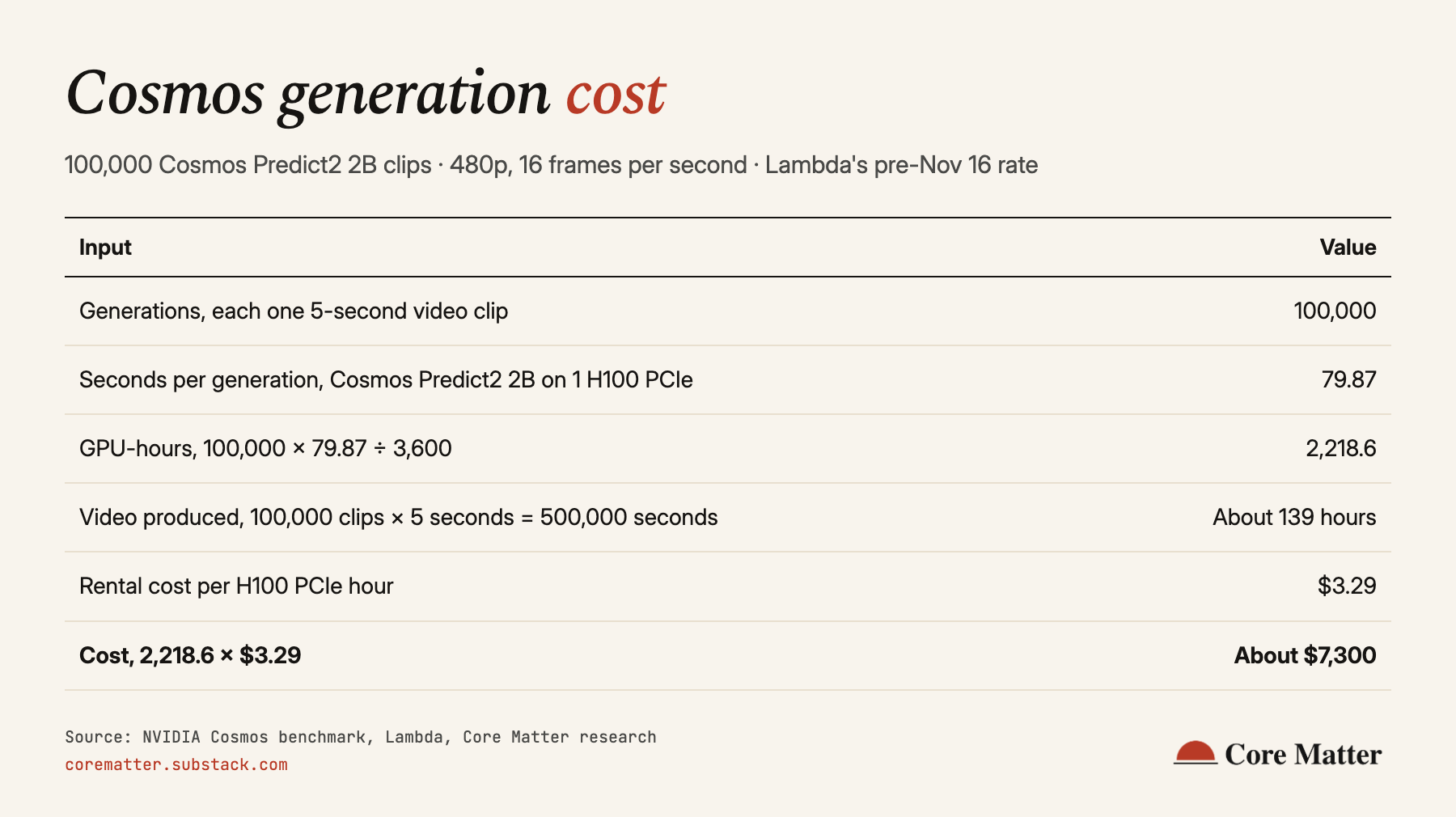
Assuming 100,000 generations, or 100,000 clips of 5 seconds each, about 139 hours of video in total, this will cost around $7,300. A generation is one complete output clip. The model builds each clip from many smaller units, often called tokens, so a generation count and a token count measure different things. For scale, NVIDIA's GR00T N1 paper reports generating about 827 hours of video to train that model, about 6 times this example. This assumes 1 allocated GPU and continuous use at the benchmark's speed. Setup, storage and rejected outputs increase the cost. If half the generations are usable, producing the same number of usable outputs takes twice the generation compute.
On top of generations, development also consumes compute resources for running experiments, training and evaluation cycles.
Figure announced an initial $3.5bn compute commitment with Nscale in September 2026 and a plan for up to 100,000 NVIDIA Vera Rubin GPUs, with initial deployment targeted for the second half of 2027. Nscale is also making a strategic investment in Figure as part of the agreement.
Shared inference
Between training the model on GPUs and running compute onboard the robot, robotics companies can also run inference on-prem or in a datacenter cloud.
The number of robots a server can support depends on the policy, how often each robot requests new actions and the response time the task requires.
A March 2026 Microsoft/Berkeley study measured the same π0.5 policy on an A100 with different request batch sizes.
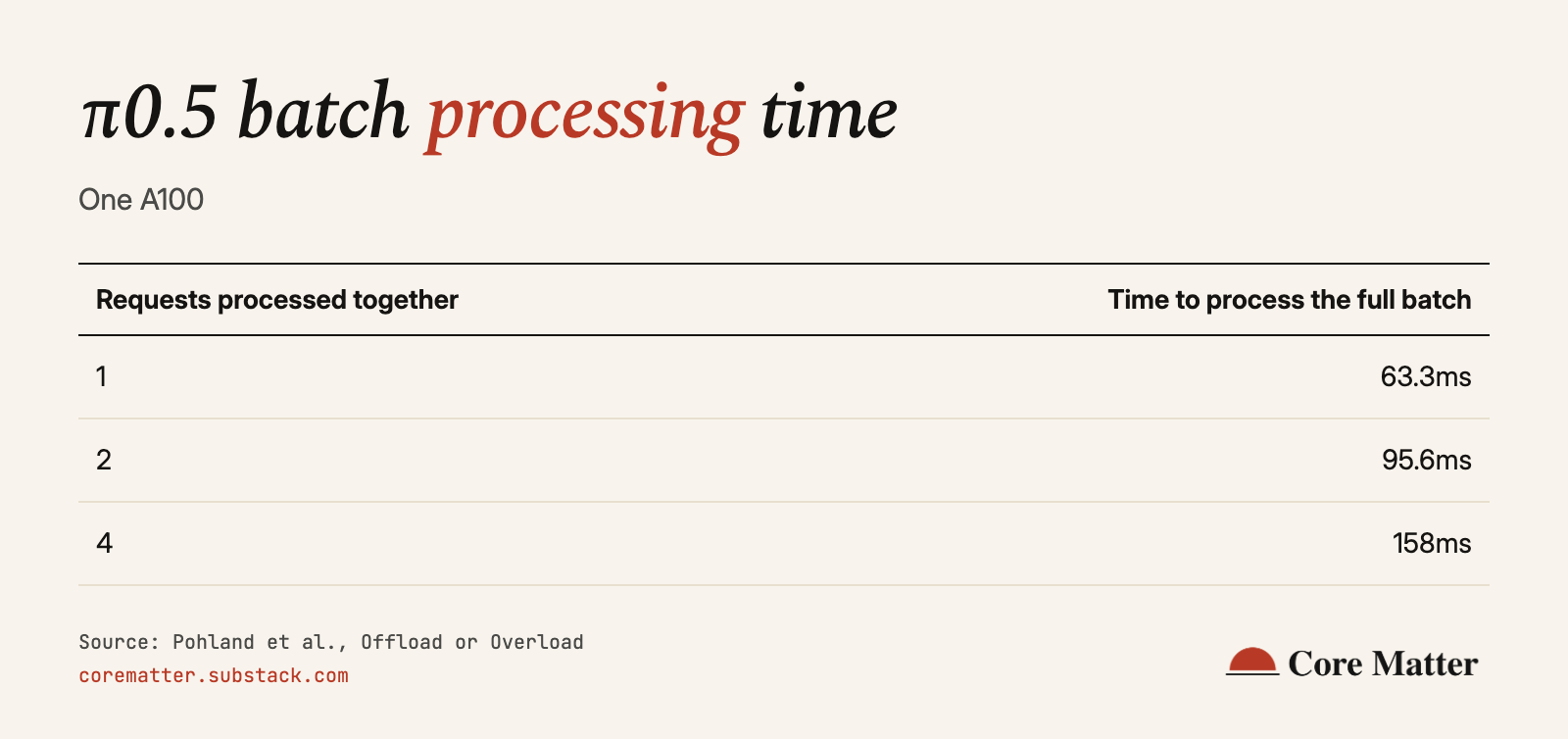
Processing 4 requests together was about 1.6× faster than processing 4 requests sequentially. Based on this calculation, sharing compute is more efficient for π0.5. Converting this calculation into fleet capacity depends on how frequently each robot requests compute, network and queueing delays, other workloads and spare capacity.
In the same study, the A100 can serve 4 robots at once with latency comparable to each robot having its own Thor. At Lambda's $2.79 per A100-hour, before its November 16 increase, that is about $0.70 per robot per operating hour.
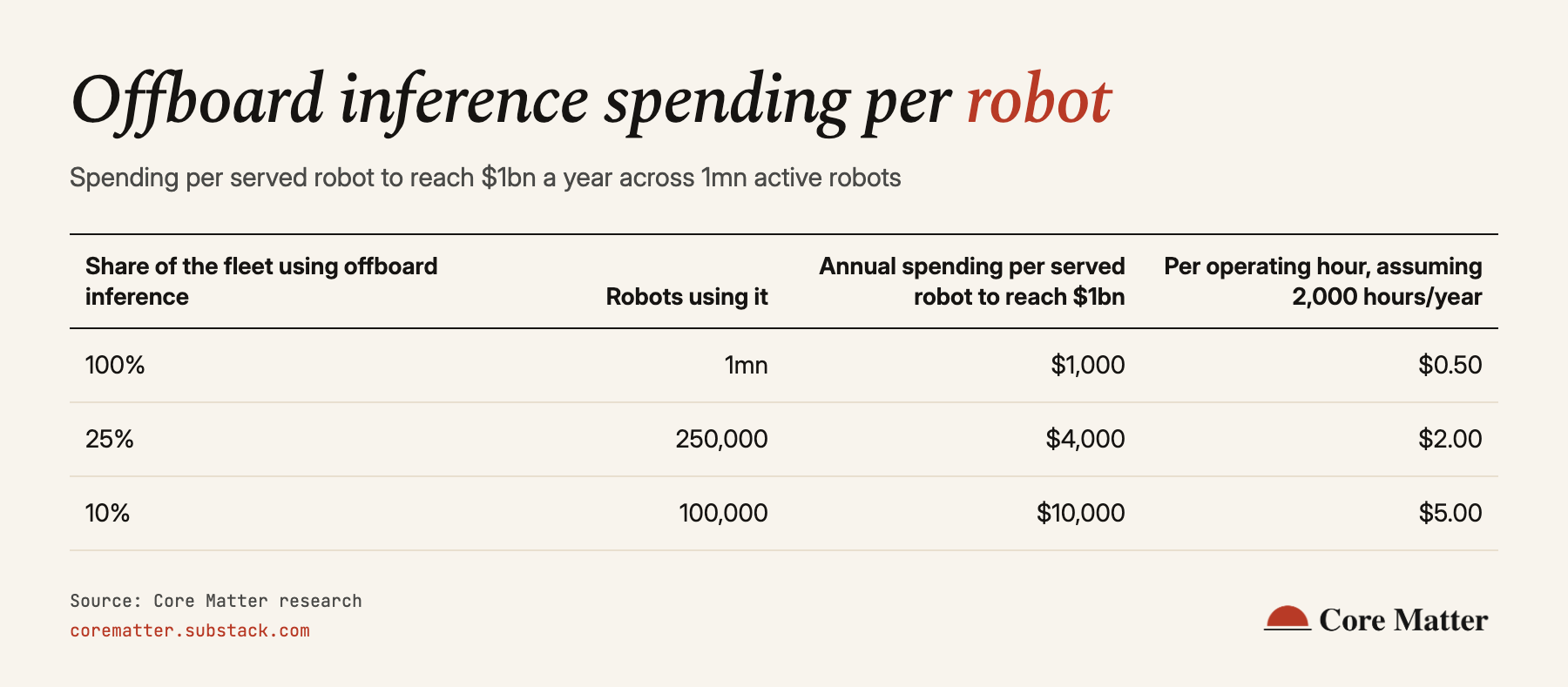
Annual offboard inference spending = active robots × share served offboard × operating hours × cost per robot-hour.
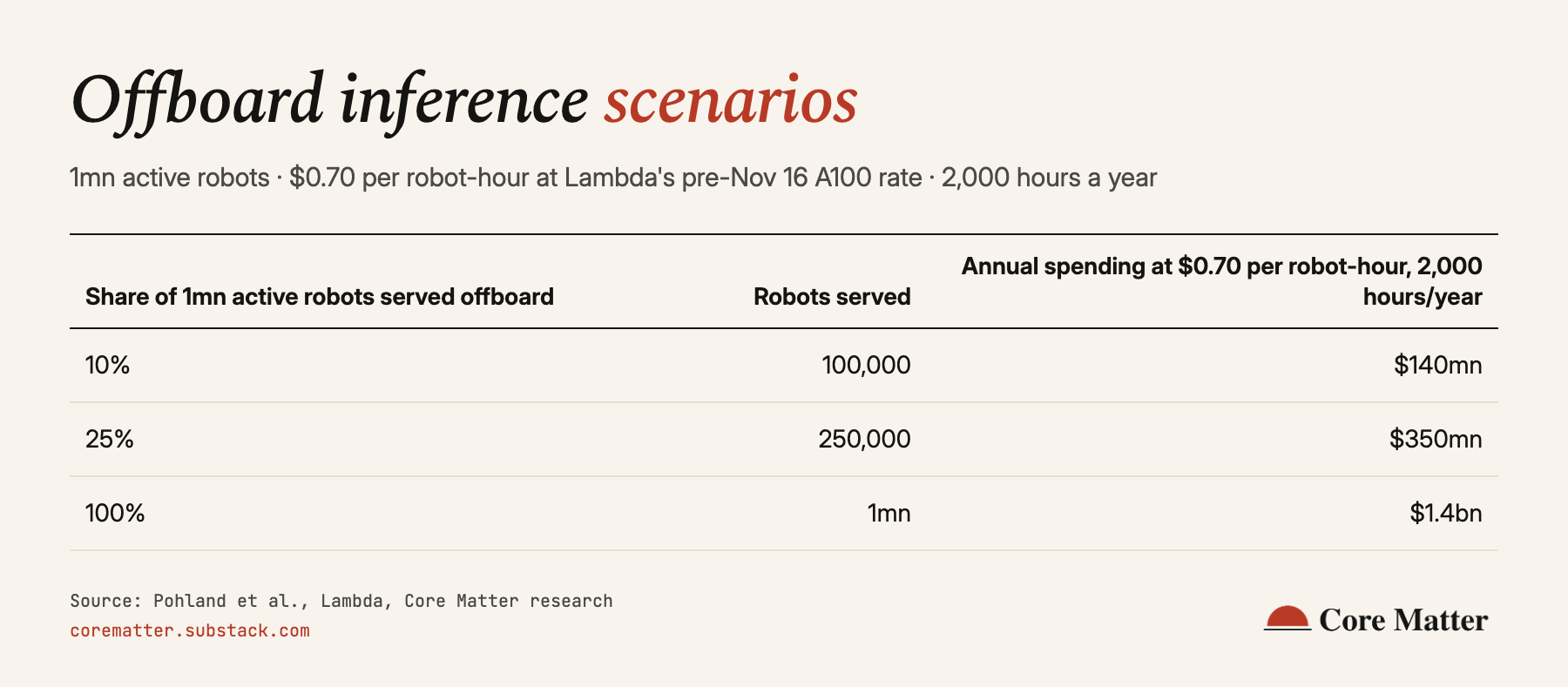
Larger planning models, faster request rates or spare capacity for peaks would raise the cost per robot-hour. Another way to size it is to ask how much each served robot would need to spend for offboard inference to reach $1bn a year across a fleet of 1mn active robots:
2. What robots use compute for
From developing and operating a robot, compute is used across 4 functions: Dream → Learn → Plan → Act. Experience from the deployed robot can feed back into learning and simulation. Some projects learn directly from real demonstrations, so the route through these functions varies.
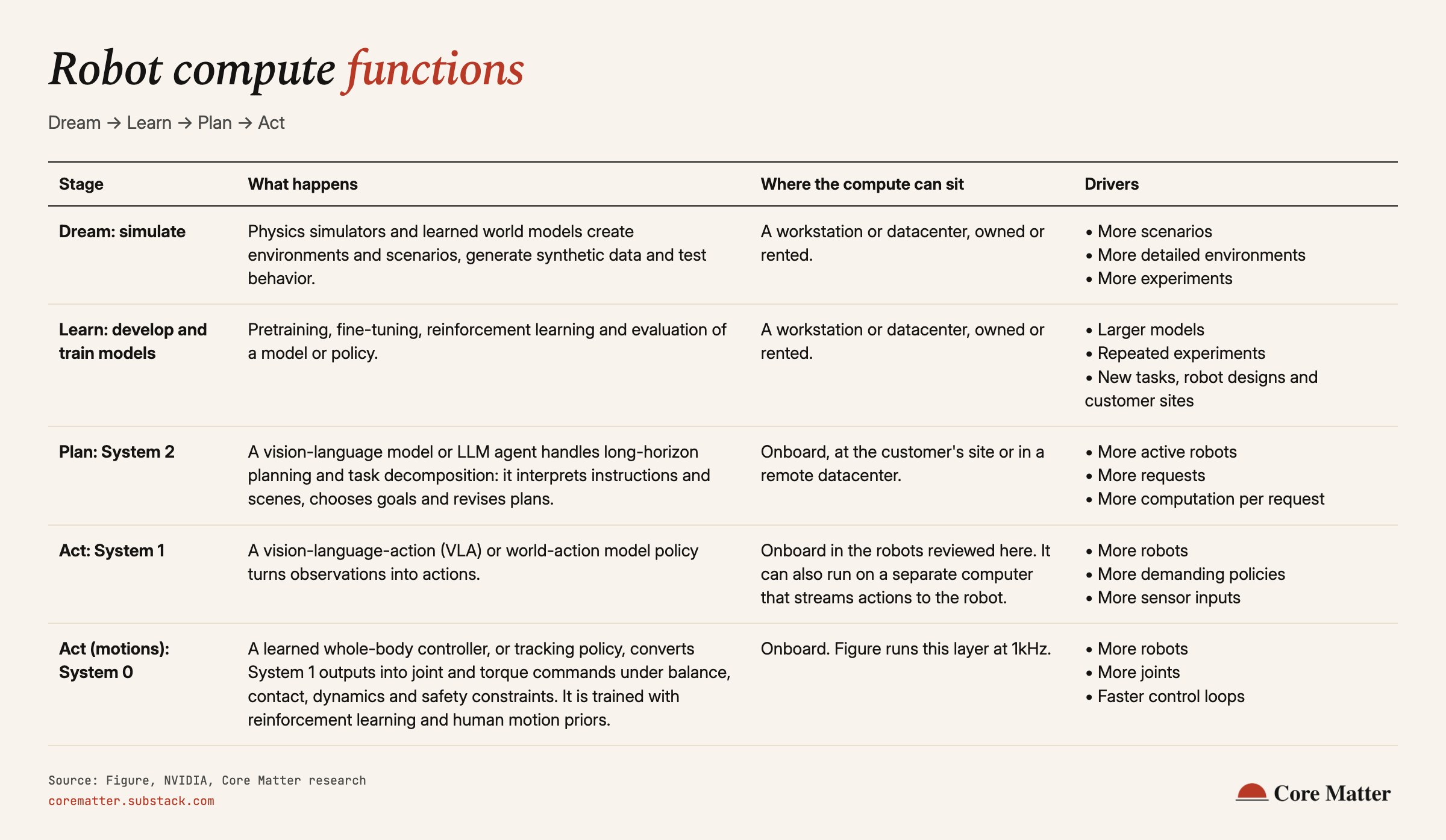
Robotics developers approach the architecture of compute differently, but the developers reviewed here put System 1 and 0 onboard.
Tesla designs its own inference chip. Elon Musk said in April 2026 that its next chip, AI5, will go into Optimus and Tesla's supercomputer clusters.
Figure's January 2026 Helix 02 architecture makes that distinction concrete. System 2 interprets scenes and instructions. System 1 produces whole-body joint targets at 200Hz. System 0, an additional control layer beneath it, handles balance and coordination at 1kHz. Figure released Helix 2.5 in September, extending the model's ability to perform tasks in unfamiliar homes. Figure says Helix operates onboard, on dual low-power embedded GPUs.
1X's June 2025 Redwood architecture keeps the action model onboard and processes speech offboard. NEO's current specification lists Jetson Thor as its onboard computer.
AgiBot's G2 Air and G2 Max carry a Jetson T5000, and Unitree's base G1 carries a Rockchip RK3588 main board. Section 4 lists the computers by robot.
A model can also predict several actions at once. The LeRobot folding system generates a sequence of 30 actions, then executes that sequence while preparing the next one. Model prediction frequency and motor-command frequency therefore measure different things.
3. How robotics drives compute demand
These functions create 3 sources of spending.
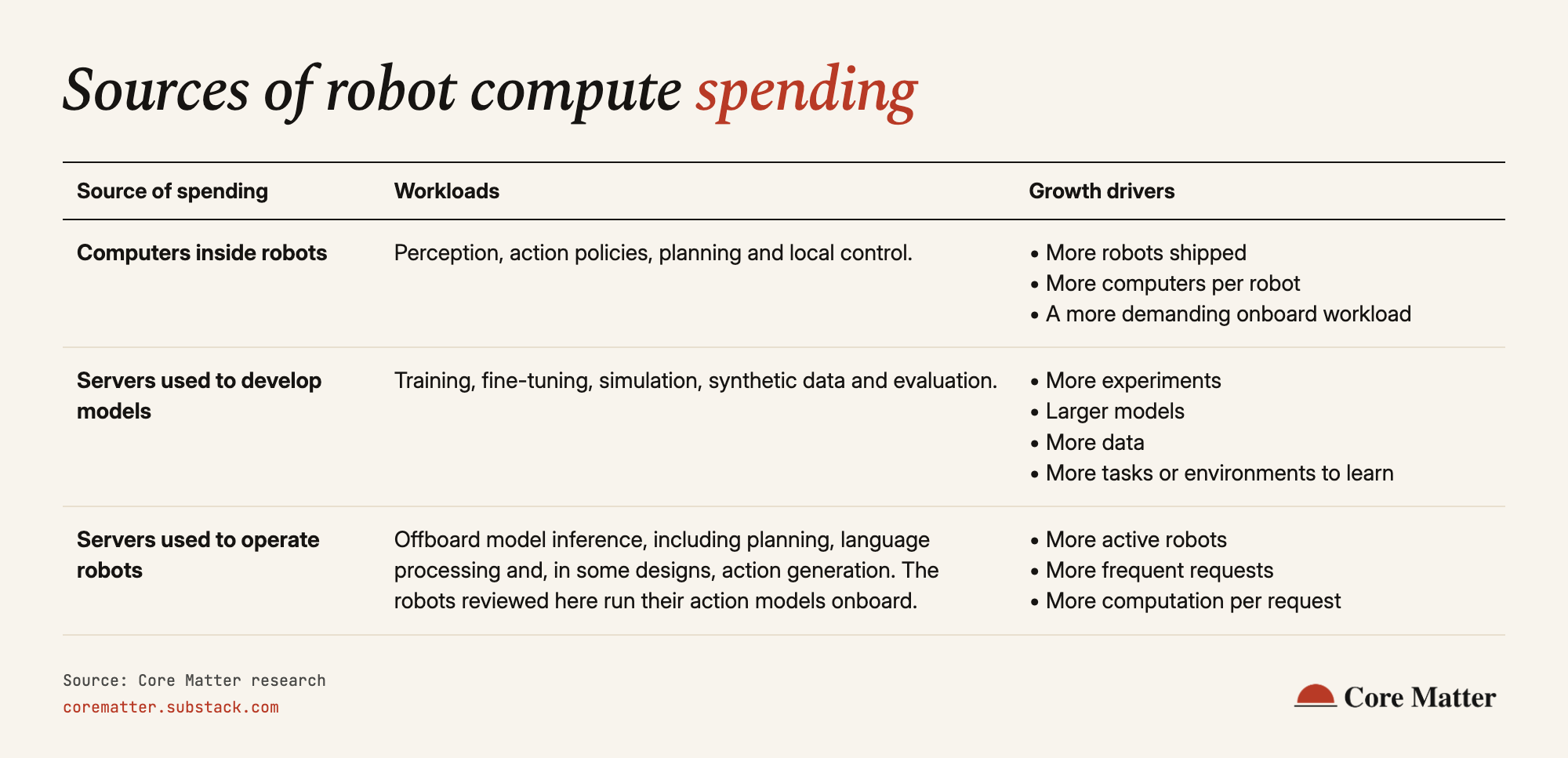
A robot maker, model developer or customer can own the servers on prem, or rent them from a cloud provider, like Lambda.
Computers inside robots include the main AI computer and local motor controllers. The AI computer processes observations and generates plans or actions. A motor controller handles the feedback needed to move a joint. For the purpose of this piece, we calculate spending on the main AI modules. Motor controllers are not included.
Before a robot hits deployment capability, model training can consume substantial compute.
The investment question is whether more experiments, more capable robots and larger fleets outweigh reductions in compute per task.
