

NVIDIA released its reference humanoid design at GTC Taipei on May 31. The BOM: a Unitree H2 chassis, Sharpa Wave hands, running on Jetson Thor. The next day Wuji teased its newest model, Hand 2. Add Agilink, spun out of AGIBOT and now a unicorn, and Linkerbot’s rumored Hong Kong IPO.
Dexterous hands are having a busy few weeks.
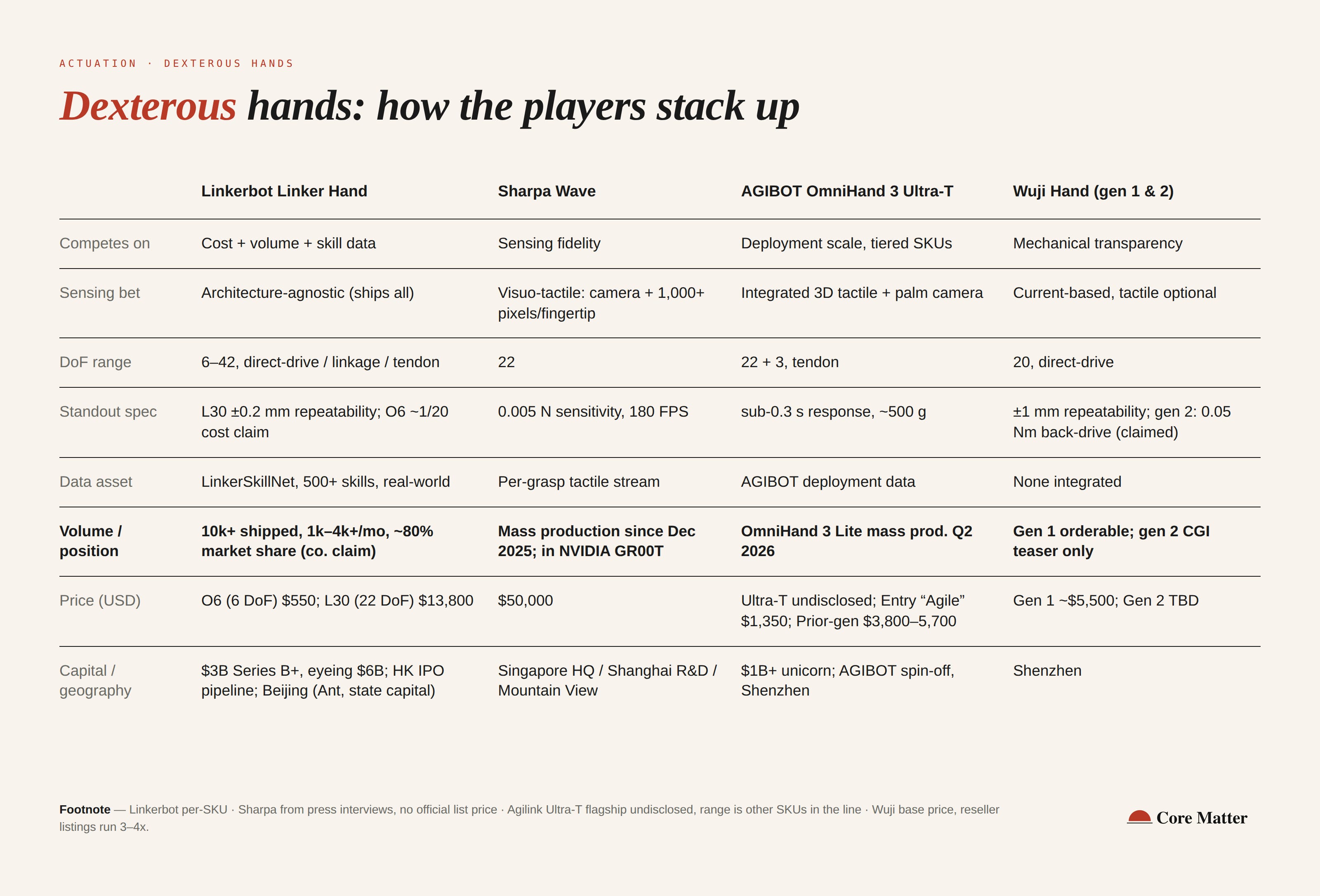
The table above sorts the noise by the column that matters: who’s actually shipping. Wuji Hand 2 is a CGI teaser. No physical units, no pricing, no spec sheet. Agilink’s OmniHand 3 Lite reaches mass production in Q2. Sharpa Wave is shipping inside a named NVIDIA reference design. Linkerbot has shipped over 10,000 hands cumulatively, 1,000 to 4,000-plus a month.
Different sensing architectures, different unit economics. Agilink and Sharpa anchor the dense end, layering cameras and high-resolution tactile arrays into the hand. That carries higher BOM and integration cost, Sharpa’s hand reportedly runs around $50,000, but generates proprietary contact data.
Current-sensing, Wuji’s approach, is cheaper, at $5,500, and simpler but misses rich contact data. Linkerbot, which claims 80% of the market, made tactile modular and sells from about $550 to $13,800.
NVIDIA picked the most expensive hand for its reference humanoid: Sharpa’s, at a reported $50K and, by some accounts, hard to get. The robots deployed in real life are picking Linkerbot, a fraction of the price. The open question is which way the gap closes. Do deployed hands eventually have to climb to the reference design’s fidelity to do useful work? Or does maximal tactile get cheap enough to make field sense first?
Down the stack
Top news down the robotics value chain, from hardware, intelligence to deployment.
Reference humanoid. NVIDIA’s Isaac GR00T reference humanoid (GTC Taipei) pairs a Unitree H2 Plus chassis with Sharpa Wave hands, running on Jetson Thor, and Stanford, ETH Zurich, and Ai2 have already signed on to build against it. Worth noting what “open” rests on. The body is Shenzhen, the hands are Shanghai-built; the compute and the software stack are the parts NVIDIA actually owns. The reference design every frontier lab now benchmarks against is, at the hardware layer, sourced from the supply chain it’s nominally racing.
Dexterous hands. Wuji Tech teased Hand 2 (June 1): a claimed 20% lift in transmission efficiency and back-drive torque down to 0.05 Nm, still sensing force through motor current rather than a tactile skin. That’s one pole of the fork. The other showed up the same week, with Sharpa’s 1,000-plus tactile pixels per fingertip and XELA’s upcoming tactile sensor release at Automate (June 22-25). The disagreement is whether mechanical transparency can substitute for dense contact sensing. One caveat on Wuji: Hand 2 is a CGI teaser, no physical units or pricing yet. The full field sits in the table above.
Actuation. Westmag raised an $11M seed led by a16z, with Founders Fund and Lux, out of stealth (June 2) as a domestic maker of drone motors and robot actuators. The catalyst is regulatory: December’s FCC ban on foreign-made drones and critical components, motors included, manufactured the demand. The harder question is the supply curve. Actuators (>50% of costs of robots) are the most cost-dominant, most concentrated line in a humanoid BOM, and onshoring them means reaching cost parity with a supply base that’s been compressing down the learning curve for a decade. Demand is policy-made. Parity has to be earned. I wrote about the actuator supply chain earlier this week.
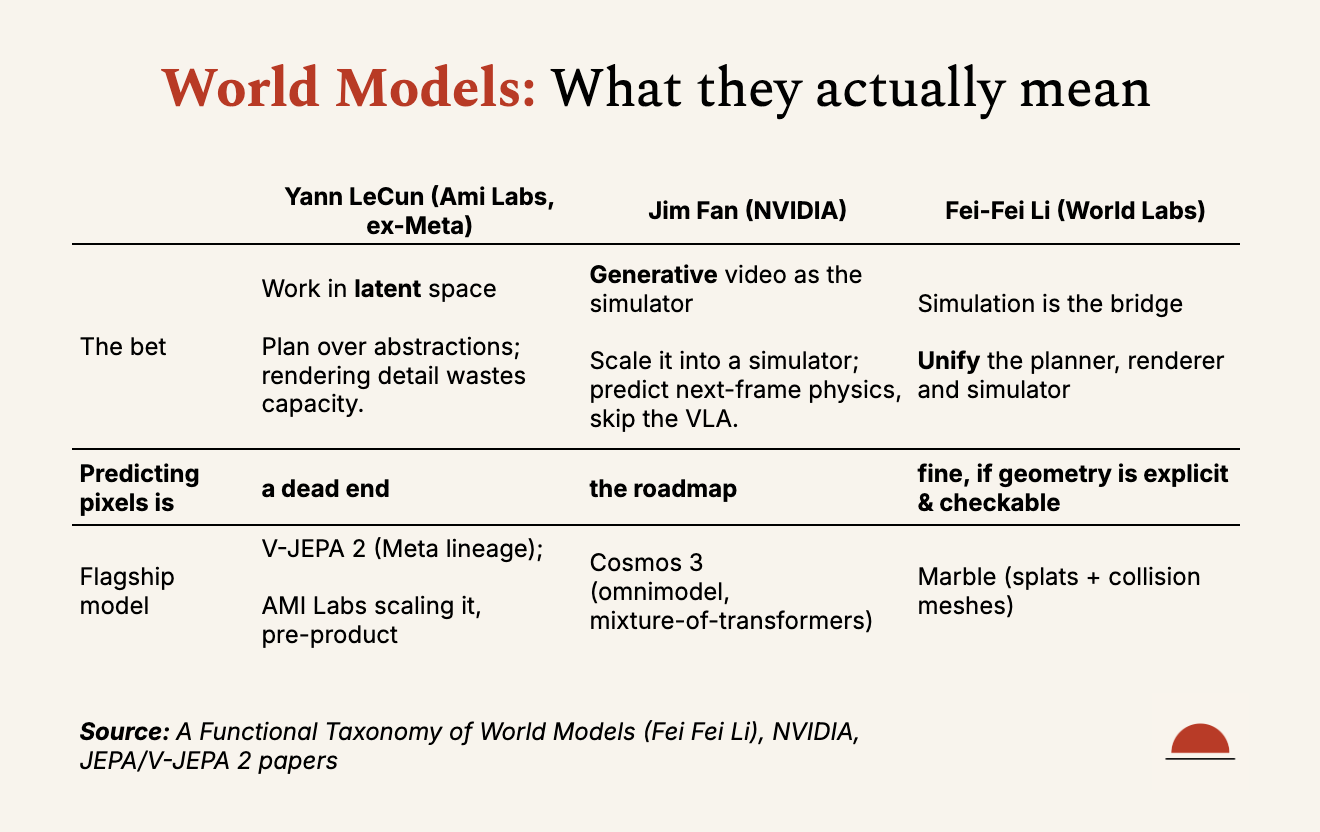
World models. NVIDIA released Cosmos 3 (June 1): an open world foundation model, mixture-of-transformers, topping Physics-IQ and PAI-Bench. The under-covered part is the license. Open weights put the same backbone in the hands of the labs NVIDIA competes with, to post-train on directly. That sits inside a larger argument the field is having over what a world model even is, where LeCun, Jim Fan, and Fei-Fei Li have each put a company or a model behind a different answer. I mapped the three architecture in a separate piece this week; the short version is in the table below.
Edge compute. Intel (OpenVINO Physical AI, at Computex) and Qualcomm (Dragonwing) both moved on edge robotics this week, aiming at the on-robot compute socket Jetson holds. Fair to want a “the socket is contestable” read here. The week’s evidence cuts the other way: GR00T shipped on Jetson Thor and Cosmos 3 landed in the same window, so NVIDIA reinforced both the model layer and the compute beneath it. The challengers are aiming at the one layer NVIDIA just spent the week deepening. The thing to watch is whether the cost-and-integration pitch lands with BOM-sensitive integrators, which is the only place that socket actually loosens.
What I’m watching next: Automate 2026 floor (June 22-25) for whether tactile pricing holds at volume; early signs of which labs train on Cosmos 3.
Core Matter covers the full Physical AI stack, from hardware, intelligence to deployment. Where value accrues, which players are real, what press coverage is missing.
If someone forwarded this to you, you can subscribe below.