

Who is building the Scale AI of robotics, and how much of the opportunity lies beyond selling training data?
Robotics has a “100,000-year data gap,” according to Berkeley professor and Ambi Robotics cofounder Ken Goldberg. His 2025 comparison put the human-equivalent reading and viewing time behind large vision-language models against roughly one year of teleoperation data. [1]
Suppliers are moving quickly. Mecka announced a $60mn Series B on October 7. XDOF emerged from stealth in June with $70mn in funding. On October 9, microagi said it had reached $100 million in ARR within six months of launching Shift. [2], [3], [4]
In this piece, we look into how collecting data builds the operating muscle and customer relationships to sell evaluation and deployment. That can turn a dataset order into recurring revenue. The question is how much becomes recurring profit after engineering, hardware and support costs.
Sections
Seven ways to close robotics’ data gap
Beyond datasets: selling evaluation and deployment
The financial comparison: Scale AI and its robotics challengers
Turning recurring revenue into recurring profit
LLM vs. robotics data: what drives delivery costs
What if the Scale AI of robotics becomes bigger than Scale AI itself?
Seven ways to close robotics’ data gap
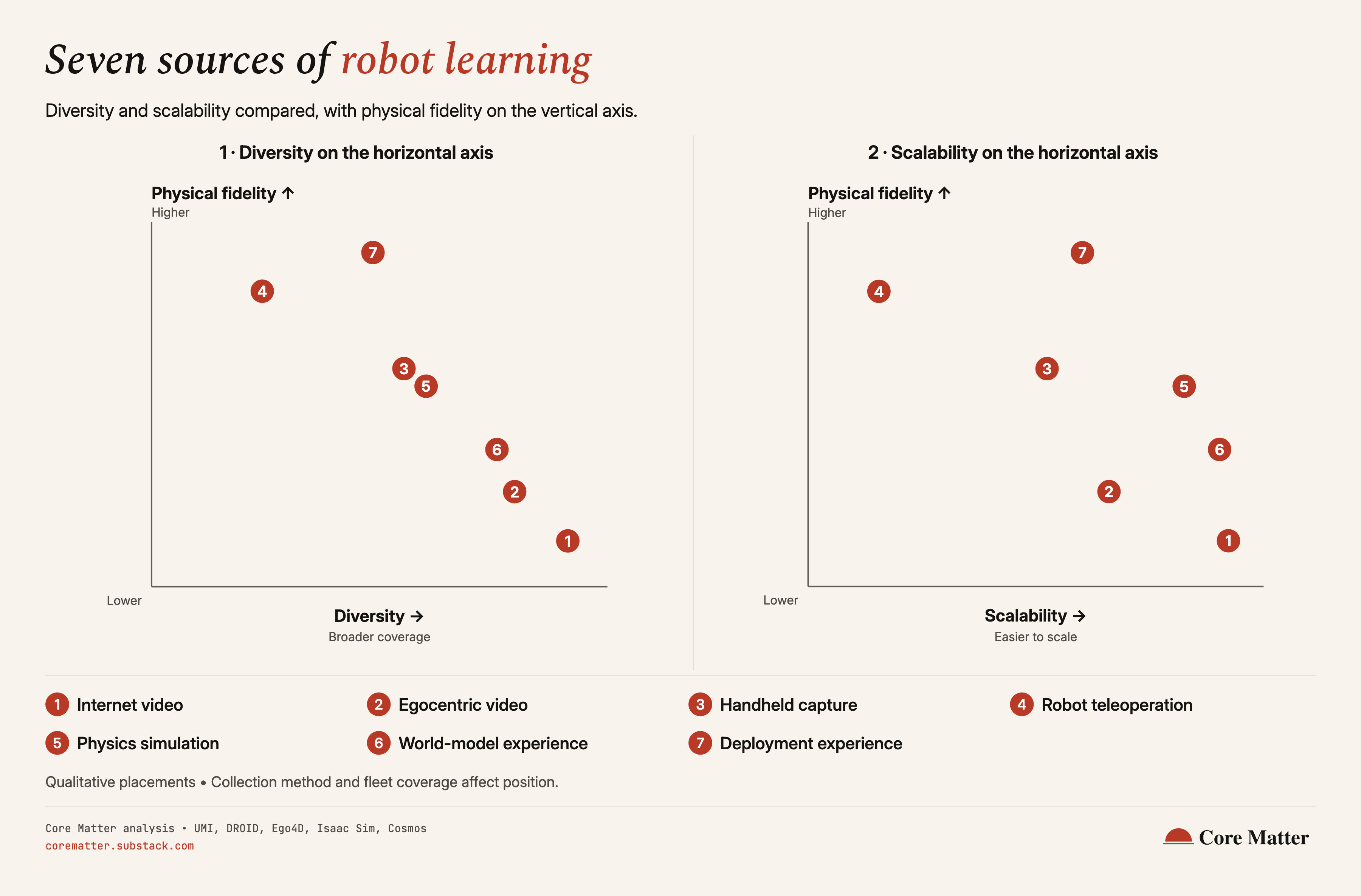
What do robotics models train on? The main sources fall into seven overlapping categories:
Internet video: existing footage of human activity, usually without robot action labels.
Egocentric video: first-person recordings of people performing tasks, sometimes enriched with additional sensors.
Handheld capture: demonstrations recorded with portable tools such as UMI’s camera-equipped grippers, without a robot at the collection site.
Robot teleoperation: a person controls a robot while its actions and sensor readings are recorded.
Physics simulation: virtual robots interact with simulated objects and environments.
World-model experience: learned models generate predicted scenes or outcomes, sometimes conditioned on actions.
Deployment experience: recordings of working robots, including successes, failures and interventions.
Three tradeoffs in robot data
Three key qualities determine how useful robot data is. Each collection method has different tradeoffs:
Scalability: How data scales with labor, equipment and cost. Teleoperation needs robot capacity and operator time. Egocentric and handheld capture remove the robot from collection. Simulation generates repeated trials without an operator for each run, but still requires compute, setup and validation.
Physical fidelity: How accurately the data represents embodiment, motion, contact and outcomes for the target robot.
Diversity: Coverage of tasks, objects, environments and conditions, including failures and recoveries.
What drives demand for robot data
Labs need broader coverage as they tackle new tasks. And data strategy is already a competitive concern in the LLM market. This translates into the robotics market.
Competitive pressure. “The labs don’t want the other labs to figure out what data they’re using to make their models better,” Handshake CEO Garrett Lord told TIME about LLM training data after Meta’s Scale investment. [5]
Limited coverage. Beyond Goldberg’s 100,000-year comparison, hardware, labor and logistical coordination limit collection across environments.
New tasks and failure modes. When model labs look to train for new tasks, robot configurations and difficult cases, they need additional demonstrations.
Utilization and quality determine the economics of data plays
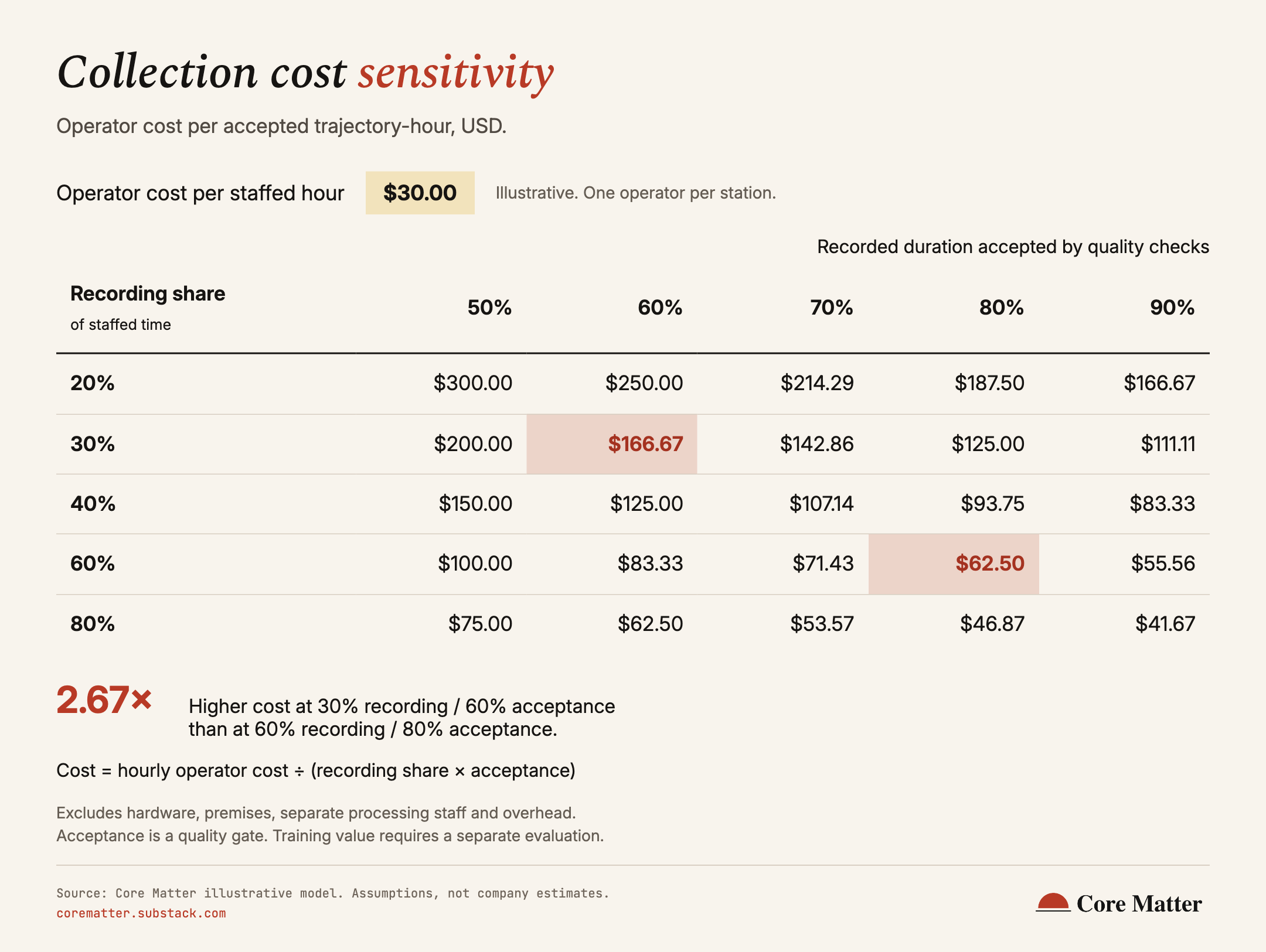
Labor cost is only one lever for a data collection operation. Data collection economics depend on staff and equipment utilization, and on the share of recorded data that passes quality checks.
Cost per accepted trajectory-hour = total collection and processing cost ÷ accepted trajectory-hours.
Consider a hypothetical station with one operator costing $30 per staffed hour. If recording occupies 60% of staffed time and 80% of recorded duration passes quality checks, labor costs $62.50 per accepted trajectory-hour. At 30% recording time and 60% acceptance, that rises to $166.67, a 2.67X difference. Both cases exclude hardware, premises, separate processing staff and overhead.
Tooling, infrastructure and software that improve utilization and data quality can reduce the cost of usable output. One example is developing specialized models to annotate video data more accurately. [16]
Beyond datasets: selling evaluation and deployment
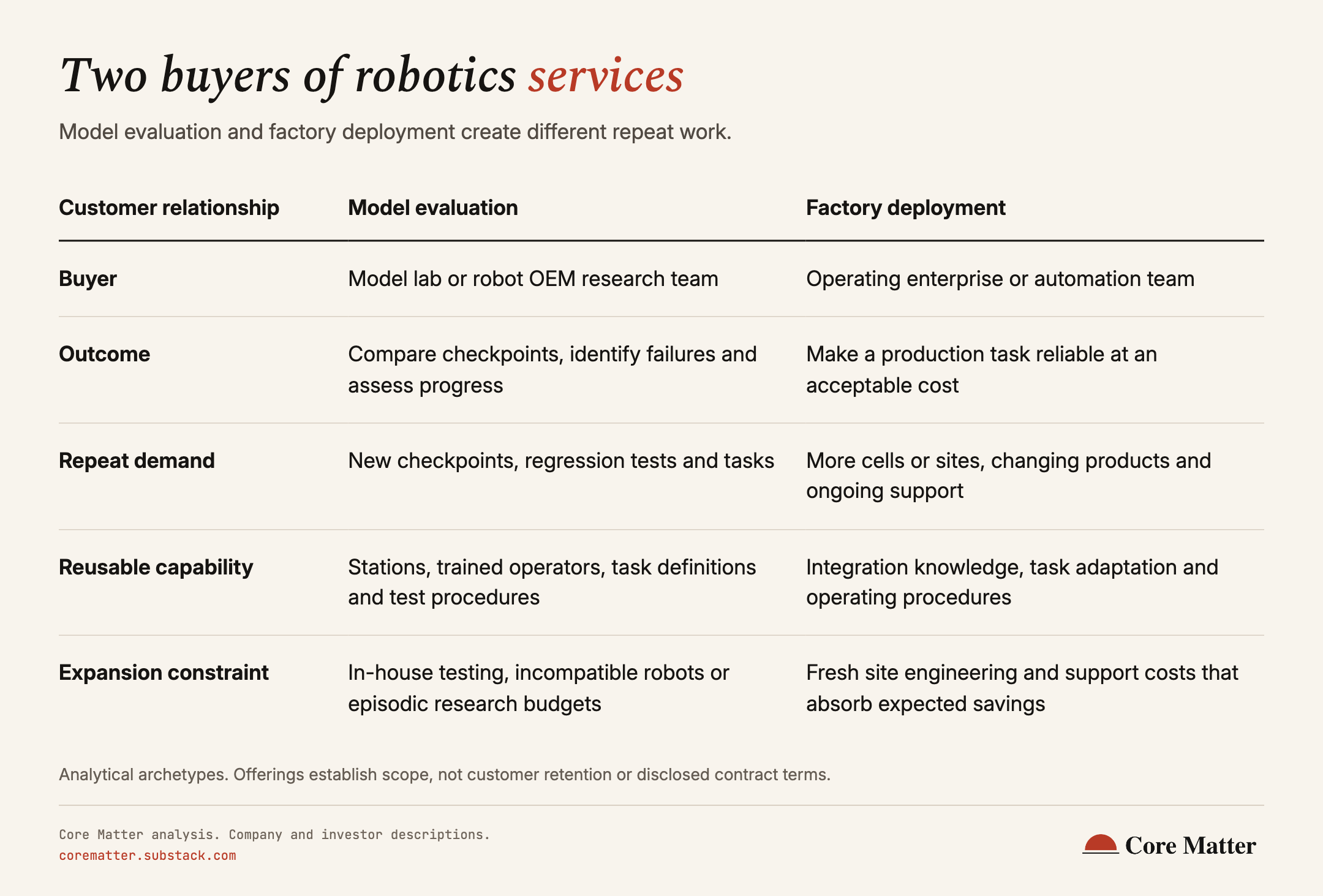
A robotics data supplier operates hardware, trains operators, sets up tasks and checks outputs. Those capabilities can support policy evaluation and, with additional integration work, deployment. These enable a data supplier to sell to two types of customers:
1) The model lab needs to test and improve a policy. It needs to compare checkpoints, reproduce failures, collect corrections and measure progress. New releases and regression tests can generate repeat work on the same stations and procedures.
XDOF lets customers select tasks, test checkpoints and receive results and trial recordings. It also offers corrective collection. Its evaluation service currently specifies bimanual YAM arms from I2RT, so infrastructure reuse depends on the robot and task. [6]
2) The factory operator needs a reliable production task. Parcel sorting, for example, requires the model, arm, sensors and workflow to function together. Repeat work can come from additional cells, new sites, changing products and ongoing support. Integration knowledge may transfer, while site conditions require fresh engineering.
microagi’s investor Redalpine describes recreating a customer’s workstation, purchasing hardware and training the system before renting the working installation to the customer. That model combines continuing revenue with equipment financing and operating responsibility. Other deployments may use customer-owned hardware, as microagi’s current site describes. [7], [8]
Mecka states: “We bring the hardware, data capture, post-training, integration, and ongoing operations.” microagi’s stated ambition is to deploy one million robots. [2], [9]
The financial comparison: Scale AI and its robotics challengers
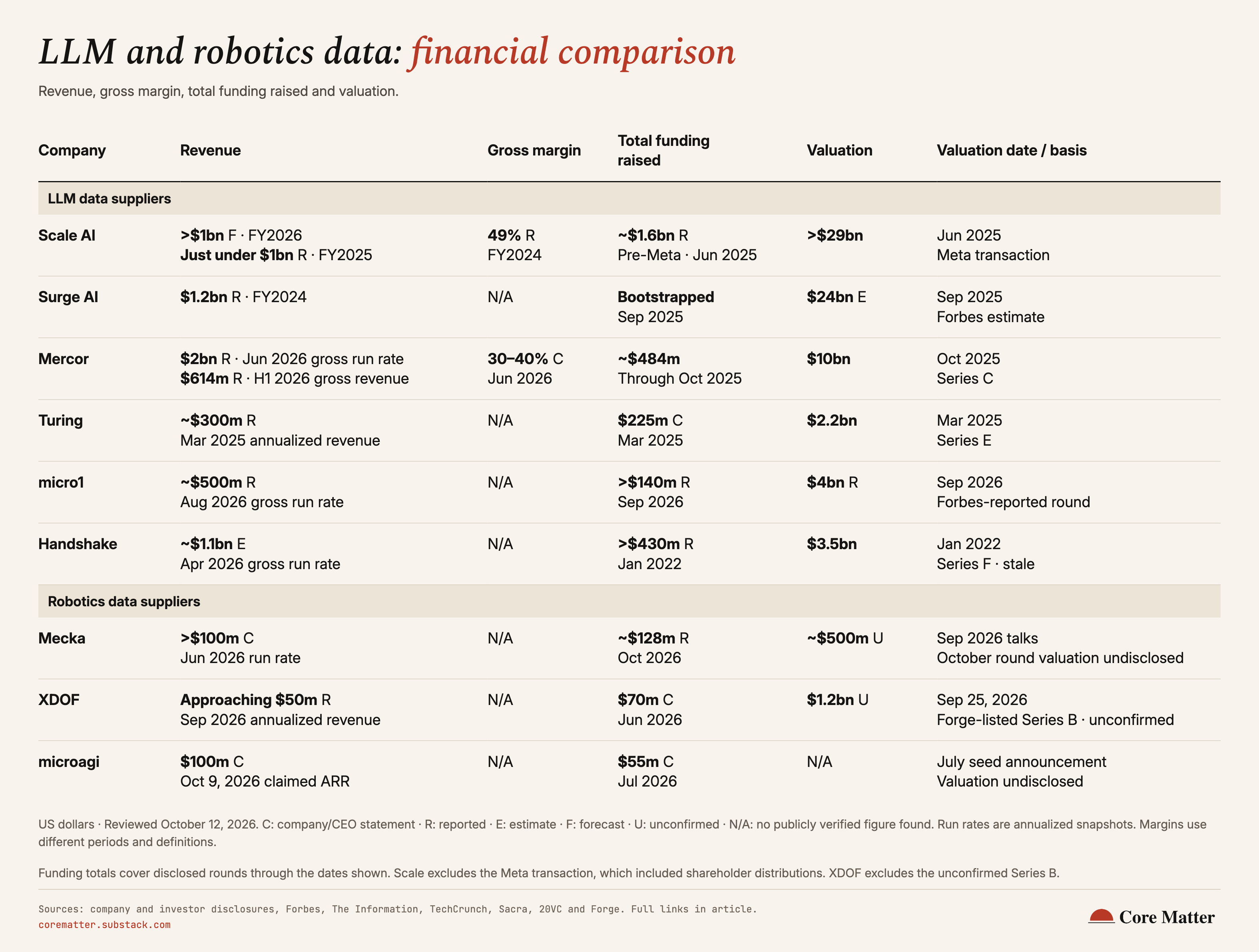
Revenue, gross margins, funding and valuations show the scale these companies are pursuing. The reporting periods and definitions differ.
[10]
