

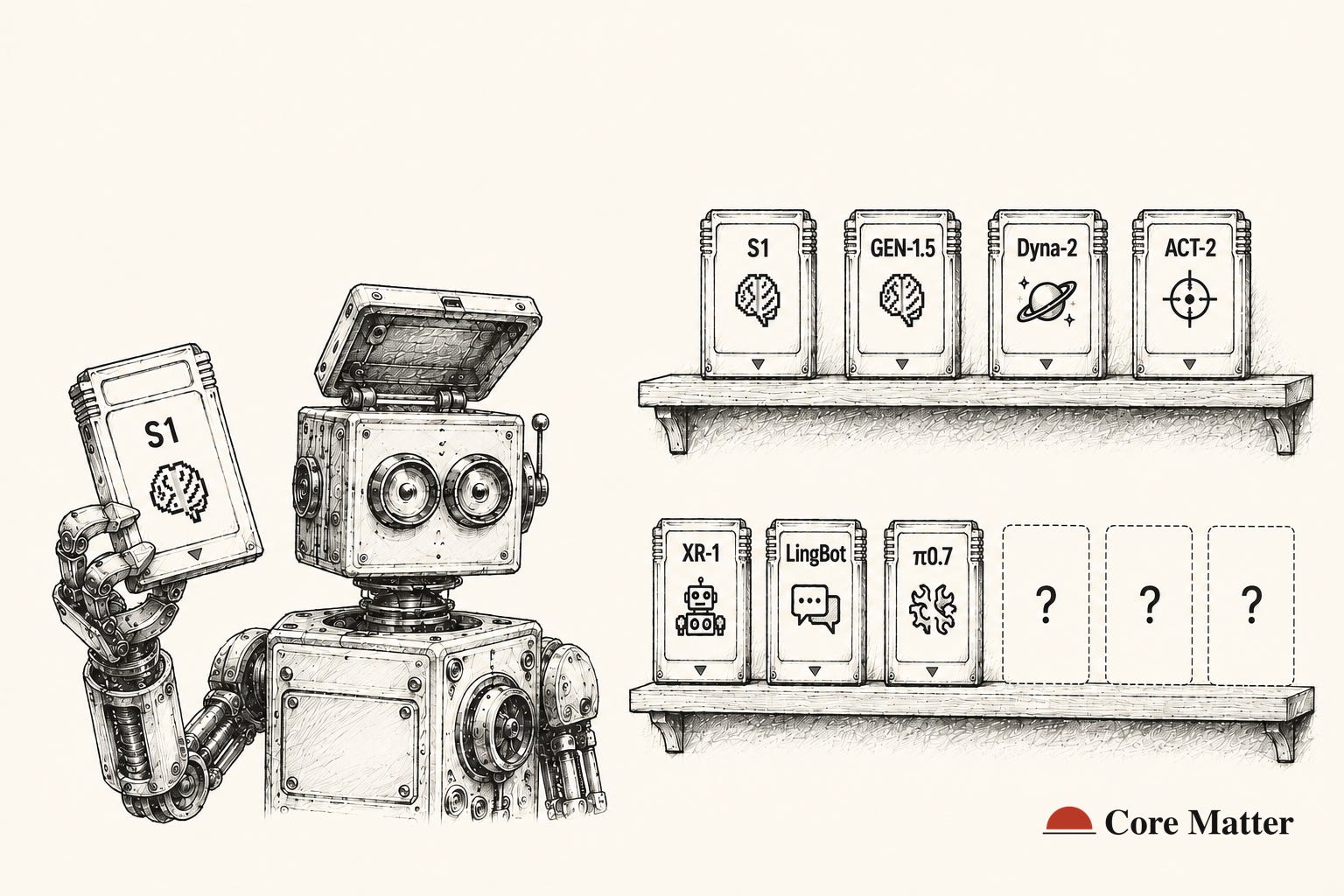
Robot models are not yet like LLMs. We do not use them daily for work or at home. That is why the releases are harder to visualize.
In 2026, every week, or multiple times a week, we see new robot foundation model releases. Many of them claim a GPT-3 moment for robotics. They are all impressive. At the same time, terms like “in-context learning” and “scaling laws” can feel abstract to many (myself included!).
When I read each release, I want to know these four things. What does it actually do, in a humanly relatable way? How does it compare with previous models of the same company and other models out there? What does it unlock? And what’s next?
This format is inspired by the WIRED series that explains complex ideas through different levels of detail. Two of my favorites are its pieces on sleep and machine learning.
In this piece, I share my mental model for answering those questions, one release at a time. Here’s the structure:
Explain it to a 5 year old
Explain it to a smart 12 year old
Explain it to an undergraduate student
Explain it to an expert peer
Which bottleneck is it solving
What it is trying to solve next
I organize by release date, most recent first. I will make this a series as new models ship, so we can compare them over time. If you are new here, subscribe to get the future pieces in your inbox.
For ease of referring to the robot, let’s call it Otto, like autonomous :) These models are Otto’s brain. Each section below gives Otto a different one. “Showing Otto” means giving the model a short recording of someone performing the task. It is closer to uploading an example into a chatbot than to retraining a robot from scratch.
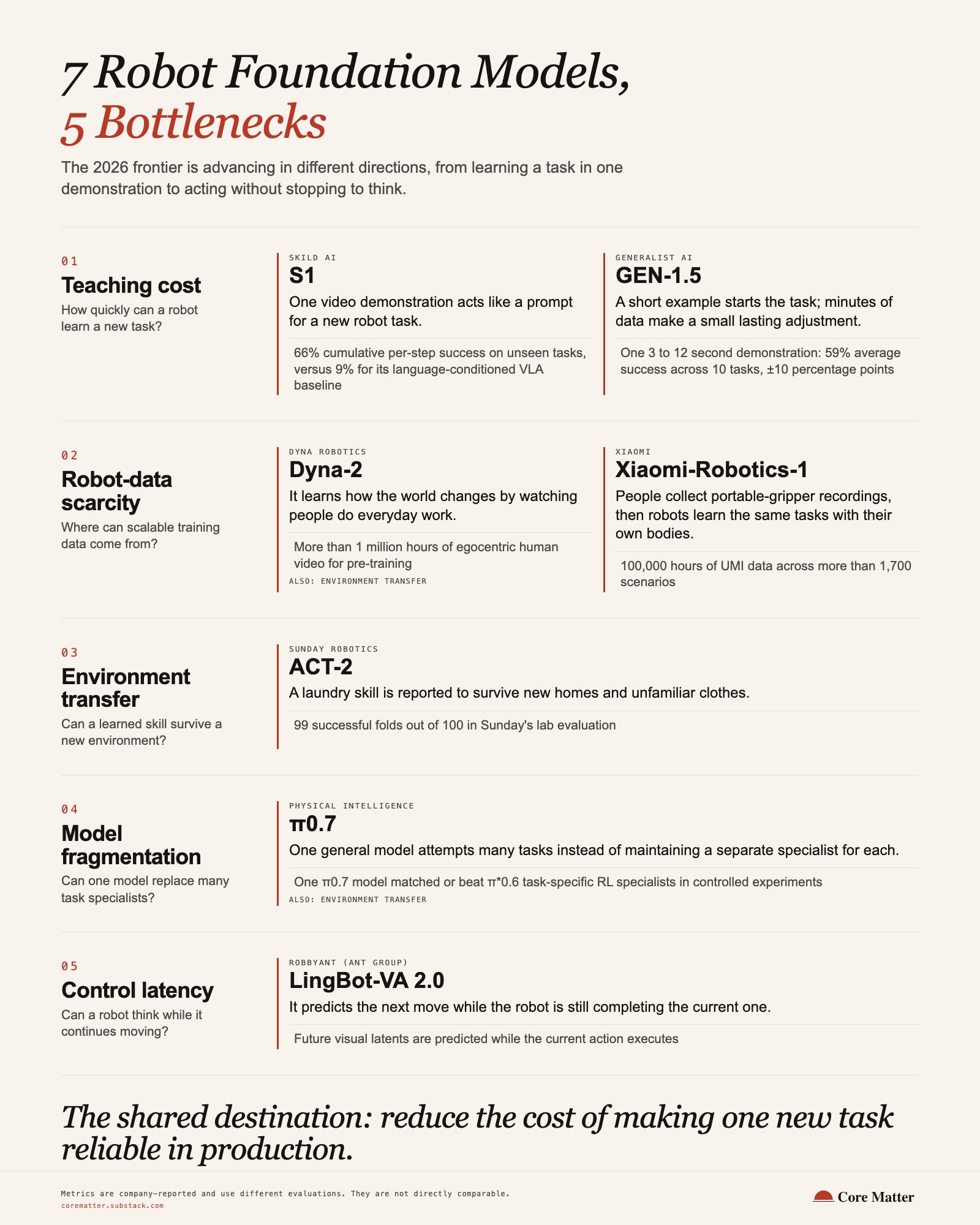
We will go through Skild AI’s S1, Generalist AI’s GEN-1.5, Dyna Robotics’ Dyna-2, Sunday Robotics’ ACT-2, Xiaomi’s Xiaomi-Robotics-1, Robbyant’s LingBot-VA 2.0, and Physical Intelligence’s π0.7.
NVIDIA’s GR00T N1.7 (July 7) expanded the underlying stack rather than demonstrating a new way for robots to learn. We omit it here to focus strictly on task-learning breakthroughs.
Every number in this piece is as reported by the companies themselves.
As always, comments and feedback are greatly appreciated.
Skild AI, S1
Release date: August 25, 2026
To a 5 year old. Dad records a video of himself making pancakes. Otto watches the recording once. Then Otto tries to make pancakes on its own.
To a smart 12 year old. Previously, teaching Otto a new task meant collecting hundreds of examples. Then running a training session for that one task. With S1, Otto learns to make pancakes from one video of Dad doing it. No upgrade to S1.5 or S2 needed. The same model handles each new task, one video at a time.
To an undergraduate student. In the GPT-2 era, each new task needed its own fine-tuning run. Want a model to sort movie reviews into positive and negative? You gather labeled reviews. Then you train. GPT-3’s breakthrough was that examples could go in the prompt itself. Give it “sea otter: loutre de mer” and “whale: baleine.” Then ask it to translate a new animal. No training run. S1 does the physical version of that. The video demonstration is the prompt. The robot executes it with the same model, weights unchanged.
To an expert peer. Skild calls this in-context learning for robot policies. S1 conditions on a video demonstration at deployment time. It does not update its weights. On unseen tasks, Skild reports 66% cumulative per-step success, versus 9% for its language-conditioned VLA baseline, after pre-training on 100,000 hours. One in-context video performed like about 380 post-training episodes. Skild says those episodes would require 50 to 100 hours of teleoperation.
Bottleneck it’s solving. Teaching a new task is expensive. It used to mean a technician’s week of robot operation. S1 changes the unit of teaching to a single recorded example, weights unchanged.
The GPT-3 parallel. GPT-3 made a new language task cheaper to specify. Users could put examples in the prompt. Before that, only machine learning engineers could train a new model. After it, anyone could teach one. GPT-4 and the models that followed did not reinvent prompting. They made it reliable enough to build products on. S1 is reaching for the same shift in robotics. Deploying a new task takes one demonstration instead of a retraining run. Over time, the same model accumulates a long task list.
What it is trying to solve next. One caveat on the numbers first. Skild grades tasks step by step. The score counts the steps Otto completed. If Otto stalls, a human can nudge it forward so the later steps still get scored. So 66% is the share of steps completed. It is not the share of tasks Otto finished alone.
The open questions:
Can one demonstration reliably produce a clean, unassisted run?
Does performance hold across unfamiliar objects, layouts, and robot bodies?
Can a one-off demonstration become a robust production system? The system is more than the robot. It includes how demos get recorded and checked, which tasks get accepted, and how failures get caught. Deployment needs a whole system to work.
Generalist AI, GEN-1.5
Release date: August 19, 2026
To a 5 year old. Show Otto a three-second video of Dad twisting open a jar. Otto tries to twist open the jar.
To a smart 12 year old. Otto can start opening jars from one very short example. Give it a few more minutes of Dad doing the same thing, plus a quick update of the brain. Jar-opening success goes from about 59% to 83%.
To an undergraduate student. A chatbot can pick up a pattern from examples you paste into the conversation. Show it two invoice lines coded the right way. It codes the next one the same way. No retraining. That behavior has now shown up in robotics. GEN-1.5 can learn physical skills on the spot, without being trained on that skill explicitly. It offers two modes. One short physical example for immediate behavior. Or a few minutes of data and a handful of updates for a small, lasting adjustment.
To an expert peer. Generalist describes GEN-1.5 as in-context learning with optional few-step fine-tuning. One 3 to 12 second demonstration produced 59% average success across 10 tasks, with a reported plus-or-minus 10 percentage-point spread. One gradient step on one minute of data reached 66.5% on a held-out task. Ten steps on about five minutes, or roughly 50 demonstrations, reached 83%, with a reported plus-or-minus 9 points. The pre-training set contains 270,000 hours of UMI data and grows by 10,000 hours per week.
Bottleneck it’s solving. Teaching a new task is expensive, and this cuts the bill. Task-specific data and compute drop to minutes and a handful of updates.
What it is trying to solve next. These are short, simple tasks: jars, zippers, pouches. The open question is whether the same pattern extends to long-horizon work.
Dyna Robotics, Dyna-2
Release date: August 10, 2026
To a 5 year old. Dad wears a head camera and records himself chopping tomatoes for dinner. Otto watches many videos like that. Then Otto tries chopping with its own robot hands.
To a smart 12 year old. Dyna teaches Otto how the world changes. When a knife cuts a tomato, the tomato splits into slices. Otto learned all of this from watching videos of people. It can translate human hand movements into robot hand movements.
To an undergraduate student. Most robot models are VLAs, vision-language-action models. They look at the scene, read the instruction, and output an action. Dyna-2 is a WAM, a world-action model. It also predicts how the scene will change next. The actions come out of that same model. Understanding how the world evolves helps Otto pick a better next move, especially somewhere it has never been.
To an expert peer. Dyna calls Dyna-2 a world-action model, not a VLA. It uses a video-diffusion backbone with a mixture of transformers, flow matching, and DiT layers with causal masking. Dyna reports more than 1 million hours of egocentric human video for pre-training. Its evaluation covers 14 benchmark tasks across 3 embodiments, with 39 tasks in total. The reported customer-site pass rate rose from 46% with DYNA-1 to 87% with Dyna-2.
This matters for a second reason. Dyna’s pre-training data is ordinary human video captured on head-mounted cameras. No robot gloves. No teleoperation rigs. That source is cheaper and far more abundant than robot data. In Dyna’s experiments, the video prediction is what made human-to-robot transfer improve as data scaled. Their WAM reached 1.55x the success rate of their previous VLA.
Bottleneck it’s solving. Robot data is scarce, and teleoperated demonstrations are the expensive kind. Dyna learns world dynamics from large-scale human video instead. If that reliably transfers to robots, we need far less of the scarce stuff.
What it is trying to solve next.
Does human video keep improving robot performance on very different robot bodies, not just human-shaped ones?
How much robot-specific data is still required after a million hours of human video?
Can the 87% customer-site result be reproduced by independent operators and across more sites?
Sunday Robotics, ACT-2
Release date: July 17, 2026
To a 5 year old. Otto folds laundry. It folds in homes it has never visited. It folds clothes it has never seen. Even when clothes fall on the floor, Otto picks them up and keeps folding.
To a smart 12 year old. Otto practiced folding laundry in Sunday’s lab. It practiced until it could fold 99 times out of 100. Usually that kind of practice only works in the practice room. A new home breaks it. ACT-2 is the exception. Otto folds laundry in homes it has never visited, with clothes it has never seen.
To an undergraduate student. ChatGPT gets better at your style of writing after a few corrections. It carries the lesson into the next conversation instead of forgetting it. ACT-2 does the physical version. One fine-tuning example teaches a new behavior. The improvement generalizes to unseen homes instead of sticking only to the practice room.
To an expert peer. Sunday uses “solve” for reliable performance across a declared scope at a stated adaptation cost. For ACT-2, the declared task is laundry and the stated per-home adaptation cost is zero. Sunday reports 99 successful folds out of 100 in its lab evaluation. The claim to test is transfer: the same behavior is reported in unseen homes and with unseen clothing, without collecting new data or fine-tuning in each home.
Bottleneck it’s solving. Skills usually break in new environments, so each new home would need its own data collection and fine-tuning. ACT-2 needs neither: no data collection or fine-tuning per home, with training data from people wearing robot gloves.
What it is trying to solve next.
Laundry is one task. Vacuuming, toy tidying, zippers, and coffee are still in training.
Does the reliability survive months in a real family home, not just evaluation visits?
Xiaomi, Xiaomi-Robotics-1
Release date: July 16, 2026
To a 5 year old. Dad loads the laundry into the washing machine. He uses a handheld robot hand. A small camera on the gripper records everything. Otto watches many recordings like that. Then Otto loads laundry with its own hands.
To a smart 12 year old. Many people recorded themselves doing chores. They used a small handheld gripper with a camera. Then the robot practiced the same chores with its own body. The recordings are not tied to one robot. So the same model can learn the tasks on different robot bodies. In Xiaomi’s tests, under 10 hours of examples per task reached a 75% average success rate.
To an undergraduate student. This is similar to training ChatGPT on a large amount of general material. Then giving it a smaller set of examples in the format it will actually be used in. Xiaomi pre-trained on broad human manipulation data. Then a smaller amount of robot data taught the model to follow language instructions on real robots.
To an expert peer. Xiaomi-Robotics-1 uses embodiment-free UMI trajectories for pre-training, then real-robot data for post-training. Xiaomi reports 100,000 hours of UMI data across more than 1,700 scenarios, followed by more than 7,200 hours of real-robot data from homes and cross-embodiment datasets. Under 10 hours of demonstrations per task produced 75% average success, versus 40% for the baseline. Under 40 hours produced 85%, versus 53% for the baseline.
Bottleneck it’s solving. Robot data is scarce, so Xiaomi splits collection in two: pre-training on portable-gripper data anyone can record, then post-training on real robots. It also publishes how much demonstration data each task took.
What it is trying to solve next.
Do these numbers hold outside Xiaomi’s own tests?
Does the handheld-gripper-to-robot transfer hold across more robot bodies and harder tasks?
What does a demonstration hour actually cost? Recording is one part. Annotation, setup, and supervision are the rest.
Robbyant (Ant Group), LingBot-VA 2.0
Release date: July 9, 2026 (arXiv, revised July 16; peer-reviewed at RSS 2026)
To a 5 year old. Otto carries a glass of water across an obstacle course. While it takes one step, it is already getting ready for the next one. It does not stop to think between steps.
To a smart 12 year old. If Otto stopped after every movement to think about the next one, it would be slow and jerky. The water in the glass would slosh out. It would lose the race. LingBot predicts what will happen next while Otto is still moving. Then it checks what actually happened and adjusts.
To an undergraduate student. There is no clean chatbot parallel here. ChatGPT generates one token after another. The next token waits for the last. LingBot-VA 2.0 predicts and executes at the same time. It predicts future video states and actions in parallel with what the robot is doing.
Picture the AI autocomplete in email apps. It drafts the rest of your sentence from context while you are still typing. LingBot does that, except the sentence is a physical movement. Otto keeps moving while it drafts.
To an expert peer. Robbyant describes LingBot-VA 2.0 as an autoregressive video-action model with closed-loop control. It uses a semantic visual-action tokenizer, a shared observation-action latent space, a sparse mixture-of-experts backbone, and asynchronous inference. Future visual latents are predicted while the current action executes. The model re-grounds each rollout on the latest observation. The paper is peer-reviewed at RSS 2026 and does not publish a task-cost number.
Bottleneck it’s solving. Robots pause between thinking and acting. Plan too slowly, and the robot is slow and jerky. Act too fast on stale predictions, and the robot keeps moving after the environment changes, eg. a chair gets shifted, something rolls into its path. LingBot predicts and acts asynchronously in a closed loop, so Otto keeps moving smoothly while staying responsive. Real environments do not pause while the robot thinks.
What it is trying to solve next.
Can the robot keep making accurate next-move predictions at speed, over long tasks?
Can it react when objects around it move unexpectedly?
Physical Intelligence, π0.7
Release date: April 16, 2026
To a 5 year old. Otto has one toolbox. Not a separate box for pancakes, one for laundry, and one for making coffee. After dinner, Otto cleans up the kitchen. It picks different tools from the same box for each job.
To a smart 12 year old. Before, robots often had a separate specialist model for each task. One for opening the drawer. Another for picking things up. Another for wiping the counter. With π0.7, Otto uses one brain for the whole kitchen cleanup. It matches or beats the separate models.
To an undergraduate student. Instead of having one AI for translation, another for trip planning, and another for financial analysis, you use Claude for all three. π0.7 attempts the physical equivalent. One model controls different robots across different tasks. The analogy is not perfect. Claude produces text in one interface. π0.7 still has to translate instructions into safe movements through a physical body. That translation is called grounding. It connects words like “wipe the counter” to the actual forces, paths, and motions that work for this robot, in this kitchen.
To an expert peer. Physical Intelligence frames π0.7 as “a step-change in generalization.” It uses multimodal prompts with language instructions, world-model-generated visual subgoals, speed and quality metadata, and control-modality labels. One π0.7 model matched or beat π*0.6 task-specific RL specialists in the company’s controlled experiments. The post does not state the total training-data scale or the cost of adapting to a new task. That missing number matters when comparing it with the models that publish demonstration hours.
Bottleneck it’s solving. When every task needs a separate model, deployment becomes a model-management problem. Different weights, interfaces, update cycles, and failure modes to track. π0.7 is one general model across tasks and robots, which simplifies that stack. It also shows a robot attempting tasks it was never taught, like operating a kitchen gadget it has not seen before.
What it is trying to solve next.
Can it do genuinely unseen tasks reliably, not just recombinations of familiar skills?
How well does grounding hold when the scene, the objects, or the robot body change?
How much does it cost, in data and in compute, to adapt the unified model to a new task?
Where this leaves us
One note on the tool behind several of these models. UMI, the Universal Manipulation Interface, is a portable gripper with a camera. A person carries it while performing a task. It captures the person’s movement and the scene at the same time. The original open-source design costs about $370 in parts. The 3D-printed gripper is $73. The GoPro camera and accessories are $298, per the paper that introduced it. That is cheaper and easier to scale than teleoperating an actual robot. Teleoperation needs expensive hardware, setup time, and skilled operators. Sunday built its own variant: sensorized gloves at about $200 a pair.
In summary:
Xiaomi-Robotics-1 pre-trains Otto on humans using handheld grippers, then adapts to new tasks with a few hours of real-robot demonstrations
S1 lets Otto learn from one example
GEN-1.5 enables Otto to learn in seconds and minutes for quick tasks
Dyna-2 teaches Otto from large-scale human video by predicting the environment
ACT-2 lets Otto do a task reliably in homes it has never seen, with no per-home training
π0.7 lets Otto do many tasks with one general brain, not a collection of specialized brains
LingBot-VA 2.0 predicts what happens next to help Otto move quickly and smoothly
The releases are moving the frontier in different directions, but they leave the buyer’s main question partly unanswered: what does it cost to make one new task reliable in production? I’ll dig into that in a follow-up piece in the coming weeks.