

A robot washes dishes indefinitely because it has no sense of how long it’s been washing.
The same robot burns the grilled cheese because it has no memory of having already started the grill.
Is memory the gating factor to robots getting deployed to industrial and home use?
At the same time, Figure and AgiBot have done days-long livestreams of long-running package sorting. How did they do it, if memory was needed for long horizon tasks?
This post is a deep dive into what robot memory is, what role it plays in terms of deployment readiness of robots, in industrial and home settings, and what the frontier is.
What does “robot memory” actually mean?
Recently there have been at least two talks about robots and memory. Chelsea Finn’s YC AI Startup School talk, where memory comes up as one hypothesis among several and is set aside, and the robotics edition of YC Paper Club “Why Robotics Still Isn’t Solved”, which had a presentation by Marcel Torne. Torne is a Stanford PhD student in Finn’s lab and built the work during an internship at Physical Intelligence.
When I looked deeper into the problem space, robot memory turns out to mean at least 3 different problems:
1. What’s happening inside one episode of an attempt. Did I already wash this dish? How long has this been on the heat? This is what the memory papers do. Status as of August 2026: five months old, and not solved. The numbers are below.
2. Improvement across attempts. The cheese was not properly melted inside the grilled cheese yesterday, even though it looked ready on the outside. I should lower the heat today. Status: started earlier, reports bigger numbers, on narrower tasks. Not solved either.
3. Preference that persists per person. This person prefers the shirts to be folded this way, the pans live here. Status: papers exist, and we have not found a robot shown doing it. The strongest real-robot work we found (VAP, POSTECH) identifies which object belongs to a given user. It doesn’t adopt a user preference yet.
How good is robot memory in 2026?
Feeding a model its own video is expensive, so the memory systems compress instead. π0 is built on PaliGemma, a 3-billion-parameter vision-language model, and it conditions on the current observation alone, with no history at all. Adding history means paying for every frame. At PaliGemma’s 256 tokens an image, three cameras and ten seconds at 20 frames a second is over 150,000 tokens for a single decision.
RoboMME is the bake-off: 14 ways of adding memory, each bolted onto the same robot brain, all scored on the same 16 tasks. Holding the backbone fixed is the whole point, because it makes the designs comparable to each other. With no memory, the policy scored 17.93%. The best memory design scored 44.51%, and several scored below the no-memory baseline, which means those designs made the robot worse than having nothing. The tasks run in simulation on a tabletop arm, which is the forgiving setting, no perception noise and no calibration drift, so 44.51% is the generous reading.
Memory is not a switch you turn on. Most ways of adding it make the robot worse. A few help.
Physical Intelligence went at problem 2 first, learning across attempts rather than inside one. Its π*0.6 model, trained with a method called RECAP, shipped in November 2025. The robot practises a task, its failures get labelled, and the next version trains on them. On the hardest tasks, throughput more than doubled and failure rates roughly halved.
Those are experience results, not memory results. They often get quoted as one thing. When someone says robots doubled their throughput on laundry, that came out of RECAP learning across attempts, which is problem 2. Problem 1, remembering inside a single attempt, is separate work: MEM, four months later in March 2026. MEM claims tasks that span up to fifteen minutes, cleaning up a kitchen or preparing a grilled cheese sandwich. On Physical Intelligence’s own bar chart, MEM reaches roughly 90% task progress on grilled cheese against roughly 50% without memory. Task progress is partial credit, not a success rate.
MEM’s number and RoboMME’s 44.51% do not sit on the same axis. RoboMME does not evaluate MEM at all. 44.51% is the best of RoboMME’s own designs on RoboMME’s simulated tasks, scored as success rate. MEM’s figure is task progress on tasks its own authors chose.
Other results run much higher, and the benchmarks do not overlap, so they cannot be ranked against each other. NativeMEM, published July 2026, compresses each past frame to a single token using the policy’s own vision encoder, and reports success rates rising from 32.4% to 84.0% in simulation and up to 98.7% on real robots. MemoryVLA, a year older, reports 84.0% across twelve real-world tasks. Each ran on a task set its own authors picked. Neither has been run on RoboMME’s benchmark, and RoboMME’s fourteen designs have not been run on theirs. So a buyer today cannot tell which memory design survives contact with their task.
Even RECAP, the part that worked, still has a person inside it. The practice rollouts were automated. Experts (humans) are still needed to label the rewards, specifying what counts as success. Teleoperators (also humans) step in mid-task to help correct the robot during the rollouts.
This is the frontier: the robot learns from its own failures, and a human has to tell it that it failed.
Why do factory robots work without memory?
1. The environment holds the state
Figure ran 249,560 packages over 200 hours, across three robots on autonomous fleet rotation. AgiBot ran 64,828 tasks at a claimed 99.99% on Longcheer’s Nanchang line. Both figures are company-claimed, from company-run livestreams, and neither company has documented any memory carried across episodes.
It turns out the production line doesn’t need memory. Package 12,000 does not depend on package 11,999. The fixtures hold the part in a known position, the conveyor belt delivers each package at a known time.
The robots averaged 1,248 packages an hour, about 2.9 seconds each, against Figure’s stated three seconds for a human worker. 249,560 packages is a quarter of a million repetitions of a three-second task.
2. The state is visible, and doesn’t need memory
Call it the photograph test. If you photograph a scene and send the photo to someone who didn’t know what happened a second ago, and they can do the next step correctly, the robot doesn’t need memory for that task either.
For example, for a half-folded shirt, anyone can look at that and continue the next folding step. Laundry folding doesn’t need memory, even though the task takes 10 to 20 minutes per load.
Grilled cheese on a pan is different. A photo of the sandwich cannot say whether it’s been on the pan for 30 seconds or 4 minutes, or whether the cheese is melting inside. It needs memory, even though the task is shorter, around 4 minutes long.
How long the task takes is not the determining factor of whether memory is needed. It’s also not about the complexity of the task. It’s about whether the current state is readable from a plain camera frame.
Just because a task has a long horizon, doesn’t mean it needs memory.
Which robot tasks are ready to deploy today?
Currently, the robot does not learn what is worth remembering. A person specifies it in advance, for every task, before training. Change the task and someone writes a new list.
Figure and AgiBot have shown robots can perform tasks for days. The question is which tasks the robots can do reliably at the current capabilities and limitations, memory included.
Below is a matrix of tasks, split into home and industrial use cases, and their deployment readiness.
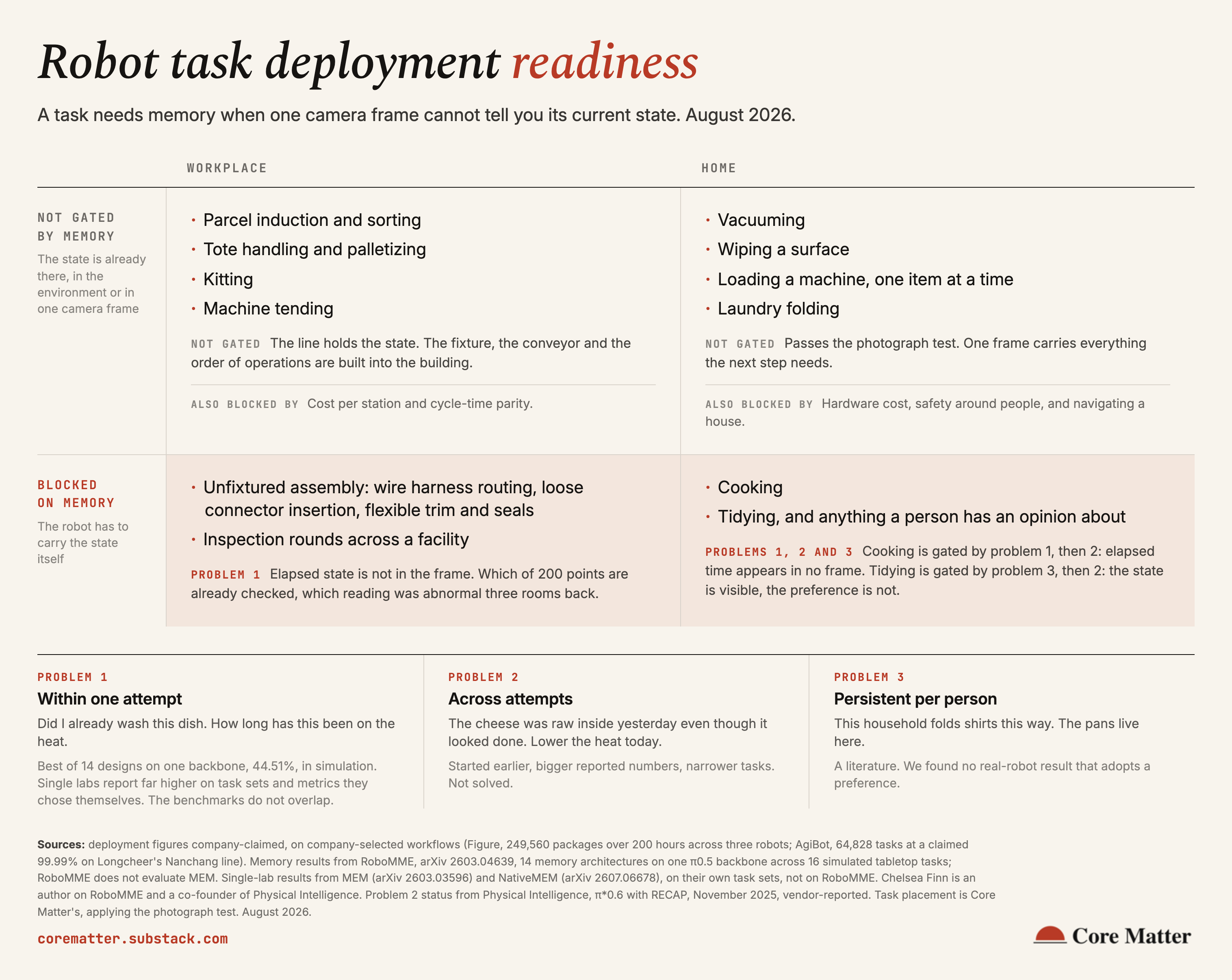
Workplace, deployable now: structured logistics and fixtured production lines. Parcel induction and sorting, tote handling, palletizing, kitting, machine tending. Figure’s package sorting is exactly this. The line does the remembering, so memory is not the blocker.
Workplace, blocked on problem 1: unfixtured assembly and inspection rounds. Unfixtured means the part is not clamped in a jig at a known position: wire harness routing, connector insertion where the cable hangs loose, fitting flexible trim or seals. Inspection rounds: walk a facility, check 200 points, know which ones you already did and which reading was abnormal three rooms back. This is the near-term commercial edge of the research as of August 2026.
Home, “standard tasks”: These pass the photograph test. These are the chores a stranger could walk in and finish. There’s a universal judge of whether it’s finished or not. Vacuuming, wiping a surface, loading a machine one item at a time.
Home, blocked, by different problems. Cooking is gated by problem 1 first and problem 2 second: elapsed time appears in no frame, which is the grilled cheese from the opening. Tidying is not gated by problem 1 at all, because the state of a room is visible in one look. It is gated by problem 3 and then problem 2, because where things belong is a household’s opinion, and the robot has to hold that opinion and improve on it.
What has to change before robots work in homes?
Two milestones will unlock robots capability significantly.
Milestone one: removing the human from deciding what counted as success and failure.
Currently, a person needs to define success and to intervene on failure for the robot. In a factory, once a workflow is defined as success, for example a tablet passes quality inspection, that definition is spread across tens of thousands of repetitions of the same workflow. AgiBot’s run was 64,828 tasks and 17,625 tablets. In a house, the task distribution is much wider. Human labeling and teleop intervention are needed more frequently at home than in a factory.
ENPIRE (NVIDIA, CMU, UC Berkeley, arXiv 2606.19980, June 2026) is the closest thing to a human-free loop we found. Coding agents run the improvement loop on real hardware: automatic scene reset, synthesized reward functions, parallel rollouts across 8 bimanual stations. It automates the reset of the scene, and the verification of the attempt. Humans are left with one-time work: set safety constraints, provide a few minutes of success and failure demonstrations so the agents can synthesize a verifier, and sign off on the reset procedure the agents build.
So why is this not already running on every robot? Because it gets more expensive per robot as you add robots.
The coding agents read the video and logs coming off every station and write their reasoning back. Token cost grows super-linearly with fleet size: the paper’s token use tracks the linear projection up to four agents and rises sharply at eight. The agents spend their hours reading logs, writing code and debugging rather than running robots.
Human labeling costs about the same per robot however many you run. The agent cost per robot climbs. The unlock will be to figure out how to scale agent efficiently to perform labeling in a fleet.
Milestone two: fully online learning.
With the human out of the reward loop, the second milestone becomes possible. RECAP runs in batches today: collect attempts, humans label, retrain, redeploy. The next improvement is the robot updates from its own attempts continuously while it works, with no labeling pass and no retrain cycle in between.
So is memory the blocker, or the reward signal?
Memory tells the robot what happened. Reward tells the robot what a good result looks like. A robot can replay the last four minutes perfectly and still not know the grilled cheese is meant to come off golden. A person has to specify that, once per task.
