

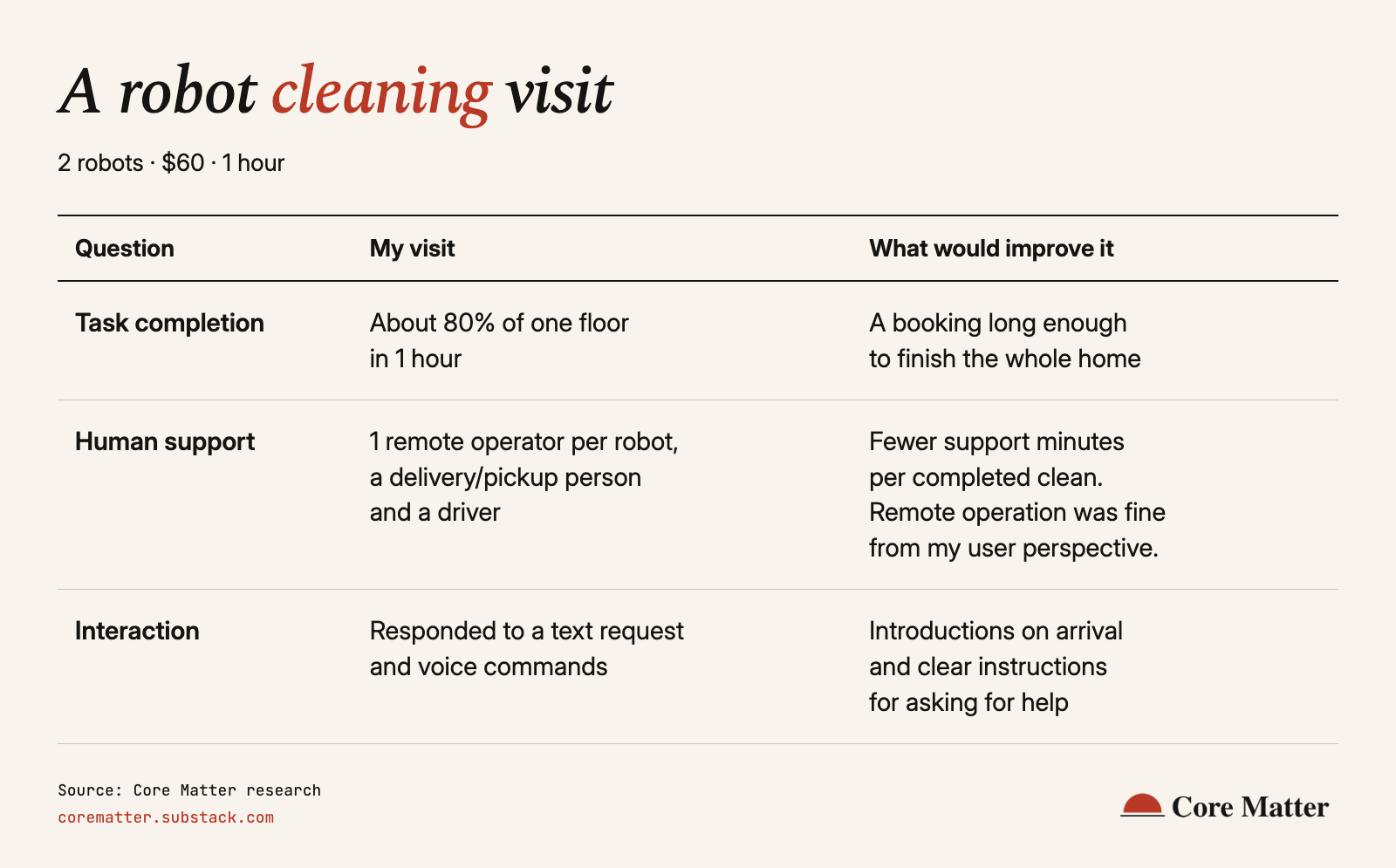
On Sunday, I paid $60 for 2 humanoids from Tau Robotics to clean my home in San Francisco for an hour. Sergey and Chelsea (the name of the two robots) tidied, wiped surfaces, vacuumed, mopped and cleaned the toilet. After an hour, they finished cleaning the dining, living room, kitchen and 1 half bathroom.
Each robot had a human operator controlling it remotely from the company’s office in the Mission. A staff member dropped them off and picked them up. For most of the hour, there was no company staff member in the house.
This experience reinforced my belief that home robots should be available to rent by the task or hour. For the user, paying $60 to try a cleaning service is a much smaller commitment than buying a robot or taking on a monthly subscription (Weave lists Isaac 1 at $449 per month or $7,999 up front [1], and 1X lists NEO at $499 per month or $20,000 to own [2]). For the robotics company, sending the same robots into different homes could increase utilization and give it more opportunities to collect data and improve both hardware and software before the next deployment.
From observing this visit, I also saw how much work surrounds that hour of cleaning. Below I share a) my experience as a first time user of a humanoid cleaning service, b) the economics for the user and for the company, c) what a future with humanoids and advanced robots doing productive work around us would look like.
If you’ve hired a humanoid to clean your home, be it in SF, or Shenzhen, or elsewhere, I’d love to hear about your experience.
1. The task is the product
I paid $30 per robot-hour, but the booking ended with work unfinished. Do I care whether it’s teleoperated or fully autonomous? No. What matters most is to have the whole home cleaned.
Around my neighborhood in San Francisco, a full-home clean costs roughly $200–220 for 2 human cleaners working about 2.5 hours. That comes to $40-44 per worker-hour. The robot service has a lower hourly price, but my $60 booking left the job unfinished. In later correspondence, one of the founders, Cornelia Weinzierl, shared that they could potentially do a longer visit by swapping batteries after an hour.
What can the cleaning robots do?
Vacuuming, mopping and wiping surfaces seem easy for them. They were doing it almost as well as a human.
The robots seemed slower on delicate tasks, such as moving objects to clean a surface and picking up small or soft objects like toys and socks. Chelsea dropped a toy, struggled with a pillow and had trouble balancing on the playmat. For the tasks they completed, grippers were enough.
They didn’t attempt unloading my dishwasher, as it was running at the time. After the service, I learned from another user that it was described as an “advanced task” by the company. The robots also didn’t fold our laundry. Weinzierl later told me that loading and unloading the dishwasher are possible but slow, and that some dishes may be placed at unusual angles. She also said the robots can “fold T-shirts, pants, shorts, skirts, diverse types of towels, roll up socks. Hang shirts, blouses, dresses, light jackets and similar. They struggle with folding bedsheets or tight sports long sleeve shirts if they are inside out.” Frankly, I find that pretty impressive with their grippers. That suggests five fingers may not be necessary for these household tasks.
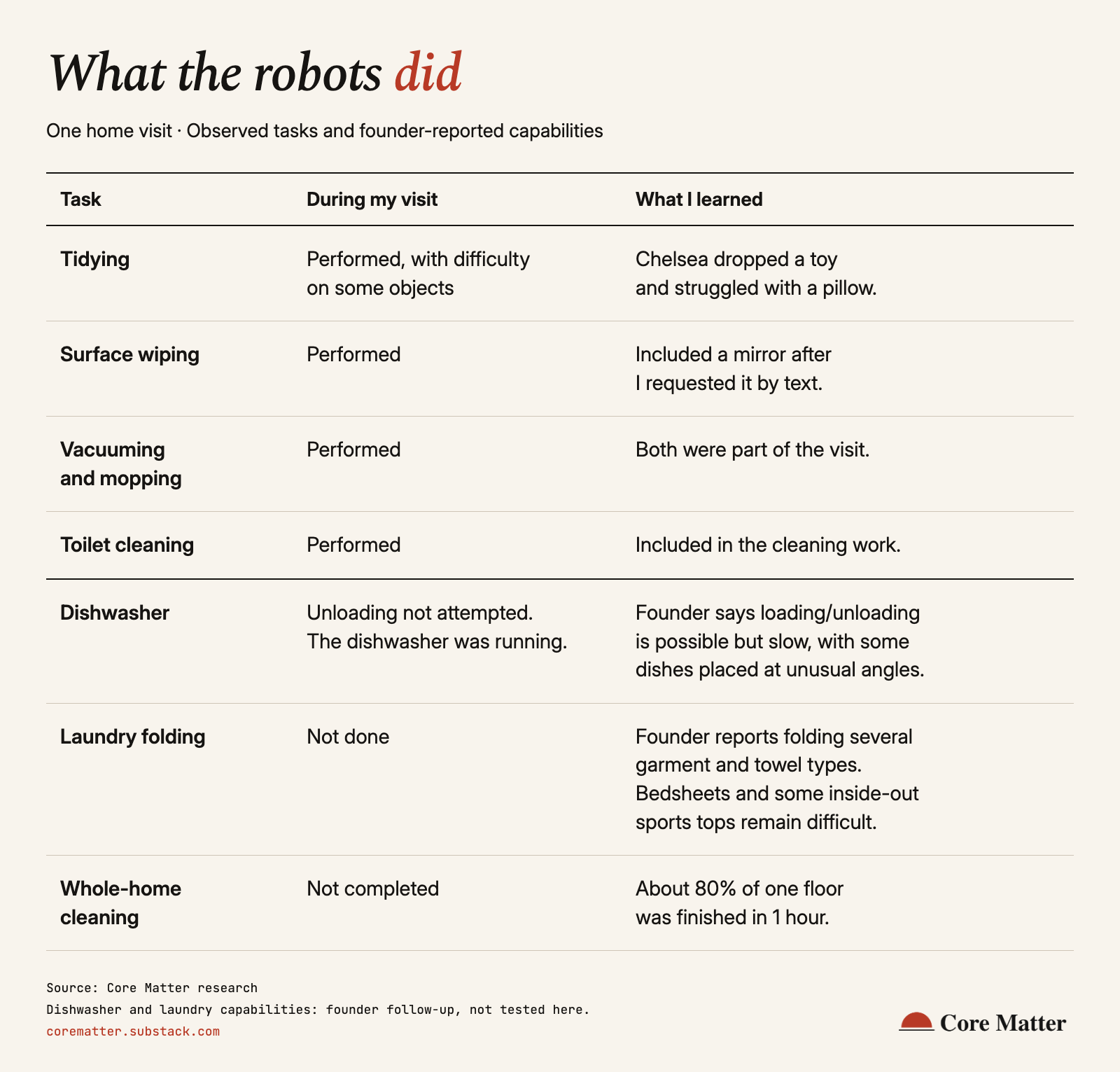
I was told the batteries needed swapping after about an hour. Extending my booking would have required swapping the battery.
2. The economics extend beyond the house
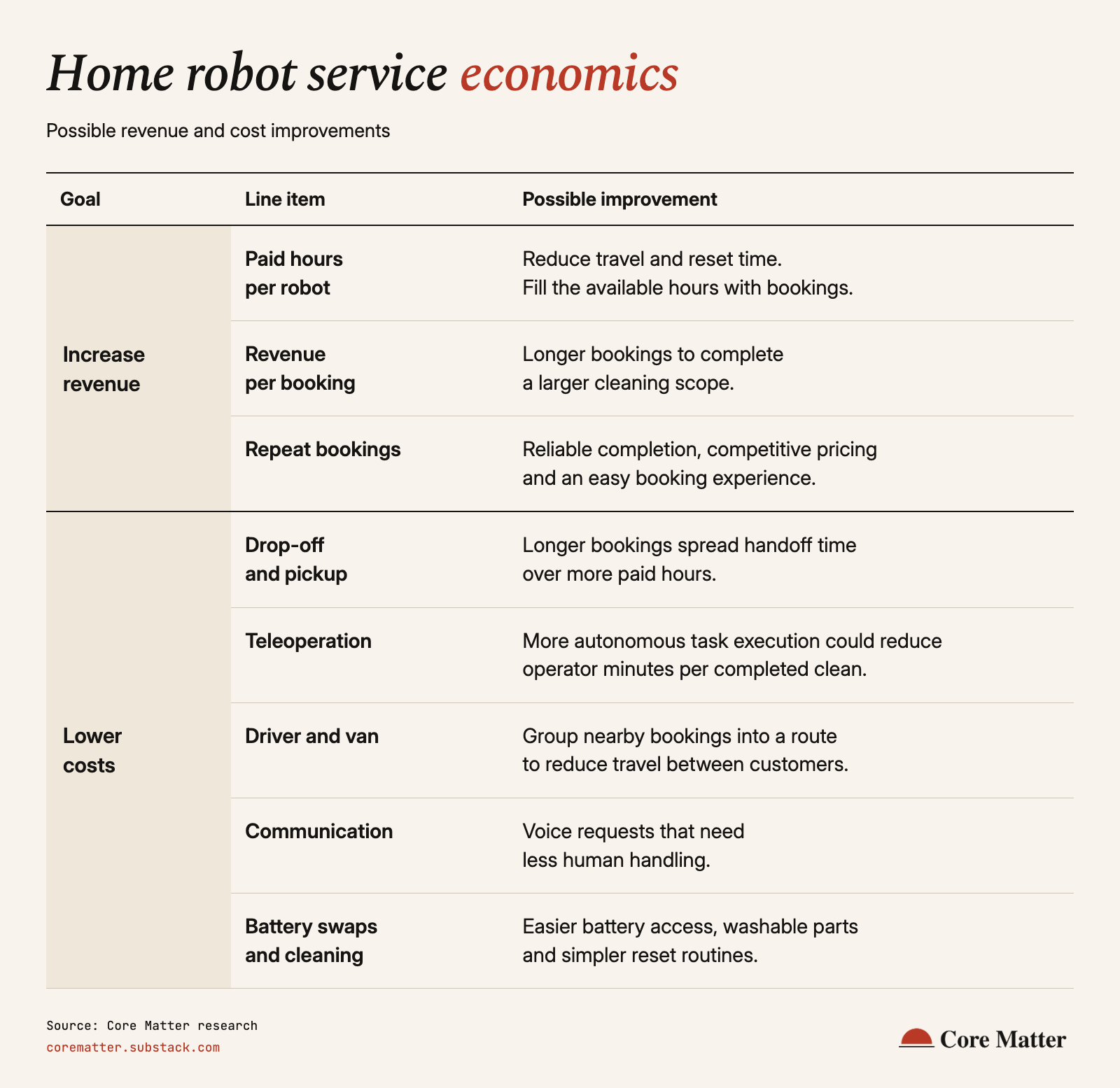
Tau Robotics charged $30 per billed robot-hour. Beyond Sergey and Chelsea’s labor, the visit required several kinds of human support:
A staff member handled drop-off and pickup. The robots also needed help taking their shoes off and putting them back on, which the staff member handled at drop-off and pickup.
One operator was dedicated to teleoperating each robot. They were Tau staff working from the Mission, according to the person who dropped off the robots.
A driver transported them in a van.
Someone responded to my text request.
Between visits, batteries need swapping and equipment, clothes, socks and grippers need cleaning.
What would improve a robot operator’s economics?
The case for optimizing utilization
At this stage of autonomy, I believe a shared fleet is a promising way to collect data and improve the service. Sending robots into more homes could expose them to different objects, layouts and failures. Collectively, this can bring a better experience for the user from each visit.
The value of collecting data in customers’ homes depends on how quickly it leads to better performance. For a comparable clean, that means handling difficult objects with less help and using fewer operator minutes. Weinzierl told me that for future visits, “It would probably start vacuuming parts autonomously. Still mostly teleoperated.” Lessons from those visits could also guide hardware changes that make battery swaps and delivery faster.
A low-hanging fruit to dial up the throughput would be apartment buildings or student housing. If enough residents book, a pair of robots could move between units throughout the day, with a place in the building to swap batteries and reset the equipment. This can increase the cleaning sessions per day, lower driver costs and could provide repeated practice in similar layouts.
3. Hospitality affects the product
Sergey waved when he came in. I would have liked both robots to introduce themselves. I didn’t initially realize they could respond by voice. When I texted a request to wipe the mirror, they did it.
Those interactions made a difference. So did the noise. They stomped around the house, which took a little getting used to. Another user told me the robots had scratched their hardwood floors when the robots weren’t wearing socks. For our visit, both wore gripper socks.
I accepted the fact that the data would be collected to train the robots. Other users may feel differently. What gets recorded, who can access it and whether a customer can opt out should be clear when booking.
4. What the robot economy looks like
The visit also got me thinking about what would need to exist around a larger fleet of working robots. The driver, battery swap and text message were small parts of my booking. Across a fleet, each becomes an operating responsibility.
Local depots and transport. A neighborhood depot could provide charging, battery swaps, equipment cleaning and repairs between jobs. Could robots eventually travel to the next booking in an Uber or Waymo? Where would robot charging stations be? Will they be in gas stations like Tesla charging ports? Someone would still need to solve loading, securing the robot, unloading and entry into the building. The van trip is part of a longer handoff.
Identity, safety and insurance. A household should be able to verify which company sent the robot and who is responsible for the visit. I would also want clear instructions for stopping it and a service contact if it malfunctions. What safety checks should a home-service robot pass? Who covers damage to the robot, the home or someone inside it?
Ratings and security. Booking history and customer feedback for each robot could help households choose a service and help operators find recurring problems. Connected robots also need controls over who can operate them and access household recordings. A customer should be able to manage access to their data and revoke that access.
Some of this could be handled by the robot company. Some could become services shared across fleets. There will be many new business opportunities from supporting robots doing productive work around humans.
Would I hire Sergey and Chelsea again? Yes, if they can finish the whole house. I would like to book about 2 hours. And I’d be curious to see them fold laundry and unload the dishwasher.
Sources
[1] Weave Robotics, Isaac 1. Advertised pricing, checked October 19, 2026.
[2] 1X, NEO order page. Standard subscription and Early Access ownership pricing, checked October 19, 2026.
Visit observations are from my October 18 home cleaning. Additional capability statements are attributed to Tau Robotics cofounder Cornelia Weinzierl in follow-up correspondence.