

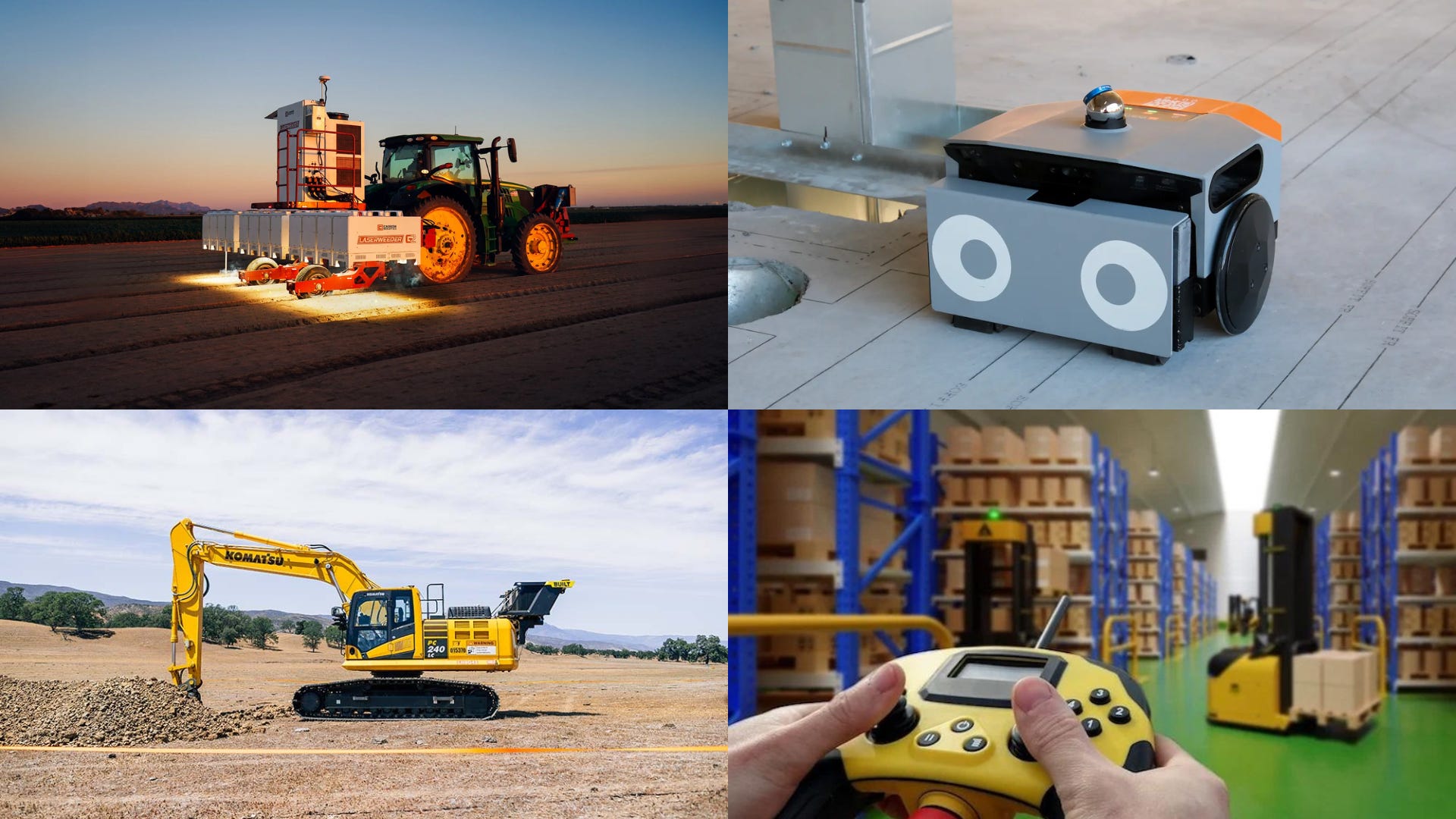
Ten 72-ton robots are driving steel piles into a northeastern Louisiana swamp to power Meta’s Hyperion data center, and they are handling more than half the pile-driving on the site. That is Built Robotics, and it is the cleanest picture of what “at scale” means in field robotics: a job site nobody wants to staff, in a location nobody wants to drive to.
Earlier today I shared the Frontier Stage at AUTONOMOUS with Noah Ready Campbell (Built), Tessa Lau (Dusty Robotics), Paul Mikesell (Carbon Robotics), and Samuel Reeves (FORT Robotics). Every company on the panel has cracked the hardest leap in robotics: getting from one robot to hundreds that work in the real world. Weeding farms, driving solar piles, printing building layouts, and the safety layer under all of it.
We talked about what “at scale” actually means, past the highlight reel. Here’s the deployment reality, the numbers, and the four things that break it.
The deployment scoreboard
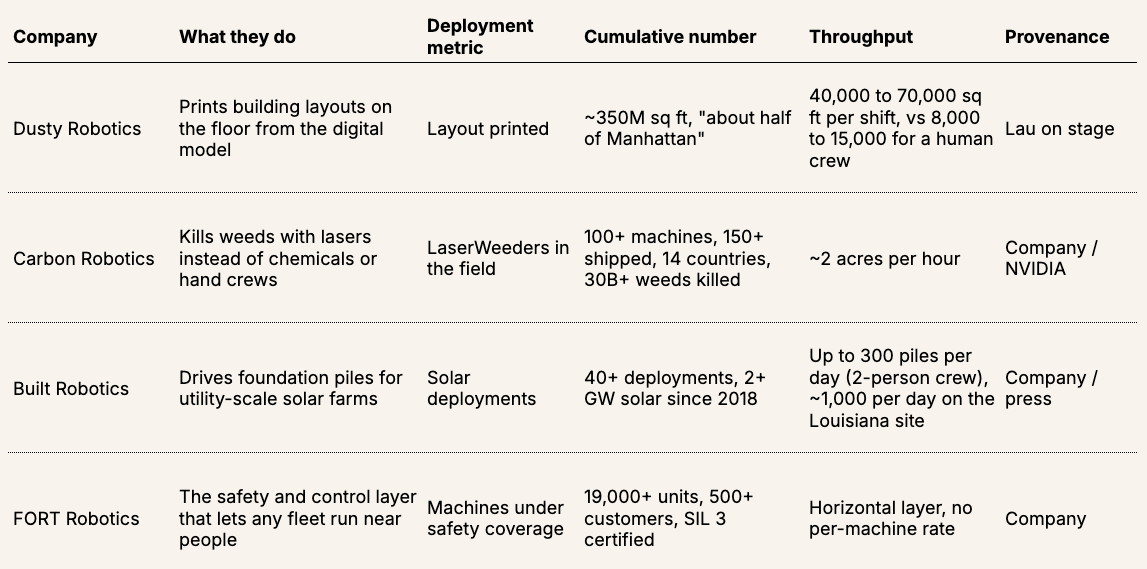
The throughput figures jumped out to me the most: Dusty runs 4 to 5x a human layout crew per shift, and Built’s two-person robot crew drives in a day what a manual team drives in a week.
What actually breaks deployment is the environment, not the autonomy.
Dust works its way into the machines in the field, degrading the hardware (Carbon).
Heat forces the robots offline. In peak summer the units have to be cooled between shifts, effectively parked in the fridge (Dusty).
Birds nesting on a cellular tower were enough to disrupt the link and cause a robot to malfunction (Built). The failure mode was connectivity, not the robot.
Safety is a shared layer, and most of them buy it rather than build it. Every fleet on this stage runs on a common safety and control substrate, and FORT Robotics is the horizontal vendor for it: emergency stop, control, and a SIL 3 certified foundation now spanning 19,000-plus machines and 500-plus customers. FORT acquired Mapless AI in May 2026 to add remote supervision, keeping a human in the loop across long distances.
Robots are going where labor shortage is most acute. Construction firms cannot hire fast enough for data-center builds in remote locations, and the sector was short roughly 439,000 workers in 2025. On the farm side, the work is dangerous: agricultural workers are about 35 times more likely to die of heat-related stress than other workers, and heatstroke deaths during harvest are a documented, recurring event. Both Lau at Dusty and Mikesell at Carbon framed the machines as freeing crews to move up to higher-skill work rather than cutting headcount.
Getting more out of the iron is the next move. The economics push toward higher utilization per machine, which is why Carbon built the Autonomous Tractor Kit, a retrofit that converts a farmer’s existing tractor into an autonomous platform rather than selling only the dedicated implement. That’s also what led Built to pivot from highway and infrastructure work into solar, where the demand and the labor gap are. Dusty widens the FieldPrinter’s scope across drywall, mechanical, electrical, and plumbing layout.
“At scale” in field robotics is being defined by three conditions holding at once: a labor gap severe enough that the customer has no better option, a structured-enough outdoor environment, and a safety layer someone else certifies. Value is accruing to the applications that own a specific unfillable job, and to the horizontal players, such as FORT on safety that every application has to run on. For operators and buyers, the question which of these deployments compounds into a data moat, and which stays a better tool. We ran out of time on stage before payback numbers, and that is the number I would put first in the next round.
Subscribe for the component-level version of this, including the BOM and unit-economics work on field robotics.
Next issue: Dexterous hand deep dive. I’ve been heads down finishing up this deep dive, which I hope would be useful for understanding this rapidly evolving space! Look forward to your feedback as always.
