

Updated 17 August 2026. Three layers were re-checked after reader feedback: battery cells, radios and depth cameras all have US production this piece originally said they lacked, and depth is more exposed than originally scored, not less. Corrections are in the text.
Hi all, I had budgeted a slower newsletter week after last week’s Dexterous Hand deep dive (thank you for all the feedback, by the way!). With the FCC Covered List announcement, I thought it’d be interesting to dive into the components of these advanced robotics, and how the Buy American test might be reached. I’m not a policy expert, so feel free to reach out if I’ve missed anything.
Recap of what happened, ICYMI: On July 28, FCC released an updated covered list where any new foreign-produced advanced robots will be banned from importing to the United States.
“Foreign-produced” means failing the Buy American test. 48 CFR § 25.101(a): manufactured in the US and domestic components above 65% of total component cost, rising to 75% in 2029. It’s not retroactive, so models authorized before July 28 can still be imported and sold.
The rule is a domestic-content threshold on the bill of materials (BOM). This affects US robotics makers as directly as it binds Chinese exporters.
The key question is how many points of domestic content each subsystem moves per dollar of BOM, and whether a US-manufactured alternative exists at that layer today.
In this piece, I walk down the BOM one layer at a time, actuation, magnets, compute, battery cells, perception, radios and software, and explore what it means to builders and investors in robotics in the US.
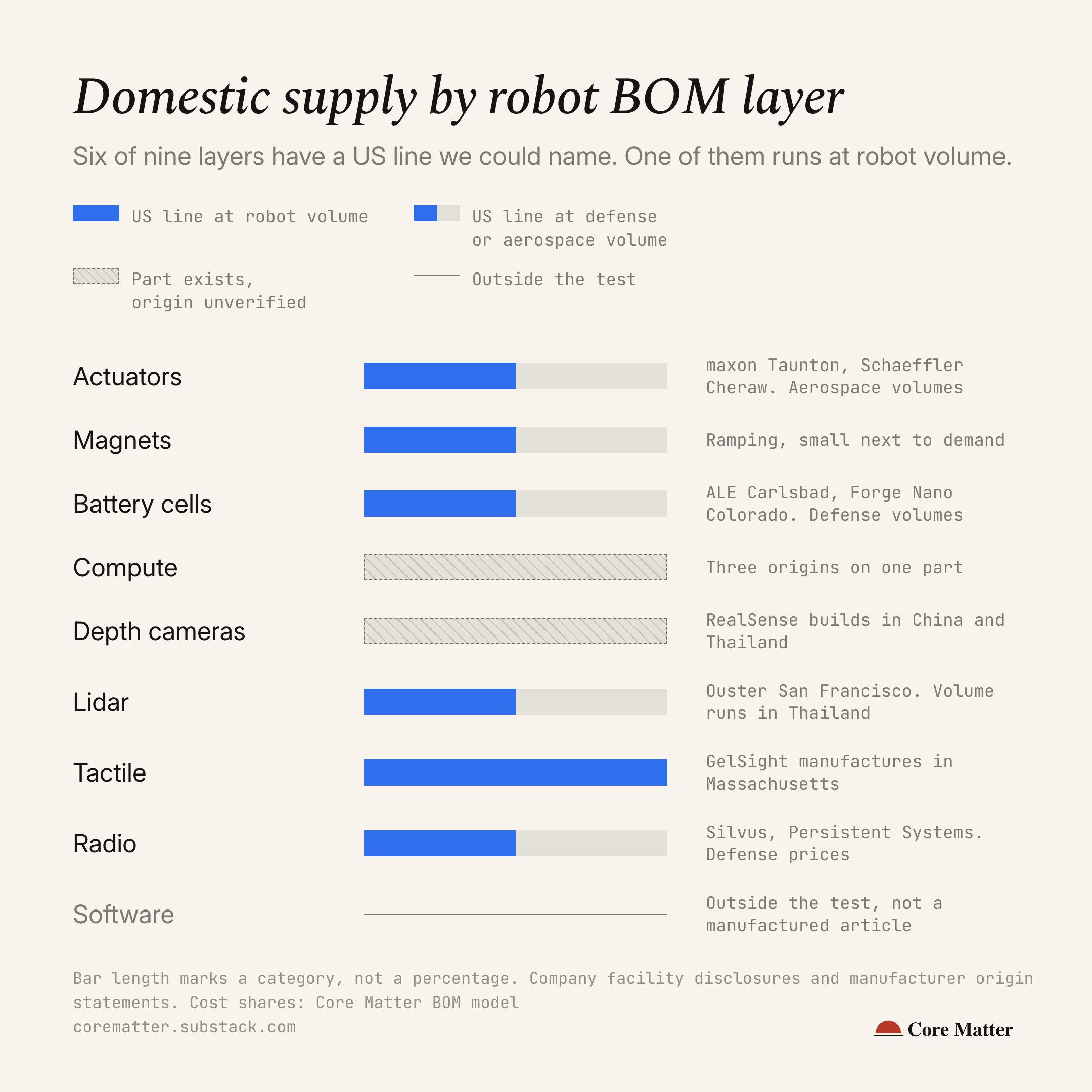
Actuation decides whether the threshold is reachable at all
Actuators are 40%-60% of total BOM costs. Right now, most off-the-shelf actuators for robotics are made by Mainland Chinese manufacturers, eg, Daimon, CubeMars.
The Buy America test is where a part was made, not where the company is from.
Sourcing from Japan or Taiwan doesn’t help. The rule splits domestic from everything else, with no allied tier. Harmonic Drive Systems, Nabtesco and Shimpo fail identically to Leaderdrive.
Frameless and precision motors have “domestic” suppliers: maxon (through its 59,000-sq-ft manufacturing plant in Taunton, MA), Kollmorgen, Celera Motion, ThinGap. Roller screws also: Nook Industries, Creative Motion Control. Schaeffler has active manufacturing facilities in Cheraw, South Carolina for high precision components like rolling/needle bearings for linear actuators, and Danbury & Winsted in Connecticut for miniature ball bearings for micro-actuators in robotics.
Harmonic Drive also operates a 97,000 sq. ft. manufacturing facility in Beverly, Massachusetts, producing precision strain wave component sets, gear units, and rotary actuators. The question is whether their capacity will reach humanoid volume and price. A humanoid needs dozens of joints each at a fraction of that price, and the Beverly line is built for aerospace and semiconductor customers. There’s a gap in both volume and price for domestic capability to supply to humanoids.
Joint ventures are being set up by Chinese actuator companies to produce in the US. Minth Group (00425.HK) disclosed a framework agreement with Leaderdrive (绿的谐波, STAR 688017) on February 9, 2026 for a US JV designing and manufacturing humanoid joint module assemblies for North America. Their claimed target customers are Tesla, Figure AI, Boston Dynamics. That fits the Conditional Approval framing of “while they work to onshore manufacturing.”
Magnets
Sintered NdFeB is the input to every actuator on the list. China is above 90% of rare-earth refining and sintered permanent-magnet production. Below are some players in the magnets space based in the US.
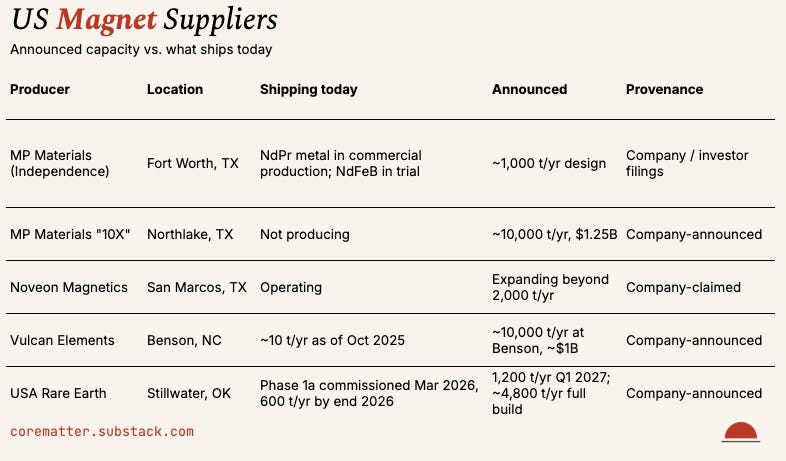
Noveon claims to be the “only operational US sintered NdFeB manufacturer”. On the other hand, since January 2025, MP has been in commercial production of NdPr metal (the alloy input that gets processed into sintered NdFeB magnets) and trial production of magnets. Both claims can be true, since making the metal and making the magnet are different steps.
For scale, MP’s magnetics segment booked its first revenue in Q1 2025 at $5.1M and $19.9M in Q2, from precursor sales to GM under their 2022 agreement. MP also has the DoD price-floor arrangement.
Is magnet origin tested at the magnet or at the motor? There is no published guidance. That answer decides whether domestic magnets move a robot’s domestic share at all.
Compute
NVIDIA Jetson is the compute module most humanoid platforms we have priced are built around. A Jetson module is designed in the US, fabbed at TSMC, packaged in Asia. Under a manufacture-location test, this may not count as domestic.
Check country of origin on the module, not on the design.
Battery Cells
Batteries are a large BOM line. Robots run on small-format cylindrical cells, the 18650 and 21700 formats.
US lines producing those formats today:
Panasonic Energy, Giga Nevada. 2170 cells at tens of GWh/yr, supplied exclusively to Tesla.
American Lithium Energy, Carlsbad CA. 18650 nano-silicon, 4 Ah, coating its own electrodes in house, with a $13.2M California Energy Commission grant to expand.
Forge Nano, Thornton CO. A 10 MWh/yr line running 18650 on a fully US-sourced bill of materials for DoD.
Amprius with Nanotech Energy. SA128 21700, 6.8 Ah, 320 Wh/kg, built against FY26 NDAA requirements.
Lyten, California. Lithium-sulfur cylindrical, dedicated defense and UAV capacity.
The constraint is captivity and price. Volume US cylindrical capacity is contracted to a single customer: Giga Nevada’s 2170 is the same format a robot uses, and all of it goes to Tesla. Merchant US supply runs at defense and drone volumes. Forge Nano’s 10 MWh a year works out to roughly 700,000 18650 cells, on the order of a few thousand humanoid packs. A robot maker can buy a US cell today at a price set by defense procurement.
Perception / Sensors
Perception sensor stack consists of depth, lidar and tactile, and the domestic capability varies by each component.
Depth has a US incumbent company and a foreign-manufactured part. RealSense, a spinout from Intel in July 2025 with a $50M Series A (Intel Capital, MediaTek Innovation Fund, led by a semiconductor PE firm), claims its depth cameras are embedded in 60% of the world’s AMRs and humanoid robots. Company-claimed, so treat it that way.
Intel’s regulatory page lists country of origin for every RealSense depth model. D405, D415, D435, D435f, D435i, D435if, D455, D455f and D456 are China/Thailand. The D555 is Thailand. That is filing-grade, from the manufacturer. Under a test that reads the production line, the depth incumbent counts as foreign, which puts depth among the more exposed layers.
Two other suppliers in the category: Orbbec (Shenzhen, the licensed successor path after Microsoft discontinued Azure Kinect) and Stereolabs (French, ZED cameras, acquired by Ouster).
Lidar is where the gap is widest. RoboSense (HKEX: 2498) ranked #1 globally in robotics lidar in 2025, over 303,000 robotics units and over 3,400 robotics clients. They shipped 185,500 robotics units in Q1 2026, up 1,458.8% YoY, about 56% of total shipments. Robotics passed automotive for the first time in May 2026.
Ouster (NASDAQ: OUST) assembles in San Francisco’s Mission District for new-product introduction and select US customer contracts, and runs volume production at Benchmark Electronics in Thailand, where it has manufactured since 2017. A US line exists at this layer and the volume does not come off it. Both companies’ figures are disclosed and the segment definitions differ, so read the comparison as order of magnitude rather than share.
Tactile: GelSight manufactures domestically. This rule is a direct demand event for them. The category problem is that no tactile benchmark exists, so buyers can’t compare parts on a published standard.
The radio module, and an exit from the FCC ban
The determination defines an “advanced robotic device” as needing all three of: sensor, connectivity component at 200 kbps or above, and software controlling navigation, perception, data collection or remote command and control. The 200 kbps is a criterion for inclusion.
Each of the volume commercial module suppliers below fails the domestic-component test under 25.101(a).
Chinese makers: Espressif (Shanghai, STAR-listed, ESP32 family), Quectel (Shanghai, cellular IoT modules, volume leader globally), Fibocom (Shenzhen, cellular modules).
Non-Chinese: Nordic Semiconductor (Trondheim, Norway), Murata (Kyoto, Japan), Telit (Italian-American).
US-manufactured radios exist, and drone makers already buy them. Silicon Labs is Austin-headquartered and fabless, so its parts are manufactured offshore. Silvus Technologies (Los Angeles, now Motorola Solutions) has the StreamCaster 4400 Enhanced on the DIU Blue UAS Framework, DoD-certified for military drone operations. Persistent Systems (New York) ships the MPU5 under the DoD Swappable Radio Module spec. Doodle Labs’ Mesh Rider is on the Blue UAS Cleared List and flies in Freefly’s Astro.
Those are defense mesh radios at defense prices, a different part from the Wi-Fi 6 and Bluetooth module a commercial robot carries. The nearest commercial analogue is Ezurio in Akron, Ohio, which designs in the US, and whose manufacturing location we have not confirmed. The silicon underneath any of these is Qualcomm, NXP or Infineon, fabbed and packaged in Asia. So it doesn’t count towards the domestic component cost defined by the FCC.
If a robot ships without a radio, or below 200 kbps, it falls outside the definition and isn’t blocked from authorization.
The OS layer, its precedent, and its ceiling
The drone ban set a precedent. AuterionOS is the cyber-secure software layer that let OEMs ship an NDAA-compliant, Blue-certified aircraft, with Auterion’s own Skynode and Skynav listed as Blue UAS Framework components. Auterion made compliant aircraft possible for OEMs building to the standard. It didn’t make a non-compliant imported airframe compliant by reflashing it.
Applied here, a US software stack is plausible evidence inside a DoW Conditional Approval application. It doesn’t move the domestic content percentage, because 25.101(a) counts articles and materials incorporated into the end product.
The Robotics OS layer is three layers, each doing different jobs:
Onboard OS and middleware: ROS 2, dimensionalOS, and NVIDIA’s Isaac ROS. (Isaac Sim and Isaac Lab are simulation and training, not onboard software.)
Fleet ops, teleop and data plane: Viam (founded by MongoDB co-founder Eliot Horowitz, NYC, describes itself as a container runtime for hardware, 200+ component drivers plus fleet management and data capture) and Formant.
Observability and tooling: Foxglove, which is robotics data recording, visualization and debugging.
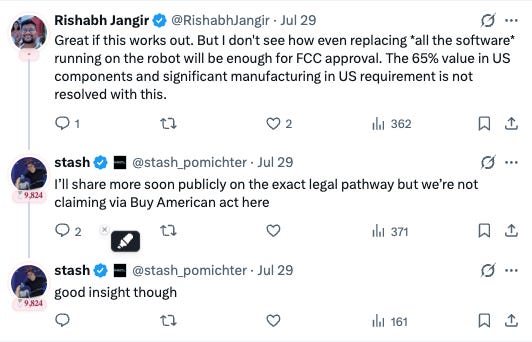
On July 29 (1 day after FCC Covered List news), Dimensional OS, an SF-based robotics software company, claimed they are now the compliant gateway for robots to access the US. Founder Stash Pomichter said there’s a different legal pathway from the Buy American test. As of mid-August the legal pathway referred to has not been published.


Security Certification Layer
No standard we found certifies an autonomous mobile platform as a whole. The adjacent ones each cover a neighbouring scope: IEC 62443 is industrial control, ETSI EN 303 645 is consumer IoT, UL 2900 is generic connected products.
A robot security standard, and an accreditation layer that tests against it, would add transparency and accountability to this nascent field. This layer can either be a standalone product, or a sub-category within the operating system layer.
Assembly is not the loophole
The Buy America test measures component cost. Labor sits outside it. Moving final assembly to the US does nothing to move the domestic share. This makes sense against the document’s stated goal in its first paragraph: reindustrialization of the US economy.
A lot of outstanding questions remain.
Does the 41 U.S.C. 1907 COTS waiver travel with the borrowed 25.101(a) definition? COTS means commercially available off-the-shelf, a commercial item sold in substantial quantities commercially and offered to the government unmodified. Most robot components are COTS. If it carries, the threshold is far easier to clear than it reads. If not, very few robots on earth qualify.
How fast will DoW process Conditional Approvals, and against what? The criteria aren’t published, so we’ll see more granularity as OEMs start receiving approval. A four-week queue and a fourteen-month queue have different implications to supply chain pressure.
Does an approval survive a model refresh? Robotics ships new SKUs annually. If approval is per model, the compliance cost recurs every cycle.
What this changes for you
If you build robots: pull country of origin on every BOM line before your next model cycle, starting with actuators. Ask each supplier which SKUs come off which line.
If you invest in the Physical AI stack: the exposed layers are the ones where the US line runs at defense or aerospace volume. Strain-wave reducers first, small-format cylindrical cells second, depth cameras third. Security certification is an open field, though it doesn’t move the Buy America component percentages.
Watch where Chinese component makers put new capacity. A shift toward US plants would be the first evidence that Conditional Approval is working as the onshoring bridge it claims to be.
If you run a research lab: models authorized before July 28 stay legal, so sub-$20k platform supply is now a depleting pool. Stock up on the units you’ll need for the next two years of research while the authorized catalog is still current.
Test out low-cost alternatives. Some examples are domestic and open sourced ones like Asimov by Menlo Research, Nori Robotics, Vibe Robotics. It’s to be determined if they pass the 65% test, and we have not found volume shipments from any of the three.
The rule reaches finished goods. The dependency it names sits upstream, in reducers and magnets and cells, where import stays free and the US lines that exist were built for aerospace and defense. Eighteen months from now we’ll know whether a gate at the border moved anything behind it.