

On Friday evening July 17 PST, a rumor circulated on X: Anthropic is pursuing Physical Intelligence.
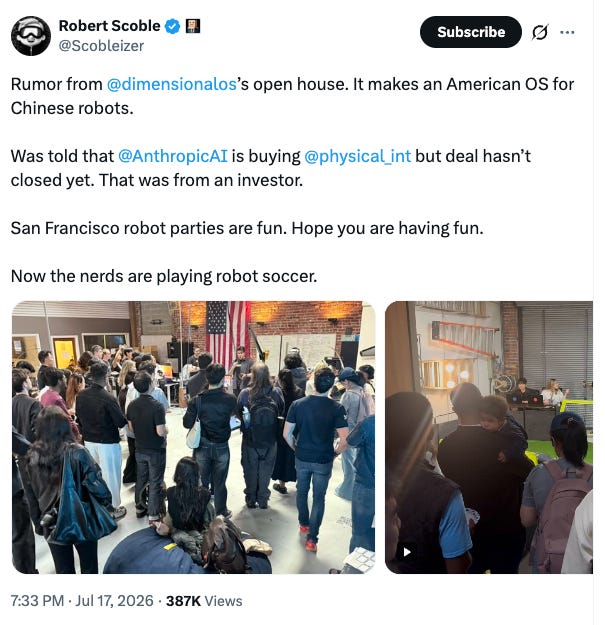
Neither company has confirmed it as of Monday July 20 11:30AM PST.
Physical Intelligence was founded in 2024 by Karol Hausman (CEO, ex-Google Brain), Sergey Levine (Berkeley), and Chelsea Finn (Stanford), among others. It raised $1.1bn across three rounds, valued at a $5.6bn in November 2025. It was reported in talks for $1bn more at $11bn in March 2026. The company never confirmed the latest round publicly. It has no disclosed revenue. Pi is founded on the vision that intelligence, not hardware, is the binding constraint for robotics, and that one model can generalize across any robot body. The company blog has not been updated since the π0.7 release in April, after seven posts between November 2025 and April 2026.
If Physical Intelligence is selling, the likely need is capital, not data or end customers, since Anthropic operates no fleet and cannot supply robot interaction data. If Anthropic is buying, it is building an embodied AI position, following OpenAI’s in-house team and Google’s Gemini Robotics group. Either way, the deal reads as capital and strategy, not data.
The model-layer approach faces three structural challenges:
The embodiment gap. π0.7 showed real progress on zero-shot compositional generalization and self-correction. But the tolerance for error in the physical world is unforgiving: 90% in a lab is not the 99.999% that commercial deployment underwrites. “Grasp the object” resolves to entirely different torque, joint-velocity, and compliance profiles depending on whether the actuator is a harmonic drive or a planetary gearbox, and whether the arm has six degrees of freedom or seven. Much of that hardware variance originates in the Japanese and Chinese component base most Western model labs never touch directly. A hardware-agnostic model still requires bespoke per-platform fine-tuning.
The deployment-data bottleneck. Foundation models improve on fresh tokens, and in robotics the valuable tokens are real-world: edge-case failures, surface variation, tactile feedback. A hardware-agnostic company does not own the environment that generates them. Its partners do. Weave, running π0.6 folding laundry in San Francisco laundromats, cut missed grasps 42% and interventions 50% once Weave’s deployment data was included in pre-training. Ultra, packing e-commerce orders across a US warehouse fleet at 96.4% autonomy on a full shift, saw throughput rise the same way, by feeding Ultra’s data back in. The structural point is legible in Pi’s own numbers: the model improves fastest when someone else’s robots feed it.
The question is how much of the value the model layer can keep from data its partners generate and own.
Skild, on the other hand, embeds directly in industrial lines, running on NVIDIA and Foxconn floors. Tesla and Figure sit at the far end, owning the body outright.
Liability and safety. Safety is the gate to scaled deployment, at home or on a line. When a robot injures a person or damages property, attribution is genuinely hard: a spatial-reasoning error in the model, a latency spike in compute, or a mechanical failure in the hardware, and which triggered which. Until that chain is underwritable, corporate buyers hold back from mass deployment.
