

World models are having their moment.
Unlike large language models that conquered text, world models aim to give AI spatial intelligence. They come with the promise of giving AI the ability to understand 3D environments, anticipate physical outcomes, and act purposefully inside rich, interactive worlds.
Over the past year, as I tracked the evolution of Physical AI and embodied systems from an ecosystem strategy lens, one pattern has become unmistakeable: world models represent the next frontier, the technology that will enable agents to act, not just talk, in the real world.
And the race is on. Google DeepMind, Meta, NVIDIA, Tencent, Wayve, World Labs, Tesla, etc. All the major labs in the world are investing heavily in the space, pushing the technology forward at a breakneck speed.
This essay is my attempt to distill the landscape as it stands today: what world models are, why they matter, what labs are building today, the key debates shaping the field, and where I see this headed.
What Is a World Model?
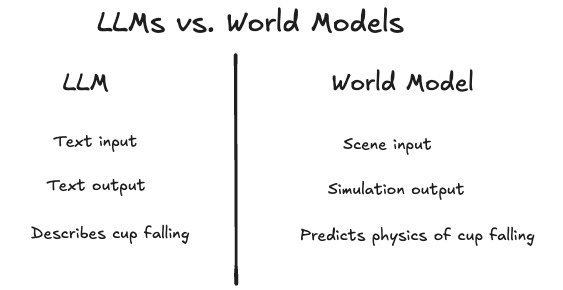
A world model is a learned internal simulator. It is a model that helps an AI system understand its environment, predict what happens next, and choose the right actions.
For example, while LLMs can describe a cup falling off a table in text, they cannot simulate the physics of what actually happens. A world model can. It encodes spatial relationships, predicts future states and enables agents to imagine consequences before acting. This distinction is precisely what separates world models from LLMs.
Yann LeCun frames it technically: given an observation, a previous state, an action and some latent variables, a world model computes both a representation of the current scene and a prediction of what comes next.
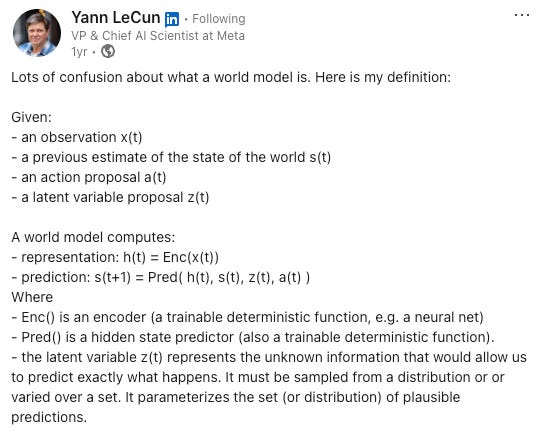
World models unlock capabilities like long-term horizon planning, causal reasoning, counterfactual imagination, and embodied action in physical space.
As Fei-Fei Li emphasizes, words alone cannot capture the essence of the world. Intelligence emerges from interacting with 3D space, objects and people.
Spatial Intelligence is the scaffolding upon which our cognition is built.
- From Words to Worlds (Fei Fei Li), November 2025
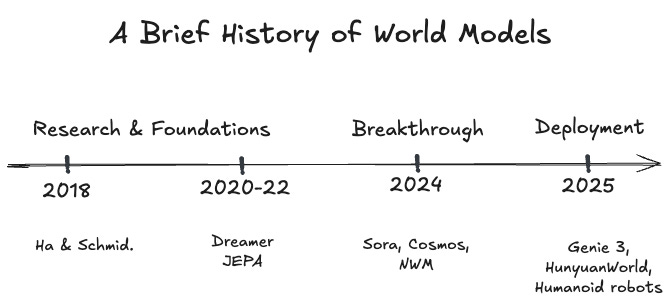
Brief history of World Models
Why Now? Two Forces are Colliding
Why are the top brains in the field all working on world models? The “why now” question matters because it reveals whether world models are truly a paradigm shift. After digging into the research, I see two fundamental forces at play.
The AI Industry Just Proved Inference-Time Scaling Works - and World Models are the Spatial Equivalent
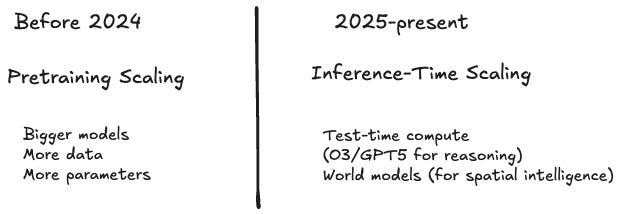
In the past decade, AI progress followed one law: bigger models, more training data, more pretraining compute equals better performance. That curve is flattening. The costs of scaling, spanning from computational, financial, environmental, coupled with diminishing margin returns, forced the industry to look for a new paradigm.
In late 2024, OpenAI’s O3 released test-time compute. Instead of just making models bigger during training, it allows more computational resources during inferences, allowing models to reason through problems, evaluate multiple approaches, and verify their work before responding.
O3 showed that a smaller base model with more inference time compute could outperform models 14X larger on complex reasoning tasks. By August 2025, GPT5 made this approach the default; reasoning became integrated rather than optional.
World models are test-time compute for spatial intelligence. MindJourney (2025) confirmed that coupling world models to vision-language models for test-time spatial reasoning delivers measurable performance gains.
As Ilya Sutskever put it, the 2010s were the age of scaling; now we are entering the age of wonder and discovery. World models are the spatial answer to the same question O3 answered for abstract reasoning.
The Infrastructure is Finally Ready
Compute architecture, datasets, and simulation tools have all hit critical thresholds simultaneously.
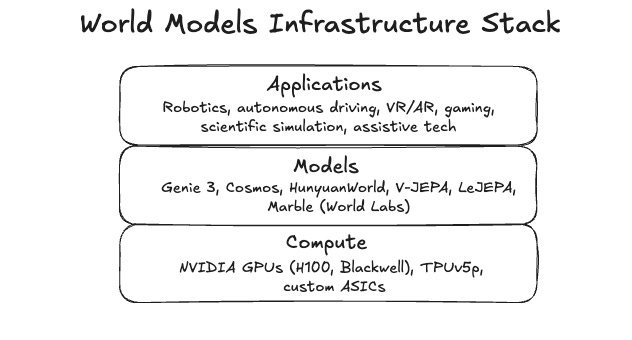
On the compute side, NVIDIA’s H100 to Blackwell transition, combined with simulation infrastructure like Omniverse and optimized diffusion pipelines, now enables long video rollouts, real time simulation, massive latent-space transformers and synthetic data loops. The hardware can finally deliver what the theory has long promised.
On the data side, large-scale video datasets (EGO4D), robotics teleop data (DROID), driving data (Waymo, CARLA), 3D scans (HM3D, Replica) and game environments (MineDojo) provide the raw sensory “experience” world models need to learn spatial intelligence. These datasets are multimodal, action-labeled, and spatially grounded in ways that text corpora never were.
On the simulation side, tools like Unity, Unreal Engine, CARLA and Habitat enable synthetic data generation at scale, closing the loop between world models and training environment.
Key Debates Shaping the Field
Underneath the progress lie three major debates that will determine how world models evolve.
Debate 1: Are World Models Essential for AGI, or Just Another Tool?
Camp 1 - “Data Wins”: Scale action-labeled datasets, skip explicit world models. Supported by some robotic labs and companies like General Intuition.
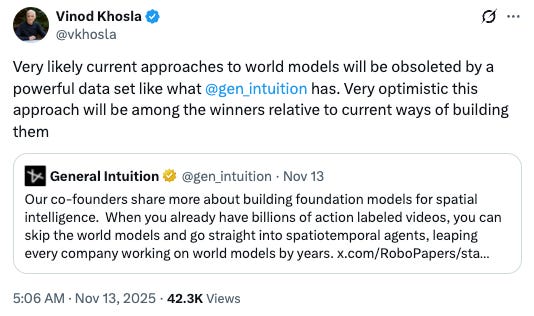
Camp 2 - “World Models Are Required for AGI”: Agents must imagine, simulate, and reason about futures. Supported by Deepmind, Meta, LeCun, NVIDIA, World Labs.
This is a philosophical split between robotics pragmatism and general embodied intelligence. My read: both camps are right in different application layers. Data scaling works for narrow tasks, generalization requires some form of world modeling.
Debate 2: Decoder-Based vs. Decoder-Free Architectures
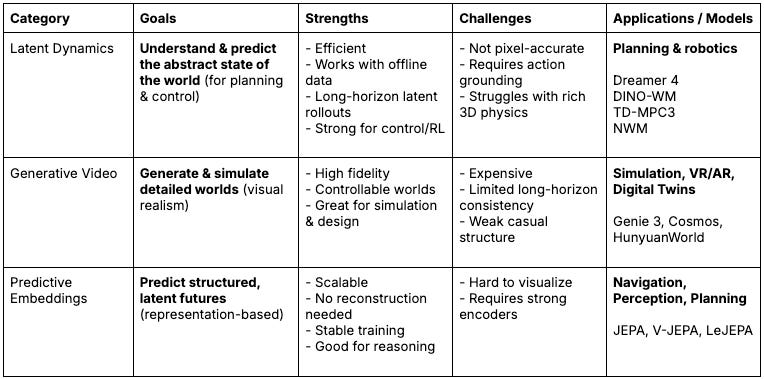
Decoder-Based (Generative): Predict pixels using diffusion or autoregression models. High fidelity, expensive. Eg: Genie 3, Cosmos WFM, Hunyuan World.
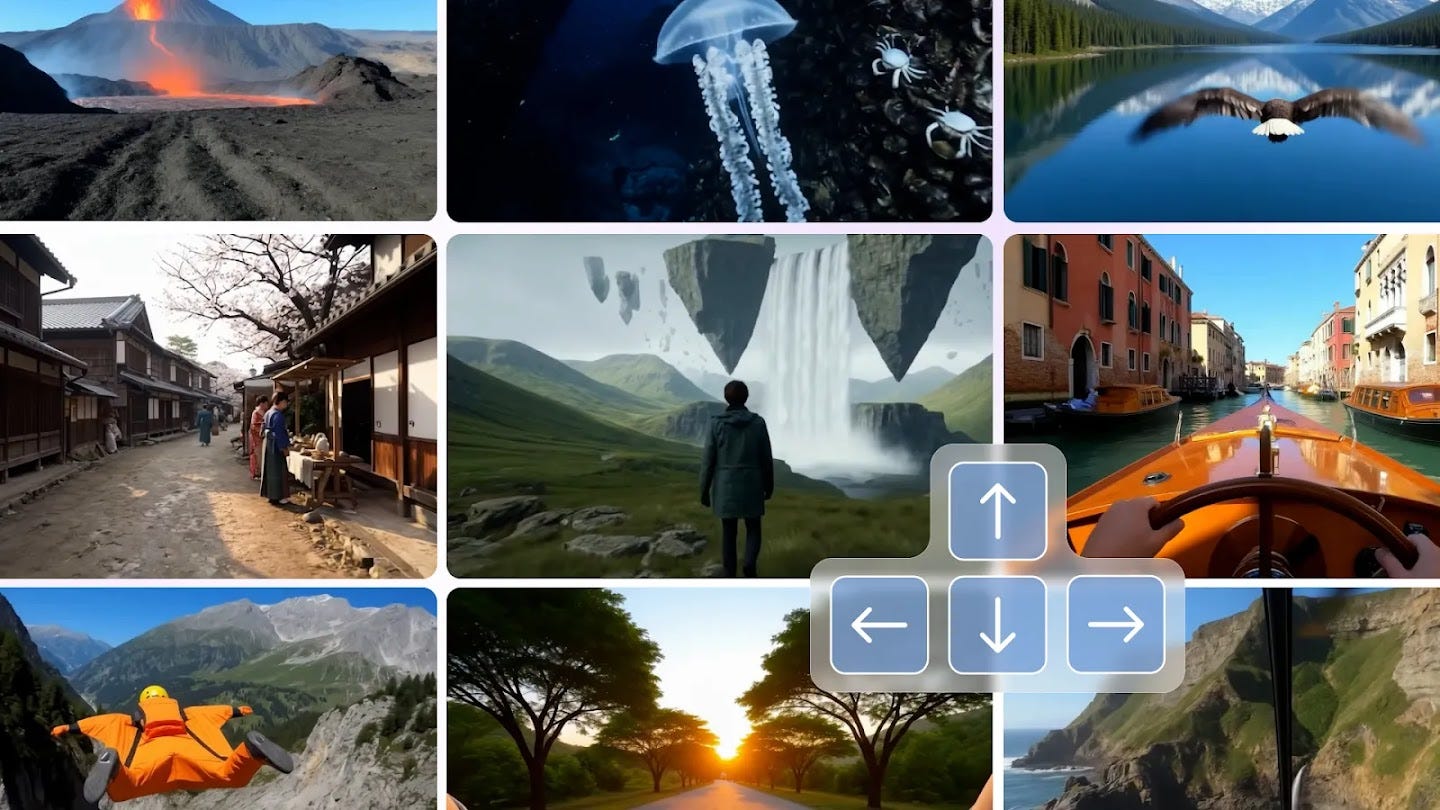
Decoder-Free (Predictive Latents): Predict future representations directly in latent space, without reconstructing pixels. Stable, scalable, more reasoning-aligned. Eg: JEPA, NWM, DIMO-WM.
LeCun’s LeJEPA formalizes the decoder-free approach with theoretical clarity. After reading papers from Dreamer 4, DINO-WM, Cosmos, and others, I’m increasingly convinced the future leans toward structured, decoder-free latent models, not brute-force pixel generators. They’re more efficient and better suited for planning and control.
Debate 3: Planning-First vs. Generation-First Approach
Planning-first: Optimized for control and decision making. Eg. Dreamer 4, TD-MPC, DINO-WM.
Generation-first: Optimized for visual fidelity and creative application. Eg. Genie 3, Cosmos, Marble (World Labs).

The World Model Infrastructure Stack (2025)
What Leading Labs Are Building (as of Dec 2025)
World models can be understood across three key categories, each with different strengths and trade-offs:
Now let me walk through the key players and their recent moves. The pace of innovation here is intense.
Google DeepMind released Genie 3, an interactive generative world model that can create controllable 3D environments from text, images, or sketches. They also launched SIMA 2, a Gemini-powered agent that operates inside Genie-generated worlds, and Dreamer 4, which achieved a real milestone: training an agent to collect diamonds in Minecraft purely offline, using only imagination rollouts.
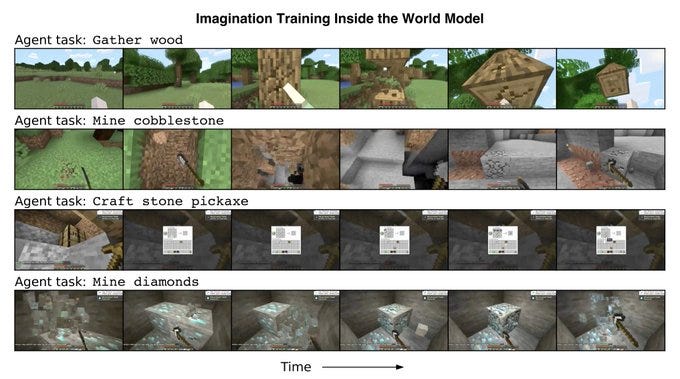
Source: Genie 3
NVIDIA is positioning itself as the de facto platform for world-model development. They released Cosmos, a set of World Foundation Models that include Predict (video prediction), Transfer (controllable editing), and Reason (physics reasoning). NVIDIA’s strategy is full stack ecosystem. They own the hardware, simulation layer (Omniverse), and increasingly the foundation models themselves.
Meta is leading the charge on decoder-free predictive models with V-JEPA, thanks to the leadership of the recently departed Chief Scientist Yann LeCun and NWM (navigation world model for long-horizon spatial reasoning). Meta’s work, as well as LeCun’s newly formed independent entity will continue to shape the next generation of efficient, reasoning-friendly world models.
World Labs launched Marble in November 2025, a high-fidelity 3D scene generator with powerful spatial reasoning and design features. They sit at the intersection of generative 3D worlds and embodied intelligence, targeting creative design and scientific visualization.
Tencent surprised the industry with HunyuanWorld-1.0 in April 2025. Instead of a 100GB model, the core checkpoints are around 500MB. It supports controllable 4D world generation, camera motion, agent-conditioned video and simulation for XR and gaming. It has since released HunyuanVideo 1.5 in November 2025, delivering state-of-the-art visual quality and motion coherence with 8.3B parameters, deployable on consumer GPUs with only 14GB VRAM, and natively generating 5–10 second 480p/720p HD videos, with 1080p cinematic quality. Tencent is becoming a quiet powerhouse in 3D generative worlds.
Source: Tencent Hunyuan (Prompt: A little girl, carrying a colorful handbag, skips through the garden. The video uses claymation style.)
Wayve, a UK based startup backed by Softbank and NVIDIA, launched GAIA-3 in December 2025. At 15 billion parameters, GAIA-3 is double the size of GAIA-2, and is built on 10X more data with a redesigned video tokenizer that is also twice as large. GAIA-3 enables repeatable evaluation of autonomous driving performance across different vehicles, environments and scenarios.
Source: Wayve GAIA-3
Tesla uses latent world models for short-term trajectory prediction, object motion forecasting, and closed loop planning in Full Self-Driving (FSD). It’s the most commercially deployed world model today, operating on millions of vehicles.
Source: Tesla FSD
Where World Models Are Useful Today
Robotics & Autonomous Driving
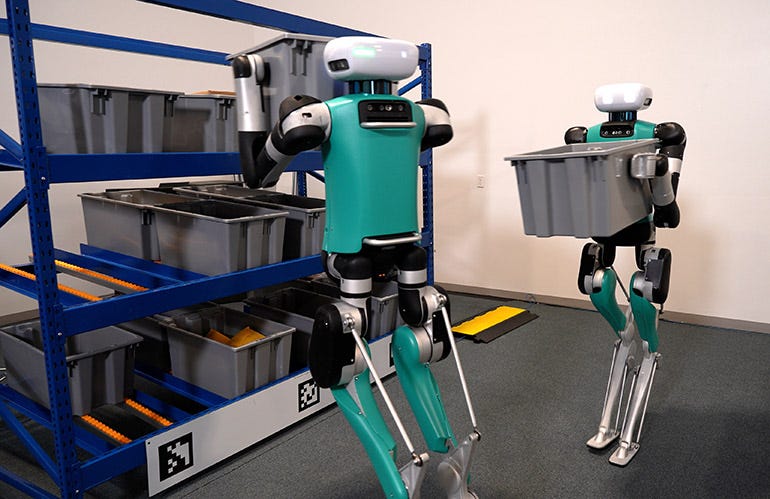
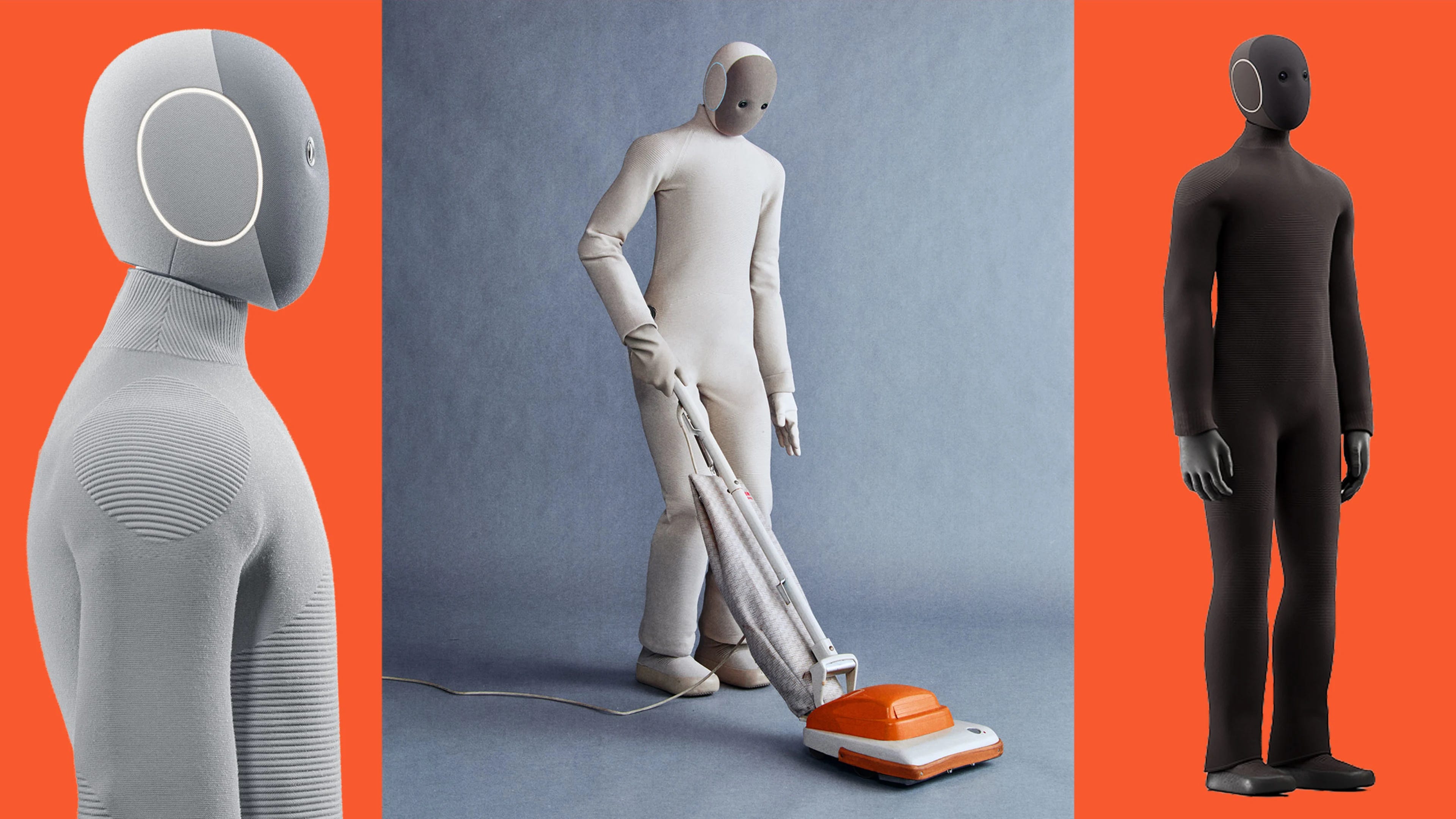
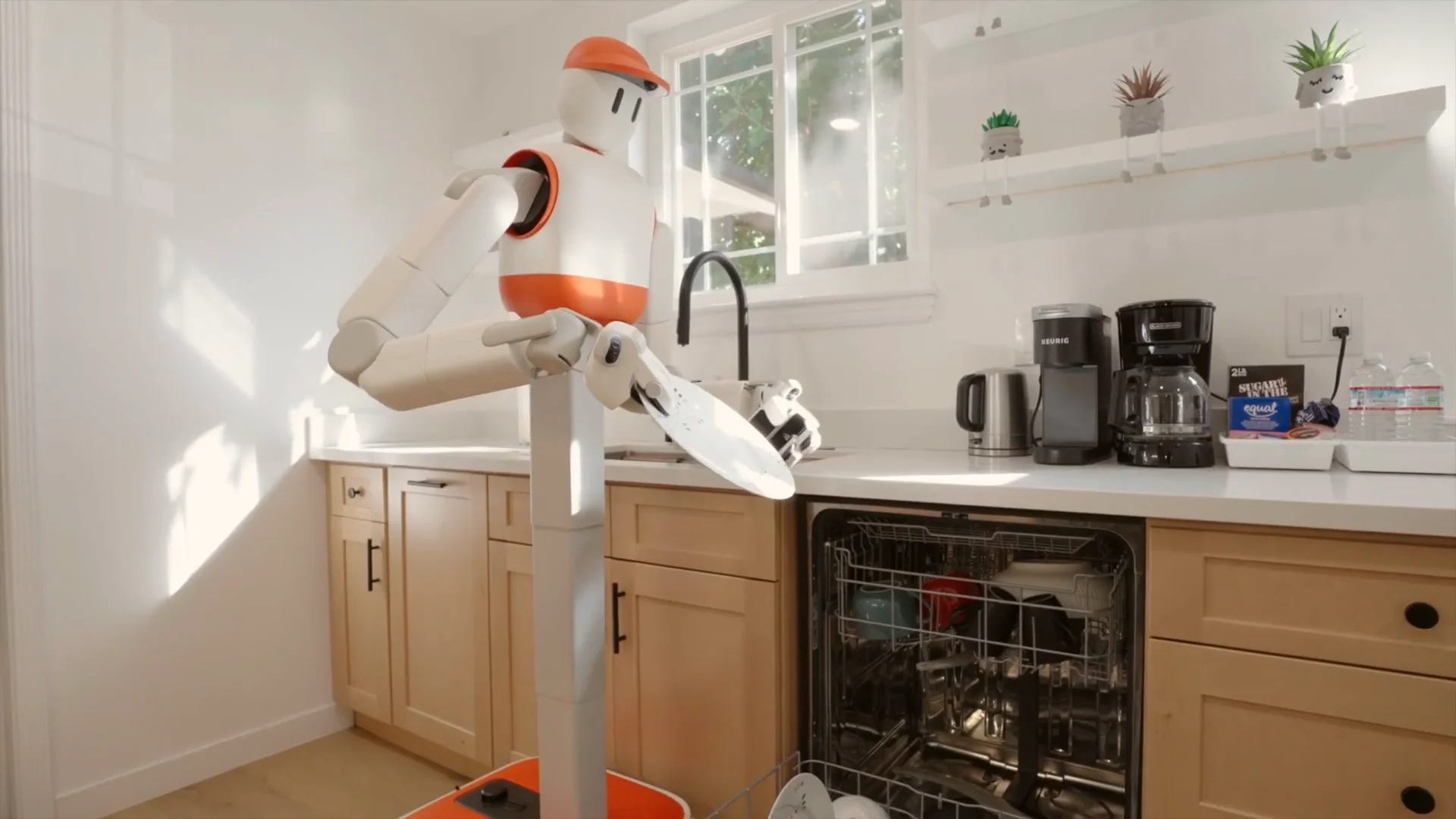
Humanoid robotics has moved from lab novelty to commercial deployment in 2025, with companies like Agility Robotics deploying Digit in Amazon warehouses, Figure shipping Figure 02 to BMW plants, and startups like Sunday Robotics launching Memo for home assistance. 1X Neo opened consumer preorders in October 2025 as the “world’s first consumer-ready humanoid robot designed for life at home”.
On the driving side, Wayve’s GAIA-3 model delivered breakthroughs to safety-critical scenarios for testing autonomous systems. Tesla’s latent world models power millions of vehicles. The commercial traction is real.
Simulation & Spatial Design
NVIDIA’s Omniverse ecosystem supports digital twins and industrial simulation, while World Labs’ Marble enables designers to generate and manipulate 3D environments with natural language. This is where high fidelity generative world models shine, enabling the design, prototyping and visualization process where pixel perfect realism matters.
Gaming, VR/AR, Media Production
Genie 3, Cosmos, HunyuanWorld are being explored for game world generation, virtual production, VR scene synthesis and interactive storytelling.
Limitations & Future Directions
While the pace of development of world models has been impressive, let’s be clear-eyed about the challenges. World models today still struggle with short-horizon coherence (most drift after seconds), weak causal understanding (basic physics violations are common), limited multi-agent interaction, and sim-to-real transfer. These aren’t trivial problems.
But the trajectory is clear. I see three key directions emerging:
Evaluation and Benchmarking Will Become Critical
Researchers have proposed AutumnBench, a suite of 43 environments and 129 tasks including masked-frame prediction, planning and predicting changes to causal dynamics. Standardized benchmarks will accelerate progress and enable fair comparisons across approaches
Training Agents Inside World Models
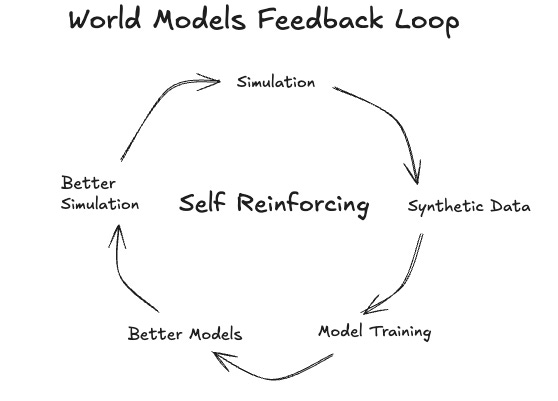
Dreamer 4 changed the game by demonstrating offline RL in latent space. SIMA 2 pushes this further by collaborating with Genie 3 to learn inside newly generated worlds. The implication: world models become the “school”, agents become the “student” and training loops become self-reinforcing. This could dramatically accelerate robotics development by enabling safe, scalable offline training.
Hybrid Architectures will Emerge
The future likely involves combining latent world models for physics, generative world for diversity, LLM reasoning for strategy. We’re already seeing early versions of this with NVIDIA’s Cosmos (hybrid Mamba/Transformer), Wayve’s integration of GAIA-3 with language models, SIMA 2’s combination of Gemini reasoning with Genie worlds.
Closing Thoughts
Some believe world models are essential for AGI. Others argue they’re too brittle outside curated environments. The truth is probably somewhere in between, and the answer will be determined by commercial traction, not research papers.
For me, world models point toward a future where AI shares our world, operates in our world, and makes meaningful physical contributions. This ranges from training better robots, to advancing scientific discovery, to powering immersive and personalized learning.
LLMs unlocked the linguistic dimension of intelligence. World models will unlock the spatial one.
And this shift from words to worlds may define the next decade of AI.
Michelle Sun is an ecosystem strategist focused on emerging and frontier tech adoption, formerly Goldman Sachs research analyst. She writes about Physical AI, world models, and the infrastructure enabling the next generation of intelligent systems.