

Unitree priced its IPO on August 6, the first time a profitable humanoid maker has carried a public price. It is the first real pricing event for embodied AI as an asset class.
On August 7, the company ran a 3-hour roadshow, where chairman, CEO and CTO Wang Xingxing, CFO Wang Feng, and board secretary Fu Fenghua answered more than 360 investor questions. Pricing was finalized at Rmb150.80 per share, giving Rmb61bn (US$8.6bn) market cap. Trading under ticker 688836 is expected to open between August 17 and 21.
In this article, I share 5 key points management disclosed, an annotated transcript in nine buckets, and the full translated Q&A transcript for paid subscribers. Fun side note: because of the full 3-hour translation, this is the longest Core Matter post to date, over 50,000 words, 189 pages long!
Unitree shipped more than 5,500 humanoids in 2025, excluding wheeled dual-arm robots, which the company claims as first globally. Blended gross margin is 60.13%, with humanoids at 63.18% and quadrupeds at 56.72%. Overseas sales were 43.65% of main business revenue, and one investor put the US at 13-19%, which management did not confirm. Humanoids contributed more than quadrupeds last year on both revenue and gross profit, at Rmb548.27m (US$81mn) of gross profit (54.40%) against quadruped’s Rmb395.69m (US$58.66mn, 39.26%).
At 92.9x 2025 ex-nonrecurring P/E, or 219x on this year’s run rate, Unitree positioned itself as “AGI via embodied intelligence”. Wang compared the present moment to the early home-computer stage. The early PC market was already selling to paying business customers, while over 70% of Unitree’s humanoid revenue today goes to academia and research institutions.
1. Industrial application was 9% of humanoid revenue
One investor put industrial application at 9% of humanoid revenue for the first three quarters of 2025, and three separate investors cited 70%+ humanoid revenue from universities and research institutes. Management did not dispute any of the figures. It said that category includes many secondary-development customers, referring to companies buying a platform to build products on.
Named customers are State Grid, China Southern Power Grid, PetroChina, Sinopec, Baowu Steel Group, Amazon and BASF. These purchases are for “validated application”, with no units, contract values or dates attached. The list came in an answer about industry applications, which across the session means inspection, fire and rescue and public services. Those are quadruped scenarios.
Core Matter take. Management’s own framing of the 9% industrial revenue is a matter of sequence: research buyers develop the application, then industrial buyers scale up in purchase later.
This is framed as not just a Unitree phenomena but industry wide. Management stated humanoid demand globally today comes from research, education and commercial consumer, and scaled industrial deployment “still needs time”. Questions about the renewal rates of research purchases were unanswered six times.
2. Q1 2026 net profit fell 52.55%
Revenue growth decelerated from 332.64% for full-year 2025 to 68.49% in 1Q2026. Excluding one-off items, net profit fell 52.55%. Management guided 1H 2026 revenue growth at 35.62%-45.41% and ex-items profits down 6.43% to 21.97%.
Management named five causes, three on the decelerating revenue and two on the declining net profit. Revenue: a larger revenue base, “industry enthusiasm gradually cooling” and intensifying competition. Declining profits: higher R&D on an expanded team, and brand promotion including 2026 CCTV Spring Festival Gala. They declined to name a turning point in 2026 or 2027, reading the same prepared paragraph to at least three separate questioners.
Core Matter take. 3 of the 5 stated causes sit on the demand side, and two of those are industry wide. “Industry enthusiasm gradually cooling” is a demand condition across the industry. I’d watch for profitability at other humanoid players that are set to go public, including AgiBot, EngineAI, Leju, to see whether oversupply and price competition are playing a role.
Unitree shared elsewhere in the session that it cut humanoid selling prices in 2025 to consolidate its industry position, which is also what took humanoid gross margin down to 63.18%.
3. The actuator stack and what vertically integrated really means at Unitree
An investor asked point-blank what share of harmonic reducers is self-made versus purchased. Wang answered without using the word “harmonic” once. Instead, he described a high-bandwidth force-controlled quasi-direct-drive (QDD) planetary rotary joint: high-torque-density motor, low-transmission-ratio planetary reducer, high-bandwidth closed-loop torque control.
Asked separately to describe the joint, Wang added a detail: a planetary reducer with a tooth profile optimized for legged impact loads, developed in-house, alongside an in-house permanent magnet synchronous motor.
The management team declined every harmonic supplier question (LeaderDrive, Tongchuan, Zhongdalide, brought up three times). Separately, when asked why reducers were absent from the R&D use-of-proceeds scope, Wang confirmed they sit inside the robot-body category.
Regarding their vertically integrated strategy, Unitree shared more color on what’s made in house vs. supplied. Design of the core components is held in-house, and so are the core algorithms, the motion control system and the models. Manufacturing is not in house. “For most PCBA surface mount, injection moulding and some machining, the company uses an outsourced processing model.” Lidar, cameras and dexterous hands are bought in from external suppliers in multiple models. This is different from previous findings that Unitree also produce their own dexterous hands, on top of sourcing from Inspire Robotics. What Unitree does in-house is design, incoming inspection, and final assembly of whole machines and core components.
Core Matter take: Most published humanoid BOM models put harmonic reducers among the largest single line items in the joint cost stack. If Unitree’s route is genuinely low-ratio planetary with high-bandwidth force control, the cost curve for the highest-volume humanoid maker in the world does not involve harmonic drive capacity at all. This also raises the question of whether other vertically integrated humanoid companies are following this strategy. This affects both the BOM and demand projections of related A-share suppliers.
In addition, management shared that “the marginal cost decline curve is less steep than expected”, naming sensors, actuators and control systems as the costs keeping humanoid prices elevated. The margin drivers is mostly revenue mix. The scale is a secondary driver, coming mostly from assembly cost. Component prices are coming down more slowly than expected.
4. Five models in 11 months, and DeepSeek partnership
Unitree gave an overview of their 5 models: UnifoLM-WMA-0 open-sourced September 2025, UnifoLM-VLA-0 January 2026, UnifoLM-X1-0 industrial-grade in early 2026, WVLA2.0 May 2026, UnifoLM-OminiA-0.3 July 2026.
One deployment is named in the 371 exchanges. UnifoLM-X1-0 completed pilot deployment testing in Unitree’s own factory in early 2026, autonomously completing tasks such as joint motor assembly. Asked how many models are commercially deployed, management gave no count. Asked separately about the gap to Figure AI, it said everyone, including their international peers, is at the test-deployment stage.
DeepSeek took 933,390 shares for roughly Rmb141m (US$20mn) in the strategic placement, locked for 36 months. Company described it as a Strategic Cooperation Memorandum, joint R&D on high-performance general robots. Five investors asked what the partnership has produced, and all five answers gave the same scripted answer with no project, timeline or spend attached.
Core Matter take. Management named two main blockers to deployment: embodied large model capability, and the durability of dexterous hands. Motion intelligence and structural components are described as already broken through and in volume production. So on the company’s own account, the hardware it sells is finished and the two unfinished pieces are the model and the hand.
5. FCC Covered List
On the FCC Covered List, Unitree’s six models hold certification and fall inside the advanced-robot-equipment definition: G1, H2, R1, Go2, B2, A2. That is the entire disclosed product line. The company did not answer questions about the FCC’s grandfathering approach, whether the company will abandon the US market, or whether they expect Europe to follow suit.
Core Matter take. We covered the Covered List mechanics in an earlier newsletter (link here). The grandfathering question remains open.
The best of candor in the session was their response to an investor’s question of whether Unitree is a toy company selling remote controlled robots. Wang compared teleoperation to the steering wheel and brake in an autonomous car. He said the remote exists as the final “physical safeguard against safety incidents caused by model errors or perception system deviations”.
What stood out to me is that the Spring Gala appearances and consumer price ladder they shared voluntarily, unprompted (Go2 at Rmb9,997, G1 at Rmb85,000, R1 Air at Rmb29,900) built the public attention and retail investors now bidding for the IPO, while most revenue came from labs and academia.
Unitree priced a long-duration call on embodied AGI, framed against the early home-computer stage. Beyond the narrative, I’m watching these metrics: H1 2026 gross margin when the semi-annual report lands, and 2027 industrial pilot conversion.
Annotated transcript and full translation below. Disclaimer: the transcript is taken from the official source on cnstock.com, translation is AI-assisted, and may contain error. Core Matter take throughout this piece (and all pieces in this newsletter) is not investment advice. Please reach out if you spot any errors. Any input is appreciated.
Annotated transcript: ten buckets
Source: Unitree SSE online investor roadshow, 2026-08-07 (issue announcement published 2026-08-07, online subscription 2026-08-10). roadshow.cnstock.com/ipo/688836
371 exchanges: 5 opening addresses, 363 investor Q&A pairs, 3 closing addresses. Each bucket below carries the verbatim Chinese, an English rendering, and the Core Matter annotation. Exchange numbers refer to the full appendix.
1. Valuation
Investor 182*****376 (#353):
宇树科技以扣非市盈率 219 倍,市销率 35 倍的发行价上市,如此高于同行和行业的估值的价格是基于什么考虑的?
“Unitree is listing at an issue price implying 219x ex-items P/E and 35x P/S. What is the thinking behind pricing so far above peers and the industry?”
Wang Xingxing (#308, the fullest of three identical renderings):
按照2025年度经审计的扣除非经常性损益后归属于母公司股东净利润59,075.28万元计算,公司本次发行价格对应的市盈率为92.92倍。同时,按照2025年度经审计的营业收入169,926.93万元计算,公司本次发行价格对应的市销率为32.30倍。相比而言,行业内主营业务与公司相近的可比上市公司及拟上市公司多数尚未实现盈利,公司则实现了较强的盈利能力,尤其在人形机器人领域。
“Based on audited 2025 net profit attributable to the parent after deducting non-recurring items of Rmb590.75m, the issue price implies a P/E of 92.92x. Based on audited 2025 revenue of Rmb1,699.27m, it implies a P/S of 32.30x. By comparison, most comparable listed and pre-listing companies with similar main businesses are not yet profitable, whereas the company has achieved strong profitability, particularly in humanoid robots.”
Core Matter annotation. The gap between the two numbers closes arithmetically, and neither party in the exchange closes it.
Both of management’s figures reconcile exactly on pre-issue share capital of 364,017,906 shares. 364,017,906 x Rmb150.80 = Rmb54,894m; divided by Rmb590.75m gives 92.92x; divided by Rmb1,699.27m gives 32.30x. On post-issue capital of 404,464,340 shares the same inputs give 103.25x and 35.89x. The 35.89x is where the investors’ “35x P/S” comes from, so the questioners are on a post-issue basis and the company is quoting pre-issue. The two bases differ by 11.1%.
Neither figure is 219x. Post-issue market capitalization of Rmb60,993m at 219x implies net profit of Rmb278.5m, which is within 1% of 2025 ex-items profit reduced by the 52.55% Q1 decline cited at #018 and #236 (Rmb280.3m). The 219x circulating through the session is therefore a forward or annualised figure built off the Q1 2026 decline. Publishable form: the company answers a 219x question with a 92.92x number, and the gap is the difference between last year’s audited profit on pre-issue capital and this year’s run rate on post-issue capital.
Two further points from the same bucket. The defense offered is that the peer set is mostly loss-making, so the multiple is defended by the absence of a comparable multiple. And at #236 an investor put the Q1 numbers directly against the multiple, asking how 332.64% growth decelerating to 68.49% and ex-items profit down 52.55% supports 219x, and received the total addressable market answer with no earnings path and no comparable.
How the price was actually set (#230, Gao Ruoyang, CITIC). The one mechanical pricing answer of the session: preliminary bookbuilding by qualified offline institutions, the highest-priced tranche excluded, then bids, comparable company valuations, and “the lower of the four values.” What is absent from that list is any issuer forecast, because none was given anywhere in the session (#199, #209, #241, #246). The multiple was set against a bid book and comparables with no issuer guidance underneath it.
Expense context (#063). Administrative expense went Rmb13.33m to Rmb25.01m to Rmb399.60m, reaching 23.52% of revenue in 2025. Management names the components in order: share-based payment first, then employee compensation, then intermediary fees. A larger post-listing incentive plan is promised at #201 and #349, on the same line.
2. The 2026 earnings decline
Investor 186*****814 (#322):
上会稿显示,宇树科技的营业收入、扣非净利润增速已较往期明显放缓,预计上半年扣非净利润同比下降6.43%—21.97%,请问:当前增速放缓是短期周期性调整,还是行业生命周期进入成熟期的长期拐点?
“The filing shows revenue and ex-items profit growth slowing markedly, with first-half ex-items profit expected to fall 6.43% to 21.97%. Is the slowdown a short-term cyclical adjustment, or a long-term inflection into industry maturity?”
Wang Xingxing:
随着公司营收基数已大幅提升、行业热度逐步缓和及市场竞争日趋激烈,公司2026年收入同比增速有所放缓。此外……公司在机器人本体与结构研发、具身智能大模型、运动控制算法等领域持续加大技术研发投入与新产品开发,并持续扩充研发团队,带动当期研发费用增长;同时……公司借助2026年央视春晚等平台开展品牌推广,当期销售费用新增金额较大,使得公司2026年1-3月净利润较上年同期出现同比下降的情况。
“With the revenue base substantially higher, industry enthusiasm gradually cooling, and market competition intensifying, 2026 revenue growth has slowed. In addition, the company has increased technical R&D investment and new product development in robot body and structure R&D, embodied large models and motion control algorithms, and expanded the R&D team, driving R&D expense up in the period. At the same time, the company conducted brand promotion using platforms including the 2026 CCTV Spring Festival Gala, and the increase in selling expense in the period was large, so net profit for January to March 2026 fell year on year.”
Core Matter annotation. Five causes, three on demand and two on spending. Demand: a much higher revenue base, “industry enthusiasm gradually cooling,” and intensifying competition. Spending: R&D on an expanded team, and Spring Festival Gala brand promotion. Two of the three demand causes describe the industry and not the company.
The full disclosed 2026 path, assembled by the questioner at #334: revenue growth 332.64% for FY2025, 68.49% in Q1, 35.62% to 45.41% guided for H1; ex-items profit down 52.55% in Q1 and down 6.43% to 21.97% guided for H1. The cyclical-or-structural question was asked twice, at #322 and #334, and answered neither time. No 2026 or 2027 inflection was offered and no forward guidance of any kind was given in the session.
Three supporting figures. Selling expense went Rmb37.72m, Rmb59.16m, Rmb141.20m across 2023 to 2025 (#262), which puts a number on the Gala explanation; 2025 selling expense is 8.4% of main business revenue, and the company spends nearly three times as much on administration as on selling. Humanoid gross margin fell to 63.18% in 2025 partly on a price cut management describes as taken “to further consolidate its industry position” (#105). And at #091 management states the industry has “no pronounced cyclical characteristics,” a few questions away from the guidance attributing the slowdown to cooling industry heat.
The same prepared paragraph was read to at least three separate questioners. #367 shows the mechanism directly: a question addressed to Wang Xingxing by name was answered by CITIC’s Chen Xiying using the exact text Wang had given twice earlier.
3. FCC and the Covered List
Investor 186*****814 (#318):
宇树境外收入占比超40%,美国市场占比约13%至19%。美国FCC已发布人形机器人禁令。请评估:若后续产品无法销往美国,对营收和利润的具体影响?
“Overseas revenue exceeds 40% and the US market is roughly 13% to 19%. The FCC has issued a humanoid robot ban. Please assess the specific impact on revenue and profit if subsequent products cannot be sold to the US.”
Wang Xingxing:
公司目前在售的主要型号产品包括人形机器人G1、H2、R1以及四足机器人Go2、B2、A2等均已取得FCC认证,并属于前述公告所指先进机器人设备,因此前述政策变更目前不会影响公司现有主要产品在美国市场的继续销售。
“The company’s main models currently on sale, including humanoid robots G1, H2, and R1 and quadruped robots Go2, B2, and A2, have all obtained FCC certification and fall within the advanced robot equipment referred to in the aforementioned notice. Therefore the policy change does not currently affect continued sale of the company’s existing main products in the US market.”
The question the paragraph does not answer (#267, 游客37835):
美国FCC新老划断的产品认证授权举措,对于公司影响有多大呢?公司是否有措施更新现有授权版的机器人,进而保持在美国市场的产品竞争力,还是说公司会放弃美国市场呢?
“How large is the impact of the FCC’s grandfathering approach to product certification authorization? Does the company have measures to update its currently authorized robots and keep product competitiveness in the US market, or will it abandon the US market?”
Answer: the same paragraph.
Core Matter annotation. Given repeatedly in identical wording by all three executives, and it is the most specific non-financial disclosure of the session. Two details are load-bearing. The six named models are the entire disclosed product line, and the qualifier is that the policy change does not “at present“ (目前不会影响) affect continued US sale. The paragraph says existing certified models can continue to be sold. Grandfathering is a question about the models that come after them, and #267 addresses neither the update path nor the abandon-the-market alternative.
2025 overseas revenue was Rmb731.66m, 43.65% of main business revenue of roughly Rmb1,676.2m (#328). Quote the percentage or the absolute figure; the percentage does not resolve against the Rmb1,699.27m total. The 13% to 19% US share is the investor’s figure and management did not confirm it. Asked whether Europe might follow, no view was offered.
Two scripts for one risk (#332). Asked what adjustments the overseas strategy will make, a different investor drew a different answer: the 43.65% restated, the products described as having first-mover, full-category and cost-performance advantages, and a commitment to build technical service and sales points globally. No adjustment is named and no distinction is drawn between the US and any other overseas market. The company has two prepared responses to the same policy risk and deploys them interchangeably.
4. The actuator stack
Investor 游客79006 (#222):
想请教公司人形机器人所用谐波减速器,自研与外采的占比大概是多少,未来供应链会有怎样调整?
“I would like to ask about the harmonic reducers used in your humanoid robots. Roughly what is the split between self-developed and externally purchased, and how will the supply chain be adjusted going forward?”
Wang Xingxing:
公司主要采用高带宽力控准直驱行星回转关节路线……以中低减速比行星齿轮传动为基础,通过电机力矩高带宽闭环控制,使关节具备高响应、强背驱性与可塑阻抗的高动态力控能力,是一种”高扭矩密度电机+低传动比行星减速器+高带宽力控”的旋转驱动方案。
“The company primarily adopts the high-bandwidth force-controlled quasi-direct-drive planetary rotary joint route. It is built on medium-to-low reduction ratio planetary gear transmission, using high-bandwidth closed-loop control of motor torque, giving the joint high responsiveness, strong backdrivability, and tunable impedance for high-dynamic force control. It is a rotary drive solution of high-torque-density motor plus low-transmission-ratio planetary reducer plus high-bandwidth force control.”
The same architecture with no supplier question attached (#094, 游客69217):
公司自研高功率密度永磁同步电机以及针对腿足机器人冲击工况的齿形优化的行星减速器……采用全内走线+双路磁编码、IP68等级的密封,使得公司核心零部件可在 –20°C-55°C环境长期工作;该技术采用快拆锥面抱合结构,实现快速换装。
“Self-developed high-power-density permanent magnet synchronous motor, plus a planetary reducer with tooth profile optimized for the impact conditions of legged robots. Fully internal wiring plus dual magnetic encoders and IP68 sealing allow core components to operate long-term from -20°C to 55°C. A quick-release conical clamping structure enables rapid swap-out.”
Where the reducer is funded (#175, 游客83620, “是没有技术能力吗” / “is it that you lack the technical capability”):
公司募投项目中包括机器人本体研发项目,减速器作为机器人本体的关键部组件之一,也纳入了该募投项目的研发。
“The funded projects include the robot body R&D project, and the reducer, as one of the key components of the robot body, is included within that project’s R&D.”
Core Matter annotation. The question at #222 was about harmonic reducers and the answer never uses the word. It describes a low-ratio planetary architecture where torque control does work that gearing usually does. Three things make that hard to read as a deflection built for the harmonic question. #094 gives the same architecture when nobody is asking about suppliers. #175 places the reducer inside the Rmb1,109.74m robot body project, where the line item reads “high-power-density transmission systems” (#154), confirmed only because an investor asked whether the omission signalled a capability gap. And the sponsor’s own component list at #149 names reducers and dexterous hands as full-stack in-house development.
No BOM share is disclosed for any component anywhere in the session, from either direction. #252 asked what percentage of unit value the harmonic reducer represents and whether it comes from LeaderDrive or Tongchuan Precision. #299 asked for the electric drive’s share of whole-machine cost and received a specification with no percentage. #311 and #312 asked whether the motors are axial flux, twice, and drew a refusal formula reserved for motor topology; axial against radial flux is a first-order determinant of joint torque density and cost. #240 and #313 asked whether the shells and dexterous hands are aviation-grade aluminum, PEEK or carbon fibre composite, which is a materials question with no vendor in it, and were refused. #154 funds “multi-scale lightweight structural parts for legged robots” without naming a material.
The in-house boundary, in the company’s own words (#350):
公司机器人产品核心算法、运动控制系统、具身智能模型、关键核心部件设计坚持自主可控,部分标准化通用元器件实施市场化采购。
“Core algorithms, motion control systems, embodied intelligence models and the design of key core components are held to independent controllability, while some standardized general-purpose electronic components are procured on the market.”
And the manufacturing side (#219):
公司对于大部分PCBA贴片、注塑及部分机加工等工序采取外协加工模式,由外协厂商根据公司提供的原材料及相关技术要求进行外协加工。
“For most PCBA surface mount, injection moulding and some machining, the company uses an outsourced processing model, with subcontractors processing to the company’s supplied raw materials and technical requirements.”
What is held independent is the design of key core components. What Unitree performs in-house is design, incoming inspection of custom parts, and final assembly of whole machines and core components. Electronics assembly, plastics and part of the metalwork are subcontracted. Lidar, cameras and dexterous hands are procured externally in multiple models and supplied on to customers (#176, #219).
Two limits management sets on its own cost story. At #031, because no scaled supply chain exists and downstream applications are immature, “the marginal cost decline curve is less steep than expected.” At #086, development and production costs remain high “particularly for key components such as sensors, actuators and control systems, which keeps humanoid market prices relatively elevated.” At #198 the margin drivers are named in order, mix first and scale second, and the scale benefit described is falling unit product cost on the company’s own volume.
Why it moves the thesis. Most published humanoid BOM models put harmonic reducers among the largest single line items in the joint cost stack. If Unitree’s route is genuinely low-ratio planetary with high-bandwidth force control, the cost curve for the highest-volume humanoid maker in the world does not run through harmonic drive capacity at all. That reprices both the BOM and the A-share suppliers the market has attached to this name, and it raises the question of which other vertically integrated humanoid builders are on the same route.
5. The models, and what is deployed
Timeline as disclosed (#173, #300, #324). UnifoLM-WMA-0 open-sourced September 2025. UnifoLM-VLA-0 open-sourced January 2026. UnifoLM-X1-0, industrial grade, pilot-deployed in Unitree’s own factory early 2026. WVLA2.0 May 2026, fusing world model with vision-language-action. UnifoLM-OminiA-0.3 July 2026, a single model coordinating multiple task types in home and eldercare.
Substantiation given for the first two:
WMA-0 (游客13700):
该模型作为可交互的世界模型仿真器,可支持10-20轮的多步交互推演。
“As an interactive world-model simulator, the model supports 10 to 20 rounds of multi-step interactive rollout.”
VLA-0 (游客72844):
仅使用单一策略(One Policy)即可在真实物理环境中完成12个不同的操作任务。
“Using a single policy alone, it completes 12 different manipulation tasks in a real physical environment.”
The count question (#184, investor 187*****957):
这些模型目前有多少已实现商业化部署?
“How many of these models are in commercial deployment today?”
Wang Xingxing:
大家都处于测试部署阶段,公司的WMA模型与VLA模型目前同样处于持续的研发测试阶段,目前主要在自有工厂等试点场景进行研发测试、部署验证,具备了相应的技术储备。
“Everyone is at the test-deployment stage. The company’s WMA and VLA models are likewise in ongoing R&D testing, currently conducted mainly in pilot scenarios such as its own factory for R&D testing and deployment verification, with the corresponding technology reserve in place.”
The one named deployment (#324, investor 158*****581):
2026年初公司自研的工业级具身大模型UnifoLM-X1-0已在自有工厂中完成试点部署测试,可自主完成关节电机装配等任务。
“In early 2026 the self-developed industrial-grade embodied large model UnifoLM-X1-0 completed pilot deployment testing in the company’s own factory, able to autonomously complete tasks such as joint motor assembly.”
Core Matter annotation. Read #184 and #324 together. Asked for a count of commercially deployed models, no count is given. Asked about brain progress, one named model is described doing one named task on one site the company owns, and the qualifier survives in the Chinese: 试点部署测试, pilot deployment testing. The task is Unitree using its own robots to assemble its own joint modules. No customer, no third-party site and no named external deployment appears in 371 exchanges (#280).
The leveling claim is applied to a named rival at #284: asked about the gap to Figure AI on autonomous task execution, “the company and other industry participants at home and abroad are all at the test-deployment stage.” At #193 the two halves sit in consecutive sentences: brain-level embodied model technology is “in a fast-developing exploratory stage,” and the company’s overall capability is “already in the global industry-leading tier.”
No public milestone for the largest use of proceeds (#295):
具身智能属于前沿技术领域,研发进程存在不确定性。公司内部制定有对应的研发工作目标,若后续出现达到披露标准的重大研发进展,公司将严格按照监管规则及时公告。
“Embodied intelligence is a frontier technology field and the R&D process carries uncertainty. The company has set corresponding internal R&D work targets,” to be announced only if they reach the disclosure threshold. Asked at #273 when roughly Rmb2bn of model spend produces a commercialisation inflection, no date is given. Asked at #296 for milestone nodes and a commercialisation timetable on the Rmb2,022.46m project, the answer repeats the project description from #155.
Where the Rmb2,022.46m goes (#150, from the sponsor). Brain is cognitive decision, task planning and the embodied large model; cerebellum is motion control and whole-body dexterous motion; body is physical structure including drivers and communication bus. The concession attached: “weak compute support and a lack of high-quality data leave models insufficiently intelligent, which has become an important bottleneck on the industry’s development.” The money buys cloud-edge-device compute, large real-world datasets, a cost-effective teleoperation system, automated annotation, synthetic data, and a data engine plus model factory plus evaluation centre. The teleoperation rig is funded as a data-collection instrument. It reads against #177, where Wang’s argument for the humanoid form is a data argument: “robot AI models are data-driven and need large volumes of real human data, which is humanoid-shaped.”
DeepSeek (#202, #259, #270, #323, #348). Hangzhou DeepSeek AI Basic Technology Research took 933,390 shares for approximately Rmb141m in the strategic placement, roughly 11.5% of the Rmb1.22bn strategic tranche, locked 36 months (#323). The relationship is a signed Strategic Cooperation Memorandum covering three areas: cooperative R&D toward AGI, deep cooperation on high-performance general robots, deep cooperation on AI large models. Asked five times, the disclosed content never grows past those three headings. #348 is the best-drafted of the five, offering three concrete tests (a joint project, model adaptation, a prototype), a binary on the technical route (plug DeepSeek’s model into Unitree robots, or jointly train an embodied-specific model), and a request for a date on the first verifiable deliverable. It adds one clause, “jointly conduct cooperative R&D and product development,” and answers none of the three tests, neither route, and no date. #237 asked whether the model is fine-tuned from a general large model or trained from scratch and what that does to compute cost, which is the question the DeepSeek relationship would answer, and drew the standard exploratory-stage paragraph. Tencent is named once, at #274, as a strategic investor alongside DeepSeek.
The two blockers (#316).
面向工业与家庭场景大规模商业化应用尚待突破的关键技术主要包括”大脑”层面的具身大模型能力与”灵巧手”的精细耐用程度两方面难题,其中最主要的技术难题还是全球范围内具身大模型均处于早期发展阶段,泛化能力不足。
“The key technologies still to be broken through for large-scale commercial application in industrial and household scenarios are two: embodied large model capability at the brain level, and the fineness and durability of the dexterous hand. The principal problem remains that embodied large models globally are at an early development stage with insufficient generalization.”
Motion intelligence and structural components are declared already broken through and in volume production. On the company’s own account the hardware it sells is finished, and the two unfinished pieces are the model and the hand.
6. The toy jab
Investor 游客21844 (#302):
听讲贵公司是遥控玩具公司是吗
“I hear your company is a remote-control toy company, is that right?”
Wang Xingxing:
类似于现阶段的智能驾驶汽车虽已部署自动驾驶功能,但仍需要配有方向盘与制动踏板……遥控操作作为机器人的底层安全保障,可随时接管机器人的控制权……为防范机器人因模型错误或感知系统偏差导致安全事故提供最终物理保障。
“This is similar to how intelligent driving vehicles today have autonomous driving functions deployed but still need a steering wheel and brake pedal. Remote operation serves as the robot’s base-layer safety guarantee and can take over control of the robot at any time. In extremely complex terrain, when the communication link is abnormal, or when an unexpected logic error occurs, the operator can use the remote control, which carries the highest command priority, to rapidly and directly execute an emergency stop, forced hazard avoidance, or correction of low-level motion parameters, providing the final physical safeguard against safety incidents caused by model errors or perception system deviations.”
The command path, asked separately (#329):
通用机器人的行动指令可以来自于人工遥控操作与群控系统、导航系统,亦可生成于具身智能模型或大语言模型。
“Action commands for a general robot can come from human remote operation and swarm control systems, or navigation systems, and can also be generated by an embodied intelligence model or a large language model,” with the model-driven path described as “an important direction of development.”
Core Matter annotation. The most candid answer of the session, and it puts two things on the record that the rest of the roadshow works around: models produce errors, and perception systems deviate. The answer never states what fraction of demonstrated behavior is teleoperated.
#329 supports it from a different angle. Asked how a language instruction reaches the actuators, the ordering given is human remote operation and swarm control first, navigation second, embodied model or LLM third, and the model-driven path is future tense.
The same point arrives without the joke at #249, where an investor puts five questions in one and management engages almost none of them. Two land: the public perceives Unitree’s “entertainment attribute” as far exceeding its “technology attribute,” and many direct purchasers are university research institutions and performance and exhibition companies, customer types that struggle to form stable large-scale repeat purchase. The Gala point is answered by citing the Gala as a valuable platform. The repeat-purchase point is answered by restating that the short to medium term market is research, education and performance, which confirms the premise. The fifth question, whether Unitree becomes an arm maker like KUKA or a component supplier if real production-line deployment takes ten years or more, is not addressed, and the numbered structure is abandoned after point three.
The consumer price ladder was volunteered without prompting (#042, #342): Go2 at Rmb9,997 in 2023, G1 base at Rmb85,000, R1 Air at Rmb29,900. Management’s own framing of the Go2 price at #342 is that it was “the first time a robot dog was brought into the consumer electronics price range.” At #260 and #263 management steers away from consumer brand extension, saying technology and product are the core foundation of the brand and marketing-led initiatives will be judged prudently.
7. Customer mix
Investor 137*****488 (#358):
2025年前三季度,超70%的人形机器人收入来自科研教育领域,工业应用仅占9%。公司计划如何突破”实验室到工厂”的鸿沟?目前真实的工业场景复购订单有多少?
“In the first three quarters of 2025, over 70% of humanoid revenue came from research and education, and industrial application was only 9%. How does the company plan to cross the laboratory-to-factory gap? And how many genuine repeat orders are there from industrial scenarios today?”
Investor 137*****848 (#289):
公司人形机器人业务 73.6% 收入来源于高校及科研院所,以教学研发类采购为主。
“73.6% of the company’s humanoid robot revenue comes from universities and research institutes, mainly teaching and R&D procurement.”
Wang Xingxing, the demand answer given to both (#338):
在具身大模型技术水平与真实场景泛化能力逐步提升的过程中,全球人形机器人的真实市场需求目前主要来源于科研教育、商业消费等领域,距离工业场景的规模化部署应用仍需时间。具身智能通用机器人行业发展初期,科研教育领域对机器人进行的科技研发、应用开发、场景验证及教育培训,是通用机器人后续在商业消费、行业应用领域大规模应用的重要基础与前瞻需求。
“As embodied large model capability and real-scenario generalization improve, real global demand for humanoid robots comes mainly from research and education and commercial consumer, and scaled deployment in industrial scenarios still needs time. In the early stage of the industry, the technical R&D, application development, scenario validation and education work that the research and education sector does with robots is an important foundation and forward-looking demand for later large-scale application in commercial consumer and industry.”
The one substantive pushback (#333, investor 136*****517 asking how long to get below 50%):
报告中的科研教育是泛科研教育,包涵很多二次开发客户。
“The research and education category in the report is broad research and education, and includes many secondary-development customers.”
Core Matter annotation. Three investors independently characterised the same concentration: 9% industrial and over 70% research and education (#358), 73.6% from universities and research institutes (#289), over 70% (#333). Management challenged the magnitude in none of the three answers. The single challenge is definitional, and it belongs beside the number every time the number is used: the research bucket is “broad” and includes many secondary-development customers, meaning companies buying platforms to build products on. No split between the two groups is given and no timeline for getting below 50%.
The definitional point connects to the moat claim. At #357 the open secondary development ecosystem is named as a competitive barrier, and at #310, asked how Unitree holds off carmakers with consumer channels (Xiaomi, BYD, Li Auto, XPeng), the defence is “a systemic moat formed from a broad installed base accumulated over time, user habit, and ecosystem content.” The moat and the customer-concentration problem are the same fact seen from two sides.
The repeat-purchase question, six times. #249, #257, #283, #296, #338 and #358. At #283 the term is 续费情况, the renewal position, which is the single number that would settle whether the research and education base is an installed base or a run of one-time sales. Handle 182*****367 asked the research market four different ways (#257, #265, #281, #283) and was refused each time. At #296 management points to “the prospectus and the relevant content of the inquiry responses (反馈回复),” confirming the repurchase rate exists in the SSE inquiry response documents, a filing separate from the prospectus.
The only named customers (#305). State Grid, China Southern Power Grid, PetroChina, Sinopec, Baowu Steel Group, Amazon and BASF. Two qualifiers travel with the list. The wording is 验证应用, validated application, with no units, contract values or dates. And the sentence sits inside an answer about industry applications, which throughout the session means inspection, fire and rescue and public services, and those are quadruped scenarios. The question that drew the list was about humanoids being confined to performance and research.
The split stated directly (#307). Quadrupeds: power inspection, fire and rescue and emergency high-risk work commercialise “relatively faster in the short term.” Humanoids: the short to medium term is research, education and performance. That division runs through the whole session and this is the sentence that states it.
Correction on the earlier reading of #207. The three-way mix (”in 2025 the shares of research and education, commercial consumer, and industry application were close, each above 30%”) sits between a quadruped sentence and a humanoid sentence, and the Chinese supports either a company-wide or a quadruped-specific reading. The earlier version of this bucket built an asymmetry claim on the quadruped reading. That claim is withdrawn. What survives both readings: no humanoid-level three-way split is given anywhere in 371 exchanges, which is why every figure characterising the humanoid customer base came from an investor.
One wording tell at #282: the middle category is called 商业活动, commercial activity, where #207 called it 商业消费, commercial consumer. Commercial activity is the more accurate label for the performance and exhibition business.
8. Supply chain: the motor wall, and the consensus list
Three prepared refusal texts are in rotation: main suppliers and procurement amounts, main raw material procurement, and third-party cooperation. The appendix records eight verbatim instances of the supplier refusal and thirteen of the third-party cooperation refusal, plus a terser fourth formula and a fifth reserved for motor topology.
8a. The motor wall
The component Unitree most consistently claims as full-stack in-house drew seven questions from five investor handles, answered by three executives and one banker.
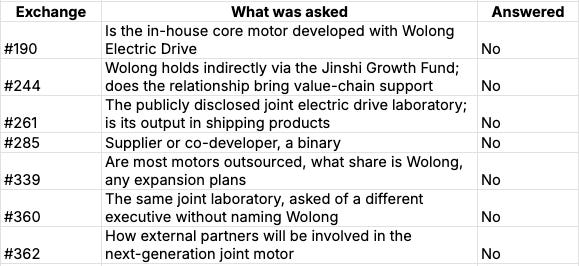
No fact about the motor supply relationship is confirmed or denied anywhere in 371 exchanges.
Three questions trace the shareholding structure behind it. #244 establishes that Wolong holds indirectly through the Jinshi Growth Fund. #287 asks which A-share listed companies hold Unitree through Jinshi and at what look-through percentage. #361 puts the question to CITIC’s Gao Ruoyang directly:
金石成长作为公司机构股东,背后有多家电机产业上市公司参与出资。除财务投资外,该类产业背景股东,会在供应链、工艺、零部件开发层面给公司带来哪些协同支持?
“Jinshi Growth is an institutional shareholder, and several listed motor-industry companies participated in funding it. Beyond financial investment, what supply chain, process and component development support do such industrially backed shareholders bring?”
Jinshi is CITIC Securities’ own private equity platform, so the sponsor is being asked about the industrial composition of a fund its own firm manages, and it gives the issuer’s third-party cooperation refusal. The question establishes without confirmation that multiple listed motor-industry companies are limited partners in a fund on Unitree’s register.
8b. The consensus supply chain
Named-company questions and their counts. This is the crowd-sourced list of A-share names the market has attached to Unitree.
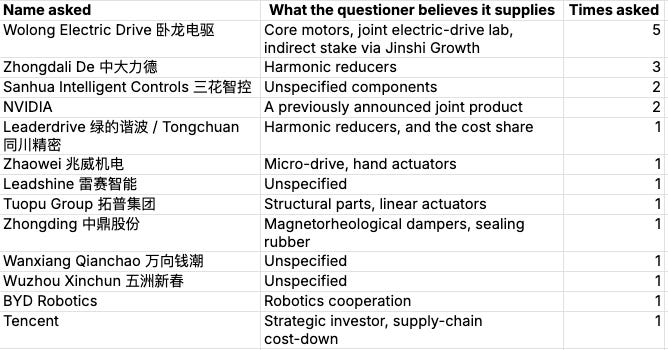
Also refused: the Jinshi look-through (#287, #361), Henan supply chain participation (#245), the Chengdu municipal agreement and Jinjiang district facility (#248), local governments and industry colleges (#241), axial-flux motor use (#311, #312), enclosure and dexterous-hand materials (#240, #313), supplier concentration and substitutability (#253), and second sourcing on motors (#326).
Core Matter annotation. The questions carry information the answers do not. This is a consensus supply chain assembled from sell-side notes and stock-promotion channels, and it is the list of A-share names with Unitree exposure priced in. The uniformity of refusal is a disclosure policy and not evasion of any one relationship. Two observations sharpen it. #248 is a publicly announced government partnership with a named district and a named facility, refused on the same template as a component supplier question. And #326 asks a supply-security question against 190,000 units of planned capacity and receives a procurement policy, a qualified supplier admission system assessing lead time, quality, cost and service, without stating whether any key motor component has a qualified alternate.
Three things Unitree did volunteer cut against a simple full-stack reading. It buys multiple third-party models of lidar, cameras and dexterous hands to give customers configuration choice (#176, #219). It sells joint modules, dexterous hands, collaborative arms and perception sensors as a product category of its own (#233), so hands sit on both sides of the line. And for components where external process maturity is high and external cost is lower, it “will consider custom procurement” (#292), given in answer to a question about whether the tactile and force sensors inside the dexterous hand are in-house or bought.
At #370 Fu Fenghua closes the session by committing that disclosure will be “true, accurate and complete.”
9. Governance and control
Investor 135*****191 (#242):
公司设置了特别表决权机制,王兴兴先生在发行后仍控制约65.31%的表决权……公司打算如何向市场解释特别表决权与”保护中小股东利益”之间的关系?
“The company has a special voting rights mechanism, with Mr Wang Xingxing still controlling approximately 65.31% of votes after issuance. How does the company intend to explain to the market the relationship between special voting rights and protecting minority shareholder interests?”
Fu Fenghua:
公司设置特别表决权机制,是保障公司控制权持续稳定、防范二级市场恶意收购风险、降低后续增发稀释影响、确保长期发展战略顺利实施的重要制度安排……对于修改公司章程、合并分立、解散、变更特别表决权股份类别等重大事项,特别表决权股份与普通表决权股份实行同股同权。
“The special voting rights mechanism is an important institutional arrangement to keep control stable, guard against hostile takeover risk in the secondary market, reduce dilution from future issuance, and ensure the long-term strategy is implemented. For major matters including amending the articles, merger or division, dissolution, and changing the class of special voting shares, special voting shares and ordinary voting shares carry equal rights per share.”
The key-person question (#223):
请问您关于公司领导层面,您身兼ceo和cto,未来公司会有计划聘用专职cto吗?
“You hold both CEO and CTO roles. Does the company plan to hire a dedicated CTO in future?”
The answer describes talent systems and organisational mechanisms and commits to neither a yes nor a no.
Core Matter annotation. Wang Xingxing is chairman, general manager and CTO simultaneously, and controls approximately 65.31% of voting rights post-issue. 171 core employees participate in the strategic placement, with the No.2 asset management plan locked 36 months. DeepSeek took Rmb141m locked 36 months. The board is 9 directors, 3 independent, including 2 accounting professionals (#137, #138), and independent directors have raised no objection to any board resolution to date. The sponsor’s stated comfort on the team is that “core personnel are deeply bound to the company” (#214).
Three items sit alongside. An explicit dividend undertaking is volunteered at #084 that no questioner asked for, which is unusual pre-listing. A larger post-listing equity incentive plan is promised at #201 and #349, on the same line that took administrative expense to 23.52% of revenue. And at #161 an investor asked the sponsor directly to name the main risks found in diligence; the sponsor named none and pointed to the prospectus.
One prepared script across issuer and sponsor (#367). A question addressed to Wang Xingxing by name was answered by CITIC’s Chen Xiying using the exact answer Wang gave twice earlier at #178 and #179. At #359 and #364 the sponsor answers market-sizing and investment-value questions with the issuer’s own paragraphs verbatim.
10. The raise and what it buys
Investor 158*****793 (#250):
本次发行预计募资净额约59.17亿元,比原计划42.02亿元超募近19亿元。请问超募资金的后续具体用途是什么?是否会用于并购、产能扩建还是补充流动资金?公司对这笔资金的IRR预期是多少?
“Net proceeds are estimated at approximately Rmb5,917m against the original plan of Rmb4,202m, an over-raise of nearly Rmb1.9bn. What specifically will the excess be used for: acquisitions, capacity expansion, or working capital? And what IRR does the company expect on it?”
Wang Xingxing:
对于超募资金,公司将结合自身发展规划,在履行相关审议和公告程序后进行使用,相关信息请关注公司后续的公告文件。
“The company will use the over-raised proceeds in light of its own development plan, after completing the relevant review and announcement procedures. Please refer to the company’s subsequent announcements.”
Planned capacity (#232):
项目建设期 2 年,规划产能 19 万台/年。
“The project has a two-year construction period and planned capacity of 190,000 units per year.“
Core Matter annotation. The four funded projects total Rmb4,201.71m: models Rmb2,022.46m (#155), robot body Rmb1,109.74m (#154), manufacturing base Rmb624.11m, new products Rmb445.40m (#140). Gross proceeds at Rmb150.80 on 40,446,434 shares are Rmb6,099.3m, so net proceeds of Rmb5,917m imply issuance costs of roughly Rmb182m, about 3.0% of gross. The over-raise is Rmb1,715m net and Rmb1,898m gross, which is where the questioner’s “nearly Rmb1.9bn” comes from. Roughly 29% of the net raise has no stated use, and the IRR question is not answered. A separate question asking for the overall allocation of proceeds, which would have to account for the over-raise, points to the prospectus (#266).
190,000 units a year sets against 2025 humanoid shipments above 5,500 units and cumulative quadruped sales of 33,000 units across all of 2023 to 2025 (#036). Planned annual capacity is roughly 34x 2025 humanoid volume and about 5x the entire three-year quadruped history. The capacity-absorption half of the question, which is the half that matters at that number, is pushed to the prospectus.
Fixed assets are carried at Rmb35.14m against Rmb1,699m of revenue, 3.55% of non-current assets (#119), with right-of-use assets of Rmb57.86m (#129). “All current production sites are leased plants, with limited floor area and equipment configuration capability” (#152). Management’s own framing at #286 is the frankest line on the raise: “the company urgently needs to establish a scaled, intelligent manufacturing system.“ The manufacturing base is the cheapest of the four projects at 15% of the planned total and adds all of the physical output, while models take 48%.
At #118 an investor asked two things directly: why raise Rmb4.2bn against cash of Rmb1,419.26m (#113) plus Rmb282.23m of wealth management products (#114), and whether the shift in use of proceeds from buying buildings and sales sites to 85% R&D came from regulatory enquiry pressure or a genuine strategy change. The answer in full: “The fundraising is based principally on the company’s strategic needs. Thank you for your interest.”
Full translated appendix
Here’s the Full Chinese to English rendering of the 300+ Q&A from the official cnstock console. Primary source: roadshow.cnstock.com/ipo/688836.
