

Welcome to Part 4 (and the finale!) of the Business of Actuators. Part 1 explains the joint; Part 2 explores how much it costs; Part 3 maps suppliers and production constraints. Today, I ask what it takes to build a competitive domestic actuator business.
The FCC’s restrictions on foreign-produced advanced robotic devices put sourcing on the agenda for companies making covered robots, with conditional approvals available. [1] If US robotics companies need more domestic actuator supply, what must be built or expanded, and which suppliers can turn that demand into a durable business?
The filings from Chinese manufacturers, alongside established suppliers’ production experience, give us a way to examine that question. They show customer concessions, changing product offerings and the cost of expansion. What I want to understand is which of those lessons matter for the US businesses being built now.
If you work in actuators or related fields, I’d love to chat. For paid readers, I’ll be sharing a PDF version of the report that includes Parts 1-4 and additional data and analysis next week.
In this piece:
What America actually needs to build
What makes actuator manufacturing defensible
Can an actuator manufacturer deliver venture returns?
Does selling the whole joint improve the business?
What remains imported after the factory opens?
What else needs to be built around actuator factories?
1. What America actually needs to build
For a robotics founder in the US today, what is the hardest component to buy: the motor, the reducer or the complete actuator? The motor contains the stator and rotor. The reducer is the gearbox, which can be planetary, harmonic or cycloidal. A complete actuator, sometimes called a joint module, combines more of the motor, transmission, sensing and control functions, depending on the design.
Domestic production already exists. Harmonic Drive LLC says most products it sells are made in Massachusetts. [2] The question is whether available supply meets a customer’s requirements for price, performance and volume.
Suppliers can offer off-the-shelf products that cover common needs or work on customer-specific designs. For example, Atlas Motion Systems, an actuator startup in the US, says it designs systems around customer requirements and allocates manufacturing resources to its partners as customers scale. Its website describes prototyping in Southern California and volume production in the Philippines. [3] The same supplier can do both.
For a US robotics founder, the question is which part of the joint they can already buy domestically at the price, performance and volume they need, and which part still needs another supplier.
2. What makes actuator manufacturing defensible
Making an actuator involves manufacturing processes, cost optimization and innovation that improves performance or lowers cost. Just because someone can tear down an actuator and see the design doesn’t mean they can reproduce the process behind making it. Process innovation can improve cost, performance or delivery while producing consistent quality.
On August 13, Schaeffler said it had validated its formed strain-wave gearbox for humanoids, claiming manufacturing-cost reductions of more than 25% and material-use reductions of more than 75%. The company reports supplying more than two million formed automotive gearboxes over ten years. That is accumulated process experience. It plans humanoid mass production for 2027. [4]
For stator winding, conductor geometry interacts with bending, twisting, welding and insulation limits. Research on automotive hairpin windings shows how closely the design and manufacturing process interact. It helps explain the work involved in reproducing a winding process, while the economics of a smaller robot motor still need to be established. [5]
The filings make this concrete. Harmonic-reducer maker Laifual measures capacity from flexspline-line throughput. Planetary-reducer maker Newstart measures capacity at ring-gear machining. Precision-transmission supplier Seenpin describes long delivery and commissioning cycles for expensive equipment. [6][7][8]
A new supplier could develop these capabilities in-house, or buy qualified output from specialists. The question is then: which processes does it need to control to meet customers’ cost and performance requirements? Bringing a process in-house adds equipment and ramp-up costs. That investment needs to earn its keep through better economics, dependable capacity or performance that customers value. [14]
When evaluating how defensible an actuator supplier’s business is, I would ask:
What would take a capable competitor the longest to reproduce?
What yield, cycle time, tool life and sustained performance has the supplier demonstrated?
3. Can an actuator manufacturer deliver venture returns?
Growing humanoid and advanced-robotics production could expand demand for domestic actuators. But the volume a supplier wins depends on its customers, market share and how much robot makers produce in-house. The filings also show that average selling prices can fall as businesses grow. [7][9]
US$ equivalents below use a fixed Rmb7.19 per US$1 for scale; percentage changes use the original Rmb figures. [15]
An actuator supplier can grow total gross profit even while prices fall. Look at Newstart, a planetary reducer maker. Its 50–240mm planetary reducers illustrate this: from 2024 to 2025, average selling price fell 6%, from Rmb844 (about US$117) to Rmb791 (about US$110), while units sold rose about 70%. The company attributes part of its broader margin pressure to price concessions for leading embodied-robot customers. [7]
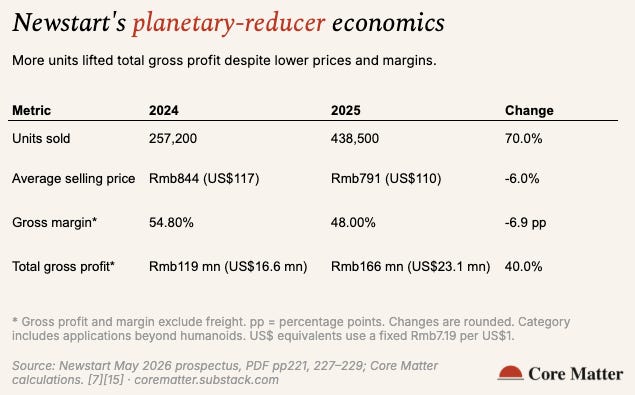
For this product category, total gross profit rose from Rmb119.1 mn (about US$16.6 mn) to Rmb166.4 mn (about US$23.1 mn). Newstart earned less gross profit per average unit but sold enough additional units to increase the total. This was a recovery from 2024; category gross profit remained below its 2023 level. [7]
Margin erosion is not observed across the board. Look at another example here: Direct Drive Tech, or DDT, a Chinese manufacturer of direct-drive actuator modules and robots. From 2023 to 2025, its direct-drive module average selling price fell from Rmb77 (about US$10.7) to Rmb31 (about US$4.3) while the category’s gross margin rose from 8.3% to 20.0%. Management attributes margin improvements to design changes, better yield, purchasing and spreading factory overhead across more output. Consumer-robot modules accounted for 88% of company revenue in 2025. The changing application mix also affects this category average. [9]
Newstart shows how additional volume can offset lower gross profit per unit. DDT showed improving margins as their consumer-product business scaled. These cases show how profits can continue to grow while prices fall. Applying DDT’s consumer-robot economics to humanoid joints would require separate analysis.
For a US actuator startup, growing demand creates room to build a larger business even as prices fall. But the company still has to win that volume and earn enough from it to cover R&D, sales and the cost of running the business. It also needs to have a sound capital plan to fund equipment, facilities and inventory before those orders turn into cash.
For an investor, I’d consider how much cash the next production line can generate relative to what it costs to build and ramp. If every increase in sales requires another large equipment purchase and equity round, growth can absorb much of the value it creates. Reusing designs and equipment, filling capacity and collecting customer payments sooner can reduce the amount of new equity needed to expand. [14]
Debt can reduce the need for new equity, but adds interest and repayment obligations. Hadrian provides an example from US advanced manufacturing: it announced a US$360 mn revolving credit facility in August to support infrastructure, machinery and related hardware. [10] An actuator startup would still need to establish how much it can borrow, on what terms, and whether its cash generation can support the repayments. The financing plan is part of the venture-return question. [14]
4. Does selling the whole joint improve the business?
How do actuator suppliers differentiate from one another, other than price?
What I see from studying suppliers such as Laifual and Zhongda is that their offerings are extending from individual transmission components into integrated products. [6][11]
Laifual, a Chinese manufacturer of harmonic reducers and joint modules, reported joint-module average selling prices rising from Rmb2,010 (about US$280) in 2023 to Rmb7,074 (about US$984) in 2025, about 3.5X the earlier level. The company attributes the increase to added content: low-voltage modules introduced in 2024 included drivers and braking systems, while some 2025 modules added customer-specified housings and water-resistant cables. The invoice grew along with what was supplied. [6]
Zhongda, a Chinese maker of geared motors, precision reducers and integrated actuator units, reported 2025 gross margins of 21.44% for precision reducers and 25.08% for intelligent actuator units. Its integrated products combine reducers, motors and drives. The integrated category earned a higher gross margin. Differences in products and customers leave the contribution of integration unresolved. [11]
Selling more of the joint can increase the average selling price. Whether the supplier keeps enough of that revenue is another question. Does the customer save engineering and assembly work by buying the full module? Can the supplier reuse its design, tooling and testing across customers? If each order needs extensive new engineering, a higher selling price may still leave a difficult business to scale.
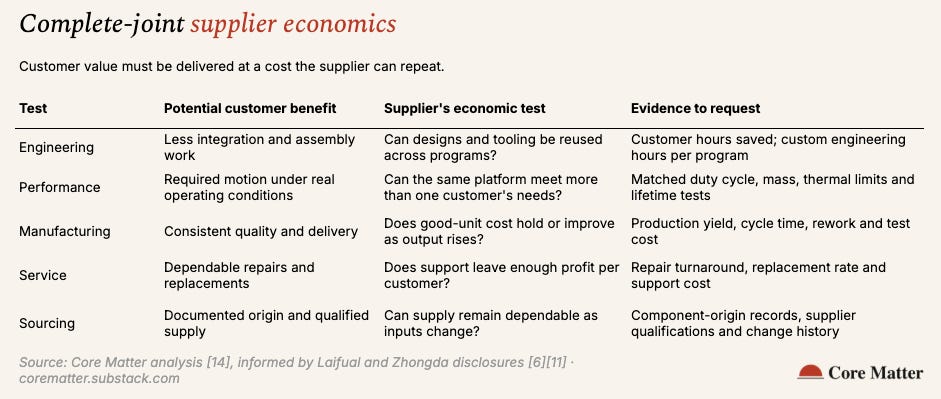
For a complete-joint supplier, I would test five things:
Engineering: How much integration and assembly work does the customer save, and how much of the supplier’s design can be reused?
Performance: Does the module meet the required duty cycle, size, mass and thermal limits, and does that performance carry across customer programs?
Manufacturing: Can the supplier deliver qualified modules at a consistent yield and cost as volume grows?
Service: Does the customer get dependable replacements and repairs, and can the supplier provide that support profitably?
Sourcing: Can the supplier document origin and maintain qualified supply as components or vendors change?
5. What remains imported after the factory opens?
An actuator involves many components, and the components need raw materials, machines and labor to produce. Local assembly can leave upstream dependencies elsewhere.
Some examples of these upstream dependencies:
China accounted for 94% of global sintered permanent-magnet production in 2024, according to the IEA. [12] For a motor supplier, the questions include where magnets and other inputs come from, and which production and testing steps it controls.
For reducers, the flexspline and ring-gear processes mentioned above are specific capabilities to investigate. [6][7]
For linear actuators using precision screws, Seenpin’s equipment and commissioning disclosures raise a specific question: can the supplier order, install and qualify additional precision grinders and inspection equipment in time for the promised ramp, and how will it fund that investment before the new capacity earns revenue? [8]
Domestic players are moving to solve these dependencies. For example, USA Rare Earth is partnering with Pasqal and Riven Systems to develop more efficient rare-earth separation chemistry. The September announcement describes a research program upstream of finished-magnet production. Turning that research into commercial supply remains a further step. [13]
Labor is the other input to plan for. Actuator companies told us that people with the skills to operate their production machinery are hard to find, so they hire recent graduates and train them in-house. [16] For a supplier promising a fast ramp, the time it takes to train operators belongs in the schedule alongside equipment lead times.
So, a US robotics founder needs to ask their supplier:
Which components and production steps depend on imports, and where do they come from?
What would be most constrained if production rose 10X or 100X in the next 12 months?
What equipment, supplier qualification or financing would be needed to remove that constraint?
How many trained operators would that ramp need, and how long does it take to train one?
6. What else needs to be built around actuator factories?
As domestic actuator supply ramps up, I see opportunities beyond finished actuators. The dependencies above suggest five areas to investigate: