

Turns out the conference I skipped this fall is the one with the most stacked lineup and keynotes. So much fomo the past few days!
CoRL (Conference on Robot Learning) took place in Austin from November 9 to 12. I caught up on the launches, papers and keynotes, and pulled out 5 takeaways for anyone investing in or building robotics in 2027.
The headline is that the robot AI stack is splitting in two: planner (System 2) vs. actor (System 1). A planner such as OpenAI’s GPT-6 Astra decides what to do, and a fast model such as NVIDIA’s GR00T 2 does the hands-on work. Google DeepMind’s slew of launches this week further echo this split.
Under that split, the costs are moving. Training data and training compute are getting cheaper, as human video, handheld grippers and simulation take over from robot teleoperation. What stays scarce is data from real deployments, speed on the robot’s own chips, and touch.
If you were there, leave a comment or hit reply to share what stood out to you the most.
In this piece
5 key takeaways
The robot AI stack is splitting into a planner and an actor
Robot training data is getting cheaper. Action labels matter more than raw volume
Training data is getting commoditized. Deployment data and self-practice compound
Training needs far fewer GPU-hours, and speed on the robot is the bottleneck
Touch is the next data layer: LingBot-Touch and T-Rex
8 key product launches: Gemini Robotics 2.5, GR00T 2, Steel, DexBench and VABAR, MuJoCo 4.0, AIRoA-0, Liber-0 and LingBot-Touch
8 top papers: DreamZero, Being-H0.5, π0.7, MolmoB0T, SuperMimic, RL Token, FACTR 2 and the benchmark audit
5 key takeaways
1. The robot AI stack is splitting into a planner and an actor
The 1.0X-speed demos (which I’m a fan of!) in Jim Fan’s keynote showed OpenAI’s GPT-6 Astra and NVIDIA’s GR00T 2 working in tandem. Astra plans the task, checks each step and calls GR00T 2 for the manipulation. On 3 toy assembly tasks that started from parts dumped on a table, the pair succeeded in 97 to 98 of 100 trials. Google DeepMind’s Mercedes-Benz test showed the same approach: Gemini Robotics-ER tracked the workflow, and Gemini Robotics 2.5 controlled the hands and arms.
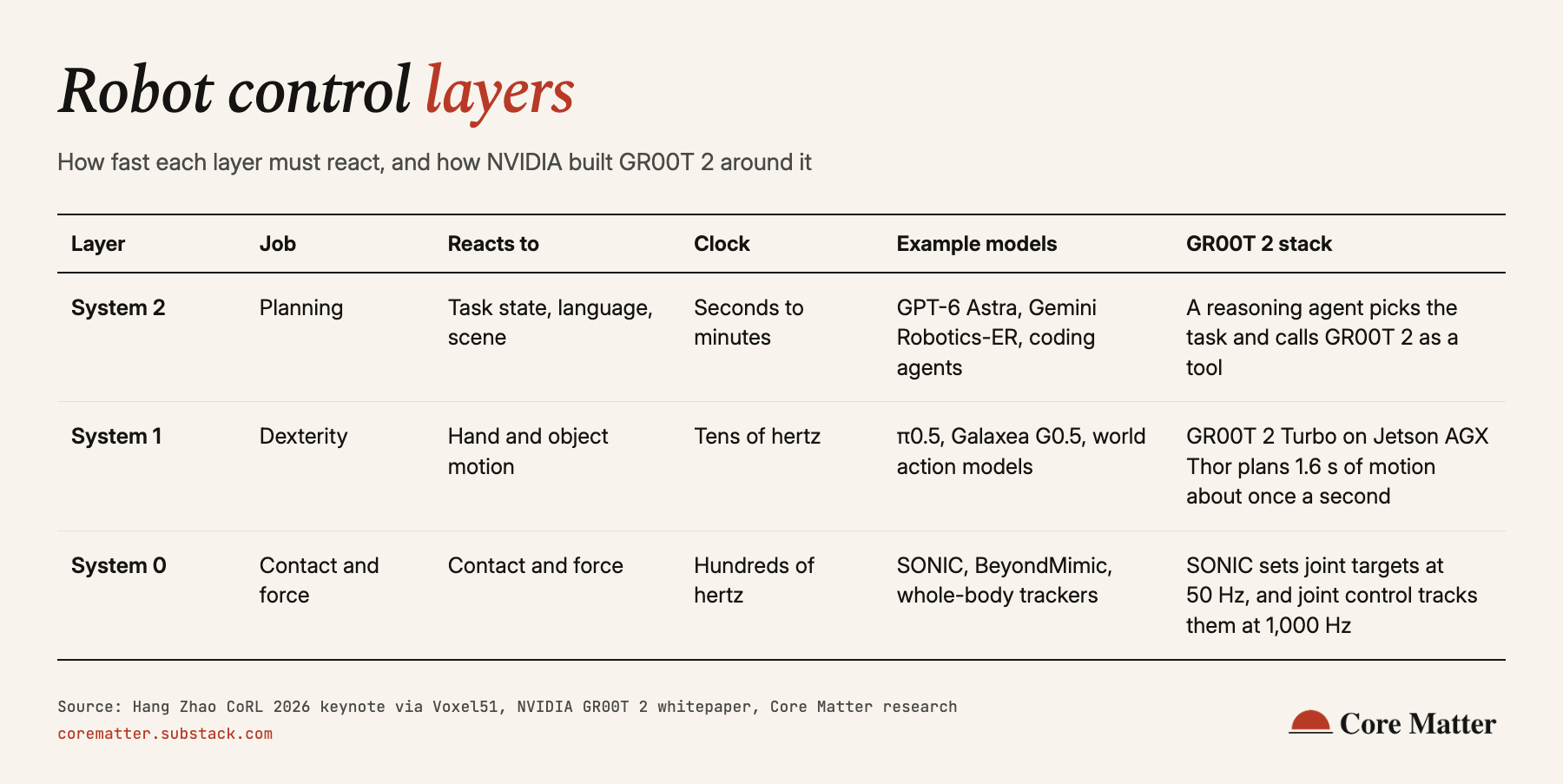
Hang Zhao, a Tsinghua professor and co-founder of the Chinese robot company Galaxea, laid out a framework for this in his Day 1 keynote, “Organizing Physical AI Across Timescales.” Each layer of the stack works at the speed of the events it has to react to:
System 2, planning. It reasons over seconds to minutes about the task, the instruction and the scene. Examples are GPT-6 Astra, Gemini Robotics-ER and coding agents.
System 1, dexterity. It tracks how the hand moves relative to an object, tens of times per second. VLAs such as π0.5 and world action models sit here.
System 0, contact and force. It reacts to contact hundreds of times per second. Whole-body controllers such as NVIDIA’s SONIC and Berkeley’s BeyondMimic sit here.
NVIDIA built GR00T 2 on this pattern. Its whitepaper describes an optional reasoning agent as System 2, GR00T 2 Turbo as System 1 on the robot’s Jetson AGX Thor, and SONIC as System 0 on a separate Jetson Orin NX.
Value is shifting across the layers:
The planner layer is pricing down. Luma AI’s ZAP, an open 27bn-parameter model trained only in simulation, matched Astra’s 97% on a real 2-arm robot. It took 146 seconds and $0.29 per task, against 397 seconds and $4.87 for Astra.
A frontier model alone is a slow robot. LiberAI tested Astra as a standalone robot policy. It averaged 87.3 seconds of reasoning per decision and succeeded on 8.3% of pick-and-place tasks.
System 1 is the contested layer. It covers contact-rich manipulation, and it is where VLAs and world action models compete. Roboticist Benjie Holson, writing on his General Robots Substack, called it “the big challenge for robotics in the next 6 months,” since “we have good tools for system 2 and 0 now.” Zhao’s proposal is one model with 2 clock speeds, a slow one for reasoning and a fast one for motion.
World action models moved into System 1 this year. A vision-language-action model (VLA) looks at camera images and an instruction and outputs the robot’s next motor commands. A world action model (WAM) starts from a video generation model and predicts the next few seconds of video together with the motor commands.
February. NVIDIA published DreamZero, a 14bn-parameter world action model that controls a robot at 7 Hz.
April. NVIDIA’s Jim Fan declared VLAs dead at Sequoia’s AI Ascent.
November. NVIDIA introduced GR00T 2, a 2bn-parameter world action model, and GR00T 2 Turbo, which predicts in 124 ms on the robot’s own computer. Weights are due in December.
“Pure” VLAs are playing catch-up. Physical Intelligence’s π0.7 uses a lightweight world model to generate visual subgoals inside a VLA, and Gemini Robotics 2.5 is a VLA.
Evaluation may need a clock as well. Zhao showed that counting thinking time changes the ranking. In RoboCasa, a simulated kitchen, 4 approaches completed over 60% of tasks when thinking time was free. Once inference time counted toward a 50-second deadline, a policy calling a frontier model directly completed 15% and an agentic policy 20%. This is useful framing for deployment, as a factory buyer pays for task time as well as success.
2. Robot training data is getting cheaper. Action labels matter more than raw volume
Robotics data companies are having their moment in 2026. How will the data market shift going into 2027? The price of an hour of robot training data has fallen by source, from robots to people to software:
2022, robot teleoperation at lab scale. Google’s RT-1 took 13 robots and 17 months to collect 130,000 demonstrations, about 390 hours by Inside China’s Machine’s estimate.
2026, teleoperation at factory scale. Chinese data factories sell teleoperation data at Rmb500 to Rmb1,000 ($70 to $141) per hour, possibly below their own cost at typical utilization by the same estimate.
2026, handheld grippers. AIRoA had 179 people at 22 desks record 8,434 hours in a little over 2 months, with no robots, on the way to 16,151 hours.
2026, human video. Mercor pays businesses $12 to $18 per approved hour of workplace footage. GR00T 2 trained on 402,730 hours of it.
2026, simulation. MolmoB0T’s authors estimate $2 to $5 per hour of simulated robot data.
NVIDIA’s GR00T 2 shows where the hours now come from. Of its roughly 439,000 pretraining hours, robot teleoperation, the costliest source above, is about 5%, and human video is about 92%:
Egocentric human video: 402,730 hours, about 92%
Robot teleoperation: 23,500 hours, about 5%
Handheld gripper recordings: 10,184 hours, about 2%
Studio recordings of people, matched to the robot’s camera views and speed: 3,000 hours, under 1%
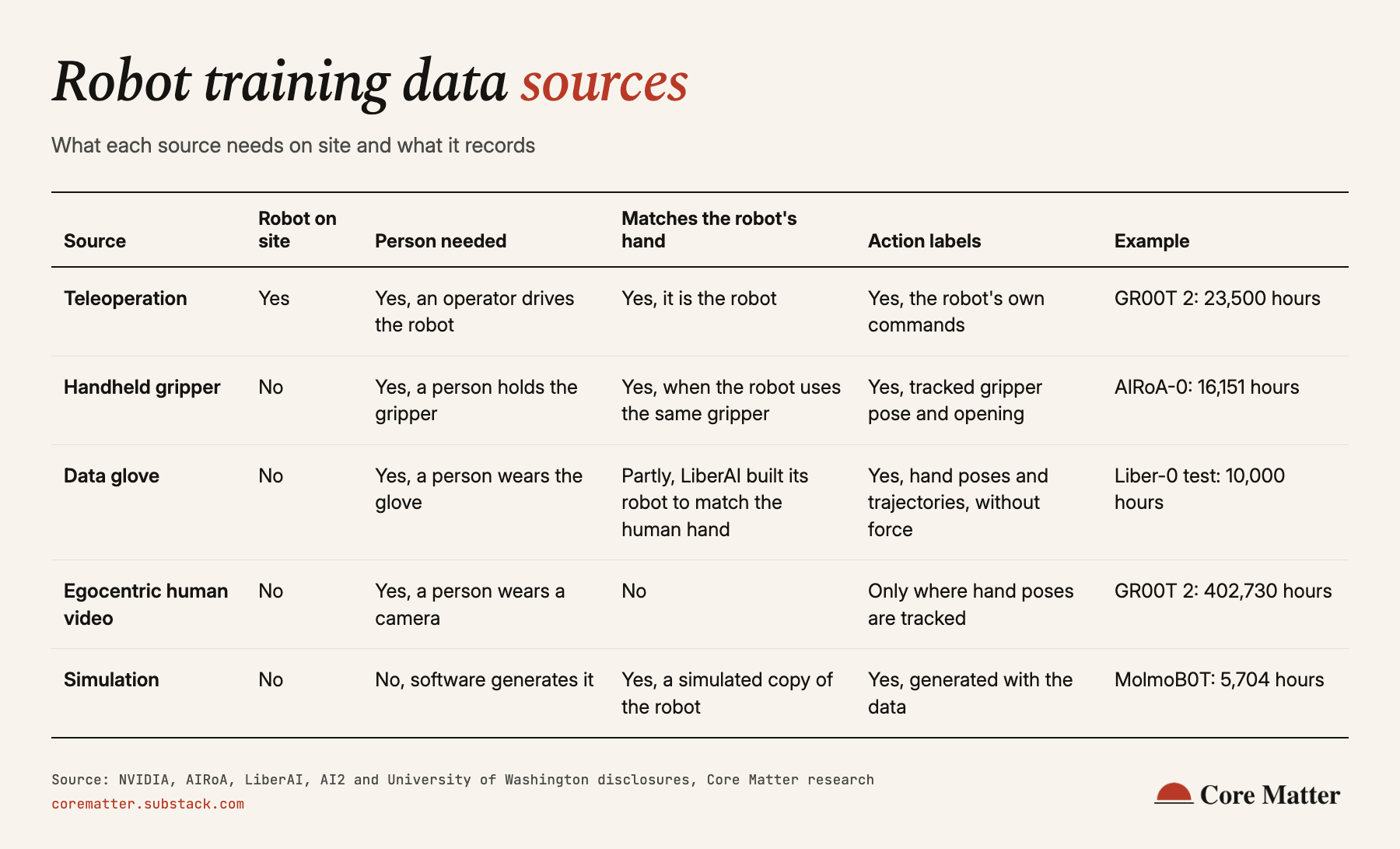
Action labels matter more than hours. An action label records the motion behind the video: a robot’s motor commands, a gripper’s tracked position or a hand’s measured pose. One controlled test came from LiberAI, a Beijing startup that makes its own data glove:
The setup. LiberAI pretrained separate models on 5 sources, its glove, other robots’ data, 2 sets of egocentric video and web video, at 1,000 to 10,000 hours each, and web video up to 2mn hours. Every model then got the same robot post-training and the same 76 tasks.
The result. Web video at 2mn hours scored 64.6 on pick-and-place and 51.2 on harder manipulation, both below 10,000 hours of glove recordings. That is 200 times the hours for a lower score.
Where labels matter most. Going from 1,000 to 10,000 glove hours added 13.1 points on harder manipulation such as folding and opening. Other sources gained much less there than on pick-and-place.
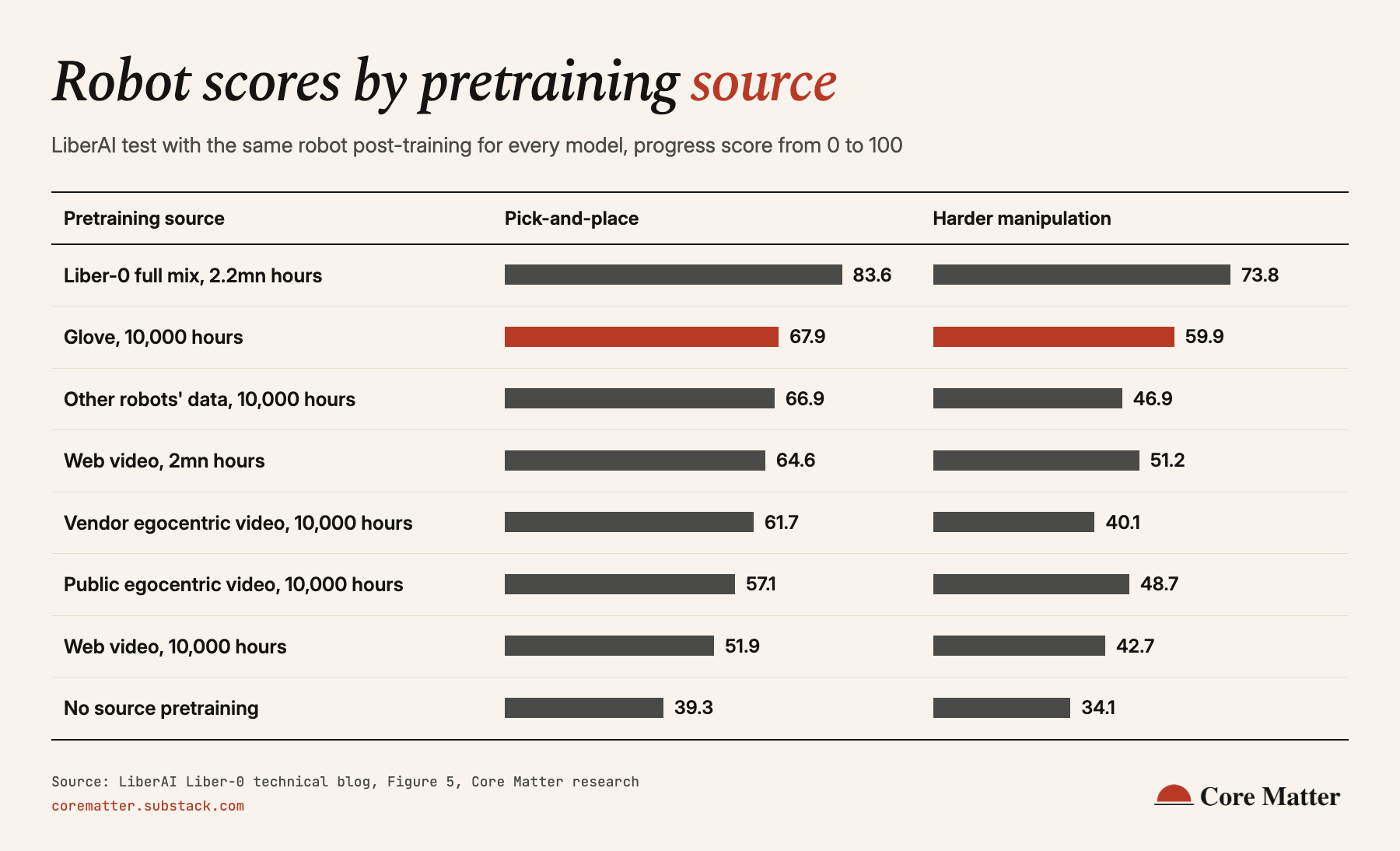
NVIDIA and LiberAI both combine the 2: broad human video for coverage, and labeled motion for manipulation. Liber-0’s full mix scored highest in LiberAI’s test.
Simulated demonstrations are training real robots:
MolmoB0T. It generated 1.7mn simulated demonstrations, about 5,704 hours of robot experience, and transferred to real robots with no real-world fine-tuning.
GRAIL, NVIDIA and UCLA. A video model generates humanoid training data with no teleoperation or motion capture. A real Unitree G1 trained only on it succeeded at 84% of object pick-ups and 90% of stair climbs.
Gemini Robotics 2.5 and MuJoCo 4.0. Google DeepMind turned real camera scenes into thousands of simulated practice attempts, and released the first major version of its simulator since 2023.
Diversity > volume. FAKTUAL, a CoRL oral, scores a dataset’s diversity before training, and picking the most diverse demonstrations beat random selection. Junfan Zhu, who attended CoRL, put it this way: “the scarce resource is no longer robot hours. It’s assets, simulators, and knowing which data adds coverage.“
How much of this will replace teleoperation? NVIDIA lists it as an open problem. LiberAI offers one data point: glove recordings plus 25% of its robot demonstrations scored 75.6 in task progress, against 72.8 for all of the robot demonstrations alone.
3. Training data is getting commoditized. Deployment data and self-practice compound
Russ Tedrake, founder of Walden Robotics, called mid-training data, such as human video, handheld grippers and bought teleoperation, “commoditized.” Deployment data is different: “you have to earn it.”
His keynote, “Learning in the factories,” made the case from a live production line:
The deployment. Walden Robotics spun out of Toyota Research in January 2026. Its humanoids have loaded camshafts on a Toyota main line on full shifts since April: “33,000 cam shafts and counting.” A remote assistant steps in when the robot needs help, and “the robot has never slowed the line.”
The loop. Walden ships a new model over the air every Thursday. The newest one goes 340 seconds on average between interventions. He estimated 3 remote assistants could watch 50 robots.
The experiment. Walden gave base models of 3 sizes the same short deployment on a new task. The strongest model sent back the least intervention data and improved the most. “Stronger models actually do get less intervention data, but they actually improve more.”
Other teams showed robots improving from their own practice:
RL Token, Physical Intelligence. The hardest phase of 4 precision tasks became up to 3x faster within minutes to a few hours of practice, and on one task the robot beat expert teleoperation speed.
GR00T 2, NVIDIA. Reinforcement learning on real hardware raised 4 contact-rich tasks to 88% to 98% success, from 40% to 76%.
Flexion. It reported a jump from 38% to 90% on an internal 16-step humanoid mission.
π0.7, Physical Intelligence. Labels describing the quality of each episode let it train on failed attempts, so a deployment’s mistakes become training data too.
Going into 2027, I believe more companies will focus on deployment metrics eg. mean time between interventions on a paying line.
4. Training needs far fewer GPU-hours, and speed on the robot is the bottleneck
As noted in our deep dive eariler this week, Economics of Robot Brain, there are 3 demand drivers for compute from robotics: Training on data center, on prem GPUs, and edge compute on robot.

Several launches at CoRL showed improved methods need fewer GPU-hours to train:
SuperMimic, the CoRL Best Paper. It trained a humanoid whole-body controller in 3 hours on 1 H100, against about 21,000 GPU-hours on 128 L40s for NVIDIA’s SONIC. The saving comes from training through a learned model of the robot’s motion in place of trial and error, on a more expensive chip.
Steel, Skild AI. On a mix of 20 tasks, its physics solver reached 3.90mn simulation steps per second against 300,000 for PhysX, with 11 GiB of GPU memory against 29 GiB.
AIRoA-0. Post-training on a new task takes under 4 hours on 8 H200 GPUs.
Running the model on the robot is the harder budget, and NVIDIA says so itself:
NVIDIA’s own words. GR00T 2 takes a median of 153 ms per prediction on a GeForce RTX 5090. The whitepaper says humanoid whole-body control “sets a much stricter budget” and must run on an edge GPU such as the Jetson AGX Thor, “which has far less compute.”
Speed costs dexterity. Turbo keeps the same 2bn model and predicts far fewer video tokens, which brings it to 124 ms on Thor. Its success on dexterous hand tasks fell to 34.3% from GR00T 2’s 68.6%, while gripper tasks held at 65.0% against 71.7%.
Bigger models need data-center chips. DreamZero’s 14bn-parameter model needed 2 GB200 data-center chips to reach about 150 ms per prediction.
Slow thinking fails the task. In Hang Zhao’s RoboCasa test (takeaway 1), success fell to 15% to 20% once inference time counted.
The demand this creates sits with onboard chips and model compression. NVIDIA designs Thor and plans to release GR00T 2’s weights. AMD is buying World Labs.
5. Touch is the next data layer: LingBot-Touch and T-Rex
One of the key themes I’m watching in 2027 is touch & force models. Robbyant released LingBot-Touch during CoRL week, an open-source tactile foundation model pretrained on nearly 5,000 hours of real tactile data. Robbyant says it transfers across sensors, dexterous hands, tasks and action models.
The T-Rex paper trained on about 100 hours of bimanual data from fingertip tactile sensors on Sharpa Wave hands, and reported over 30% higher average success than the top baseline across 12 tasks.
The gap they target is visible in this year’s largest models:
GR00T 2. NVIDIA’s whitepaper says it “does not take touch as input, and tactile recordings are scarce compared with video.”
Liber-0. LiberAI’s glove records hand poses and trajectories, without contact or force.
Scale. LingBot-Touch’s nearly 5,000 tactile hours compare with 402,730 hours of human video in GR00T 2.
In October, Eka raised a $150mn Series A at a $1.45bn valuation, led by a16z and F-Prime, for a model that takes force as a direct input. Zurich-based Enact Intelligence raised a $30mn pre-seed to sense force through its own actuators. FACTR 2 (paper 7 below) reads force in software on low-cost arms.
Tactile sensor makers such as GelSight, XELA, PaXini and Sharpa are building the hardware side. I will cover more indepth in an upcoming tactile deep dive. The main challenge is a model that works across sensors, since the data is so different.
8 key product launches: Gemini Robotics 2.5, GR00T 2, Steel, DexBench and VABAR, MuJoCo 4.0, AIRoA-0, Liber-0 and LingBot-Touch
1. Google DeepMind Gemini Robotics 2.5
What it is. Google DeepMind’s newest VLA, announced November 10 and rolling out to Agile, Apptronik and Mercedes-Benz.
Why it matters.
A factory test. Apptronik’s Apollo 2 humanoids sorted parts from bulk bins into trays on active Mercedes-Benz lines in Kecskemét, Hungary and Sindelfingen, Germany, with 96% success. DeepMind calls the Mercedes-Benz work a proof of concept. And DeepMind robotics director Kanishka Rao said that getting from 96% to near-human reliability would be a “steep road.”
A step up from Gemini Robotics 2. Across more than 200 tasks, success rose 30% to 100% over previous baselines depending on the task type, and tasks finished 20% to 30% faster.
2. NVIDIA GR00T 2 and GR00T 2 Turbo
What it is. NVIDIA’s new robot foundation model, a 2bn-parameter world action model built on its Cosmos-Predict2.5-2B video model. Turbo keeps the same 2bn model and predicts far fewer video tokens so it can run on the robot. Foxconn, Siemens, Nexuni and MicroAGI are testing it. It works on gripper arms, dexterous hands and a humanoid.
Why it matters.
Turbo fits on the robot. It predicts in 124 ms on the Jetson AGX Thor inside a Unitree G1. DreamZero needed 2 GB200 data-center chips for about 150 ms.
The cost of speed. Turbo keeps up on gripper tasks, 65.0% against 71.7%, and loses about half its success on hand tasks, 34.3% against 68.6%.
3. Skild AI Steel
What it is. An open-source physics solver that Skild AI built with NVIDIA inside the Newton physics engine.
Why it matters. GPU simulators work best when they copy one identical setup thousands of times, and Skild trains across many robots and tasks at once. On a mix of 20 tasks, Steel reached 3.90mn simulation steps per second against 300,000 for PhysX, with about 11 GiB of GPU memory against 29 GiB. The figures cover physics stepping alone. For a business, simulation speed sets the cost of simulated training data, and Steel lowers it most for companies training one model across many robot types, Skild’s own approach. Releasing it as open source inside NVIDIA’s Newton suggests Skild sees its advantage in the model and data, with the solver shared.
4. DexBench and VABAR benchmarks
What they are. Two new benchmarks built around industrial skills.
Why they matter.
DexBench. RLWRLD, a Korean startup backed by NVIDIA, tests humanoid hand dexterity with 15 tasks across retail, logistics, manufacturing and hospitality. It gives buyers in those industries a test tied to their own tasks for comparing dexterous hands and models. The company that sets the test also shapes what the field optimizes for.
VABAR. Ken Goldberg’s group at UC Berkeley and NVIDIA cover 6 industrial task classes, including gear meshing, syringe packing and cable routing. In one study, 8 AI coding models started within a few points of each other and ended 30 points apart after 2 rounds of feedback. For a buyer choosing an agentic system, the score after feedback separates the vendors more than the first try.
